


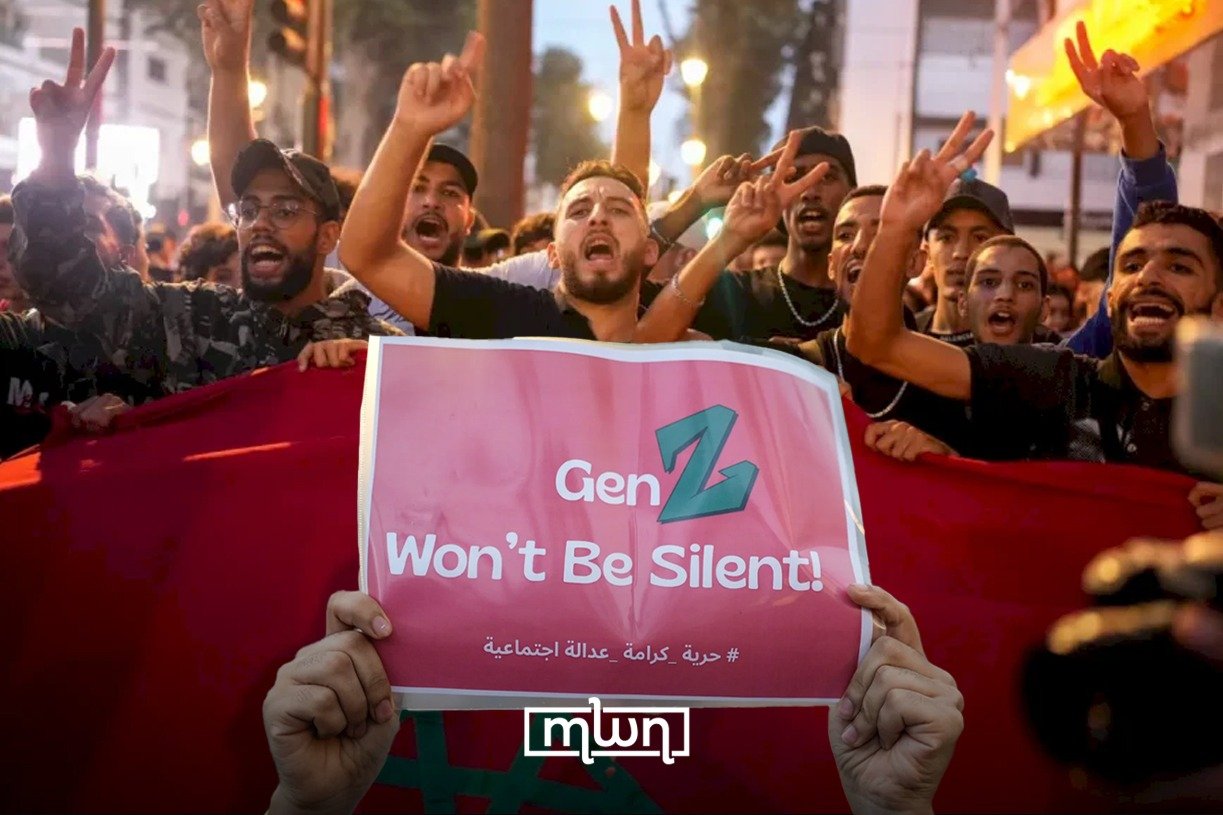
“It’s not easy being part of Morocco’s Gen Z. We think with a global mindset but live in a local reality,” said a 23-year-old Moroccan man we interviewed for a study on the changing practice of religion in Morocco. He was not complaining. He was mapping a fault line.
This fault line, between the world these young Moroccans navigate digitally and the one that greets them when they log off, is producing something that neither their parents nor their society quite know how to name. It is neither atheism nor rebellion. It is quiet and almost entirely invisible to official discourse. We sociologists call it the “individualization of religiosity,” a foundational step in any rational process of modernization. Morocco’s Gen Z are not rejecting religion and culture but are rewriting the “terms and conditions” of this relationship.
What the data says
Our study, “Moroccan Youth Between Hybrid Modernity and Conservative Religious Values,” is one of the most comprehensive inquiries into this demographic to date. By conducting a digital ethnography of Discord discussions, field survey of 3,338 respondents, as well as an extensive literature review on both Moroccan and global Gen Z cohorts, and a targeted analysis of online news releases, ensuring a holistic view of how these young people define themselves in an increasingly connected world. We examined the emerging trends shaping Moroccan youth across today’s digital, social, and political landscapes.
Far from retreating from faith, our findings suggest this generation is navigating a complex intersection of contemporary life and tradition.
They are reinterpreting religion. For many, faith has stopped functioning as a holistic social system that regulates dress, diet, relationships, and politics. Instead, it has become a personal ethical reference. “I’m a believer, but I’m against those who want to inject religion into everything,” one participant said. While unremarkable on its surface, this testimony would have been unspeakable in a public setting a generation ago.
Faith is still genuinely present, but the overarching religious authority that once organized public and private life is losing its grip. Even though this is not a uniquely Moroccan story. It is, however, a distinctly Moroccan version of a process that is reshaping societies across the globe, and that Morocco’s policymakers and intellectuals should not be reluctant to acknowledge.
A values gap
When it comes to equality and freedom of expression, support for gender equality in the labor market is widespread, particularly among women, urban youth, and those with post-secondary education. Acceptance of free expression, even when it challenges traditional norms, is rising. “I believe in God, but not in the way some people want me to believe,” a 20-year-old woman explained. “My faith is personal, not institutional.”
This is not a short-lived opinion; it is a reordering of moral priorities. Individual rights are beginning to outrank collective obligation, and personal conscience is asserting itself against inherited social and cultural axioms. And nowhere is this clearer than in the domestic sphere such as quiet conflicts over the hijab, personal relationships, marriage expectations, and family authority. “I feel like I want to be free, but I don’t want to anger God,” a 22-year-old woman told us. This tension is a renegotiation of the role of religiosity in personal life.
The economic variable
Modernization does not happen in vacuums. Youth facing unemployment, rising living costs, and shrinking opportunities do not organize their moral lives around religion. They organize them around survival and dignity. “It’s not just about money,” a 25-year-old told us, “it’s about dignity. We work hard, but the system doesn’t see us.”
Therefore, what emerges is a distinctly worldly political logic: legitimacy, for these Moroccan Genz, is measured by the state’s ability to deliver services, justice, and stability, not by religious rhetoric or the Islamization of policy. They are not anti-religious but are outcome-oriented. The state that earns their loyalty is the one that fixes the roads, hospitals, schools, not one that gestures toward the divine.
When law and life diverge
Morocco’s legal codes still reflect conservative references that most young Moroccans have quietly outpaced, which is leading to a growing chasm between what youth consider morally reasonable and what is legally or socially permissible. Many manage this by living a double life: modern and rational in private, conservative in public. “I’ve decided to keep my opinions to myself,” a 25-year-old male said. “People don’t want to hear from you.”
Historically, suppressing moral evolutions does not halt them; it simply pushes them underground where they accumulate pressure and might lead to radicalization. As the gap between legal frameworks and lived reality widens, trust in official institutions erodes. And youth might stop seeing the law as a fair regulator and start seeing it as an obstacle to honest self-expression, which is a far more dangerous outcome than open social debates.
Low-volume secularization
Obviously, none of this amounts to a revolution. These youth are not staging one. They are selecting, negotiating, and deferring conflicts. They carry what researchers call a “hybrid identity,” code-switching between home, university, mosque, workplace, and online spaces without experiencing the transitions as contradictions. The “good person” in their moral vocabulary is no longer simply the one who follows religion. It is the one who has worked out an honest relationship between faith, freedom, and self.
Critics who frame this as cultural invasion, moral decay, or a war on Islam are misreading the signal entirely. What is happening is an effort to make religion livable and sustainable inside a globalized digital economy, under economic strain, amid the competing demands of family, career, and conscience.
What policymakers owe this generation
The real question is not whether Morocco’s youth are changing. They are, visibly and irreversibly. The question is how the institutions that govern them will see and respond to this change.
Denial will not hold the line, and repression will not rewind the clock. The choice before Morocco should not be between “preservation” and “rebellion,” which is a fantasy indulged by those who have confused stability with stagnation. The real choice is between managed, constructive engagement with this cultural evolution and the kind of enforced silence that transforms generational tension into a structural fracture.
When a young Moroccan says, “I love my culture, but it sometimes suffocates me,” she is not cutting the cord. She is asking for room to breathe inside it. Morocco’s future, its economic creativity, its diplomatic relevance, and its long-term cohesion depend on whether those in charge can hear that request clearly enough to act on it.
