


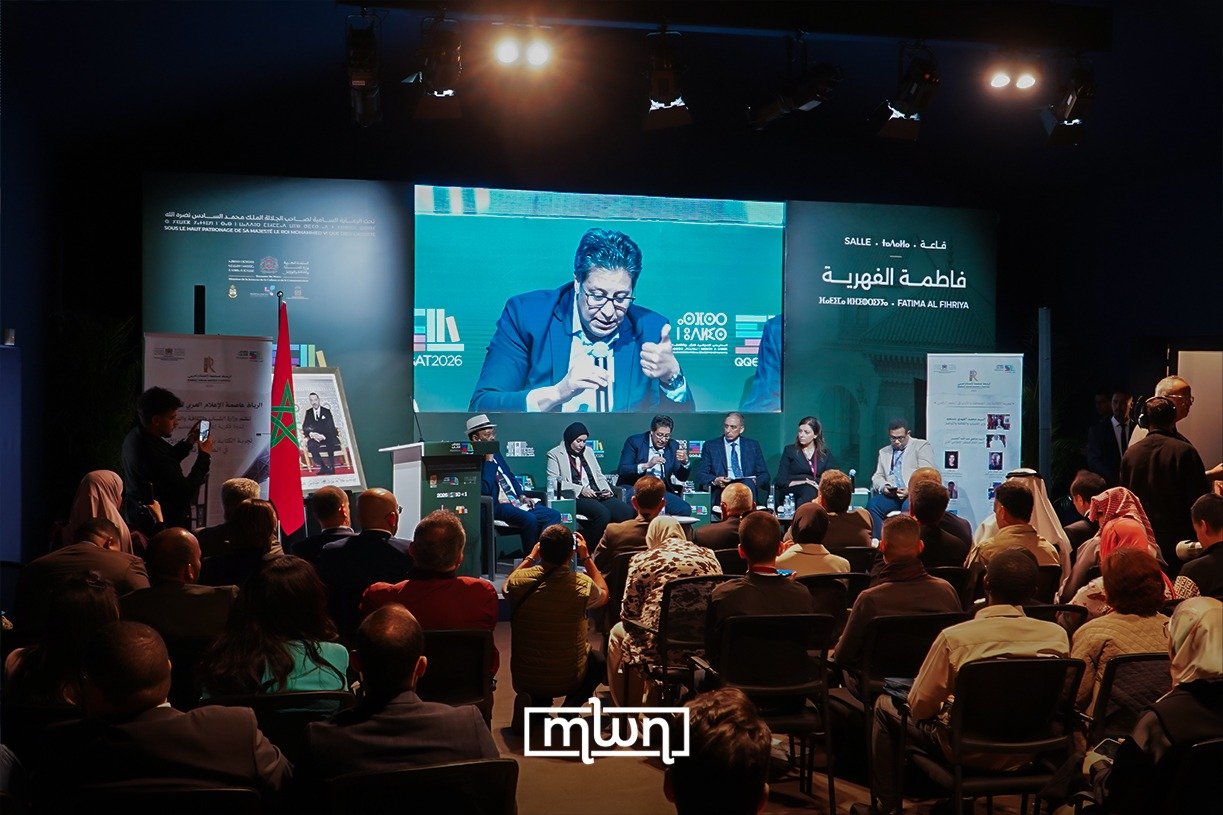
Rabat — Questions surrounding the future of writing in the digital age took center stage on Monday, during a high-level discussion held on the sidelines of the International Publishing and Book Fair (SIEL) 2026.
Organized to mark Rabat’s designation as Arab Media Capital 2026, the gathering brought together leading voices from journalism, literature, and academia to reflect on how digital transformation is reshaping storytelling and media practices.
Hosted at the Fatima Mernissi Hall, the discussion explored the theme “The Experience of Writing Between Journalism and Literature in the Digital Age,” offering a platform for exchange between professionals navigating the increasingly blurred boundaries between factual reporting and creative writing.
The session opened with remarks delivered by the Secretary General on behalf of the Minister of Youth, Culture, and Communication, Mohamed Mehdi Bensaid, marking the launch of the “Rabat, Capital of Arab Media” program’s 2026 activities.
“This achievement adds to a series of distinctions that the Moroccan capital has earned in recent years. It is also complemented by its selection as a World Book Capital in 2026,” he stated.
“All of this is not a coincidence, but rather reflects the civilizational status of this city and its rich human heritage, stemming from its deep historical roots, which make it a hub for shaping the Arab and Moroccan media and cultural landscape. It also embodies a rich journey and remarkable achievements across various fields.”
He also emphasized that today’s symposium is an integral part of this ambitious program, tackling core issues in the Arab media and creative landscape while raising pressing questions that require immediate attention.
He also highlighted the challenges that face both press and literary writing, “Among the major challenges facing writing today is the tendency to prioritize speed over accuracy, the spread of false information, and declining trust in sources. Literary writing, in turn, faces the challenge of preserving depth and beauty in the face of rapid content consumption.”
The panel discussion brought together a diverse group of participants, including journalists Talha Jebril and Yassine Adnan, writer and editor Sayed Mahmoud of Al-Ahram Foundation, novelist Hiba Saleh, and Rasha Allam, head of the Journalism and Media Department at the American University in Cairo.
Moderated by Abdelwahab Rafiqi, the conversation delved into how digital platforms have transformed narrative forms, accelerated news cycles, and challenged traditional distinctions between journalism and literature.
The discussion focused on how technology is reshaping journalistic writing in comparison to literary writing. Allam emphasized that journalism has adapted more readily to technological change, whereas literary writing has been slower to evolve due to its need for greater depth and reflection.
“Has this affected literature in the same way it has affected journalism? No, there is a difference. It has impacted both fields, but in different ways. In literature, for example, the idea of accessibility has expanded significantly. There are now many literary works, and publishing has become more open. I can publish on digital platforms, reach a large number of readers, and even produce audio works so people can listen instead of only reading.”
Participants highlighted both the opportunities and challenges associated with digital media, pointing to increased accessibility and creative freedom on one hand, and concerns over misinformation, speed-driven content, and declining editorial rigor on the other.
The event forms part of a broader effort to position Rabat as a hub for media and cultural dialogue in the Arab world, fostering conversations that bridge disciplines and address contemporary challenges.
As SIEL , running from 1 to 10 May, continues to draw regional and international audiences, discussions such as this reflect a growing urgency to rethink writing practices in an era defined by constant technological change.
