


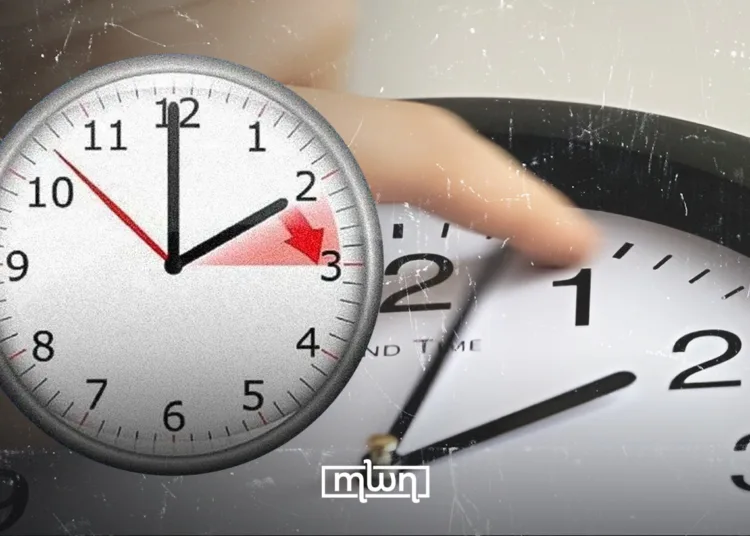
Marrakech – Morocco will officially revert to GMT+1 in the early hours of Sunday, March 22, at 2:00 a.m., when clocks will be advanced by 60 minutes to read 3:00 a.m. The shift, announced by the Ministry of Digital Transition and Administrative Reform, ends the temporary return to GMT that began on February 15 to accommodate the holy month of Ramadan.
The change is carried out under Decree No. 2-18-855 of October 26, 2018, governing legal time, and a subsequent government order published on February 22, 2024.
But the overnight adjustment comes amid a surge of public discontent. An online petition demanding the permanent abolition of GMT+1 has now gathered over 90,000 signatures and is fast approaching the 100,000 mark.
The campaign is hosted on Change.org under the title “We Want to Return to Natural Time,” and it has drawn wide participation from across Moroccan society.
Its organizers argue that the so-called “daylight saving time” disrupts the body’s biological clock, negatively affecting academic performance, mental and physical health, and family stability.
“The sudden time shift means continuous disruptions to the circadian rhythm, harming academic, educational, and professional performance as well as the psychological and physical well-being of all citizens,” the petition states.
It adds that students and pupils suffer reduced concentration and weakened ability to absorb information, directly undermining the quality of education.
Workers and employees lose their capacity for optimal performance under what it describes as “an unsuitable schedule,” the petition warns, going on to raise security concerns and citing misaligned commuting and work hours as a source of risk.
The campaign’s initiators have announced plans to file an official petition through Morocco’s constitutional framework. Under Organic Law No. 44.14, citizens may submit formal petitions to public authorities through the national civic participation platform, eParticipation.ma.
A national petition addressed to the head of government requires a minimum of 5,000 verified signatures from registered voters – a threshold this campaign is expected to surpass with ease.
Morocco’s unsettled relationship with time
The organizers also plan to petition the Economic, Social, and Environmental Council (CESE) for a comprehensive evaluation of the policy, and have called on voters to support political parties committed to restoring standard time in future elections.
Morocco’s relationship with time has been anything but resolved, however. And it only grows more contentious with each passing year.
Since 2018, the country has officially adopted GMT+1 as its permanent system. Authorities have argued that a stable time regime reduces energy consumption, aligns Morocco with key international partners, and boosts productivity.
Yet the issue has never ceased to provoke controversy. Critics argue that permanent GMT+1 places a heavy burden on families, schoolchildren, and workers, particularly during dark winter mornings. Others point to disrupted sleep patterns and social imbalance, especially in rural areas.
The temporary return to GMT during Ramadan has intensified criticism rather than eased it. Many see the move as an implicit admission of failure, questioning why a time system deemed unsuitable for one sacred month is enforced for the remaining eleven.
Some go further, arguing the annual adjustment amounts to instrumentalizing religion – bending sacred time to correct a secular policy that otherwise refuses scrutiny.
For this camp, the yearly reset exposes a deeper contradiction: a clock designed to serve institutional efficiency, yet persistently at odds with social, biological, and spiritual rhythms. The policy, they argue, acknowledges human limits only when fasting renders them unavoidable – not when families, students, and workers bear the strain year-round.
As Morocco resets its clocks once again this Saturday-to-Sunday overnight, the adjustment marks more than a seasonal ritual. It is a concession the state makes once a year – and one that nearly all citizens now demand be made permanent. Until then, the debate over whose time Morocco truly runs on shows no sign of settling.
