


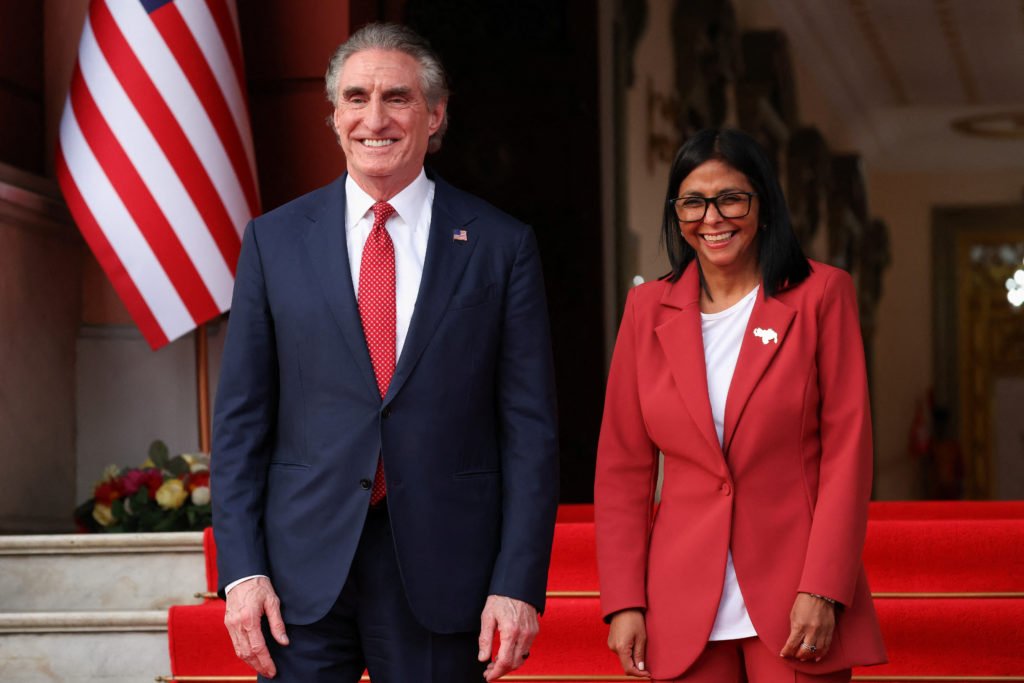
Rabat – The United States and Venezuela agreed on Thursday to restore diplomatic relations, the latest sign of improving ties between the two countries following a large-scale US military strike that captured President Nicolás Maduro and his wife in January.
The decision follows a visit by US Interior Secretary Doug Burgum to Caracas, where he held talks with interim president Delcy Rodríguez and discussed potential investment in Venezuela’s mining and energy sectors.
The US State Department said the re-establishment of diplomatic and consular relations would help promote stability and support economic recovery in Venezuela after the removal of former president Nicolás Maduro.
“Our engagement is focused on helping the Venezuelan people move forward through a phased process that creates the conditions for a peaceful transition to a democratically elected government,” the US State Department said in a statement.
Venezuela’s foreign ministry said Caracas was ready to begin a “new stage of constructive dialogue” with Washington based on mutual respect and cooperation.
The renewed ties would be “positive and mutually beneficial,” Venezuela’s foreign ministry added.
Burgum’s visit is part of US President Donald Trump’s push to increase American access to Venezuela’s natural resources, including minerals used in technology and energy industries.
During meetings with Rodrigues, Burgum said dozens of foreign companies had expressed interest in investing in Venezuela’s mining sector.
“I think you’re going to see this government very concerned about providing the right kind of security,” Burgum told reporters, referring to protections for foreign mining companies.
He described the talks as “fantastically positive” and predicted that Venezuela could surpass its oil and gas production targets by 2026.
Venezuela holds the world’s largest proven oil reserves and is also rich in minerals, including gold, diamonds, bauxite, and coltan, which are used in the production of computers and mobile phones.
Much of the country’s mining activity is concentrated in the Orinoco Mining Arc, a vast region where armed groups are known to operate.
Burgum is the second senior US official to visit Venezuela since the January 3 US bombing raid that left around 100 people dead and led to Maduro’s arrest on alleged drug trafficking charges.
Earlier, US Energy Secretary Chris Wright visited Caracas and called for a “dramatic increase” in Venezuela’s oil production, highlighting what he described as “tremendous opportunities” for both countries.
The warming of relations marks a major, though widely expected, change in US policy toward Venezuela after years of hostility under Maduro’s government. This likely reflects Washington’s interest in the country’s oil and energy resources, according to analysts.
Rodriguez, who previously served as Maduro’s vice president, has since taken over as interim leader with Washington’s backing while pledging to open the country’s energy and mining sectors for foreign investment.
Last month, she introduced reforms to Venezuela’s state-controlled oil industry to encourage private investment and has indicated that the mining code could soon be updated.
