


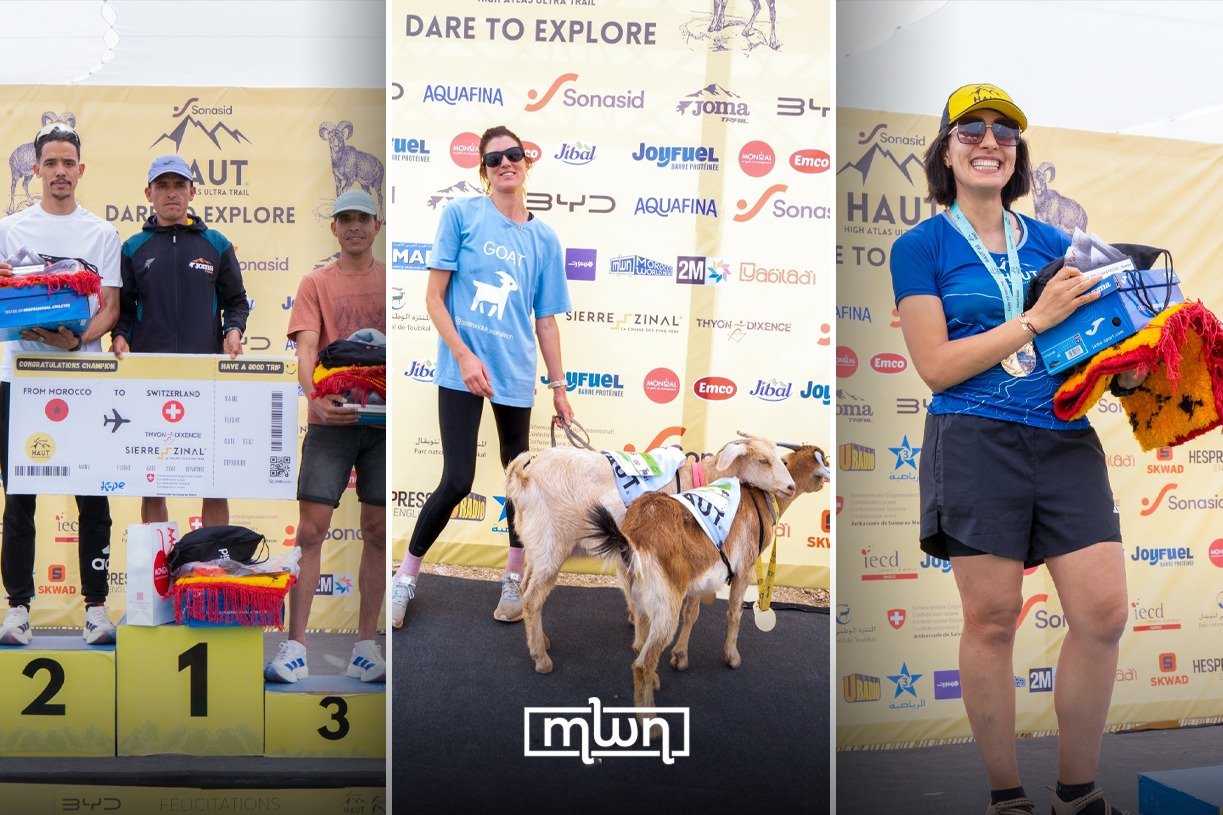
Ouirgane – The fifth edition of the Sonasid High Atlas Ultra Trail (HAUT) wrapped up on Sunday in Ouirgane with podium celebrations across six race categories, a record 1,150 runners from 26 countries, and an event that continues to prove trail running can double as a development engine for Morocco’s High Atlas.
Organized by the HOPE (Espoir) Association for Sport and Sustainable Development inside Toubkal National Park – Morocco’s first protected area, established in 1942 – the three-day event offered distances from 10 km to 120 km, with courses threading through the Imlil and Azzaden valleys across cliffs, gorges, waterfalls, and Amazigh villages.
Morocco’s Saïd Aït El Kadi took the flagship 120 km ultra in 17 hours, 11 minutes, and 20 seconds. Khalid Mouden won the men’s 80 km in 11 hours, 34 minutes, and 38 seconds, while France’s Géraldine Prost claimed the women’s title in the same distance in 12 hours, 5 minutes, and 24 seconds.
View this post on Instagram
“It was an amazing trail. It was a pleasure to discover this landscape and all the wonderful mountains,” Prost told Morocco World News (MWN). Comparing it to last year’s Amizmiz trail, she said: “This year, with big mountains, it was better.”
Algeria’s Bentalha Madjid won the men’s 60 km in 7 hours, 24 minutes, and 40 seconds, while France’s Charlotte D’Alençon took the women’s race in 8 hours, 47 minutes, and 21 seconds.
Madjid, racing at HAUT for the second time, told MWN that the course posed difficulties early on, but he found his rhythm as the race progressed. He described himself as an amateur rather than a professional. “My preparation is not like that of professional runners. I train as a hobbyist,” he stated. Yet the result – a gold finish – told a different story.
A Chaoui Amazigh from northeastern Algeria, Madjid called Imlil his “second home,” saying he has built strong friendships in the village over his visits. He said the welcome he received in Morocco was exceptional and confirmed he will next compete at the Amizmiz trail near Marrakech on May 3.
In the 42 km, Morocco’s Noureddine Bachqi and Aziza Erraji claimed the men’s and women’s titles in 4 hours, 39 minutes, and 36 seconds and 6 hours, 57 minutes, and 45 seconds respectively.
The 21 km, newly designated as the qualifier for Switzerland’s Sierre-Zinal and Thyon-Dixence races, saw Ayyoub Ahmed from Tilougguite in Azilal province win the men’s category in 1 hour, 41 minutes, and 44 seconds.
“It was not easy to win this year because the level of the competitors was very high,” Ahmed told MWN. He praised the organization and the beauty of the course through Toubkal National Park. “The checkpoints, everything was well arranged.”
Ahmed now has his sights set on improving his Swiss result. “I hope this year to achieve a better time than last year so that I can make myself and my country proud,” he said. His hope-inducing trajectory – a rural Moroccan athlete climbing from the Atlas to the European trail circuit – is exactly the pathway HAUT was built to create.
Aziza El Amrany won the women’s 21 km in 2 hours, 25 minutes, and 10 seconds. The win came just one week after El Amrany completed 270 km at the Marathon des Sables. “This victory did not come easily. It came through hard training,” she told MWN. She described a tight battle decided in the final meters. “I am still suffering from fatigue, but I managed to prove myself.”
El Amrany made no secret of her ambitions. “I hope to become a world champion in trail running. Why not? Everything is possible with perseverance,” she said. She thanked HAUT for opening international doors for young Moroccan athletes and her sponsor Joma for the support. “I want to raise my country’s flag abroad and say that Aziza El Amrany is here, strong and ready.”
The 10 km went to Abdelali Bousselm in 40 minutes and 40 seconds and Nadira El Abbady in 54 minutes and 19 seconds.
HAUT 2026 also welcomed some unexpected competitors. Rosanna Dawes did not show up to the trail alone. The Marrakech-based runner crossed the 10 km finish line in Ouirgane with Kiki and Kai – her two goats and founding members of the Goat Run Club, a Marrakech running and hiking group that took on its first trail race this weekend.
Kai is no stranger to race bibs, having completed the Marrakech semi-marathon twice. But for baby Kiki, the Sonasid High Atlas Ultra Trail was a debut. “Today is her first event and our first trail and it was awesome,” Dawes told Morocco World News (MWN). “The trail, the weather, everything is so green this year.”
The trio tackled the 10 km course through Toubkal National Park and left with the kind of story only HAUT can produce – where elite ultra-runners share a start line with a woman and her goats, and nobody blinks.
HOPE (Espoir) Association president and event director Kaoutar Bendoumou told MWN that nearly half of the participants entered the 10 km, a distance Bendoumou described as “inclusive, covering all categories from beginners and families to persons with disabilities.” Women made up 30% of the field.
The longer distances drew smaller but committed fields – 300 runners in the 21 km, 100 in the 42 km, and an elite minority across the 60, 80, and 120 km ultras. “They remain the most important distances in this race,” Bendoumou said. The ultra-endurance courses, with up to 6,400 meters of elevation gain, are what position HAUT among Africa’s top trail competitions.
The biggest change this year was shifting the Sierre-Zinal qualifying race from the 42 km to the 21 km. The move was deliberate. Bendoumou said the goal was to open the door to road runners unfamiliar with trail. “We managed to register 100 Moroccan professional road athletes to discover trail and compete for these qualifying spots,” she told MWN.
Indeed, running clubs from across Morocco – north to south – filled Ouirgane alongside international competitors.
Beyond the podiums, the event delivered what the Al Haouz region needs most since the devastating 2023 earthquake. Every hotel in the area was fully booked, generating over 3,000 overnight stays and thousands of meals. A new Solidarity Trail Market gave local cooperatives a platform to sell their products.
