


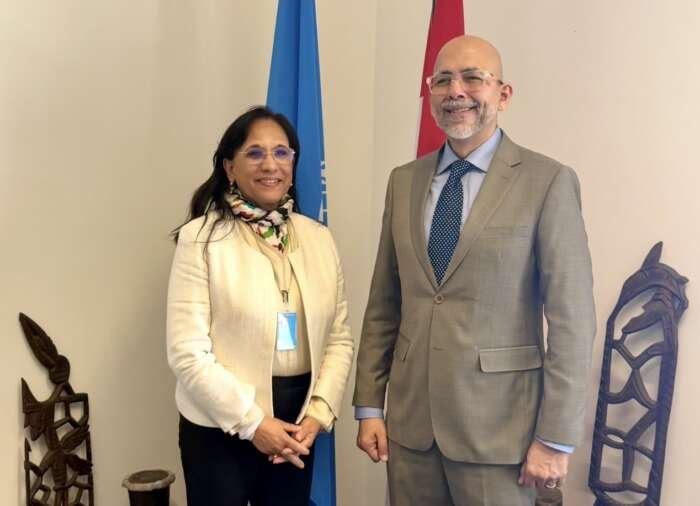
Marrakech – Morocco’s National Human Rights Council (CNDH) President Amina Bouayach held talks on Wednesday in Geneva with Siddhartho Raza Suryodipuro, President of the United Nations Human Rights Council. Bouayach attended the meeting in her capacity as chair of the Global Alliance of National Human Rights Institutions (GANHRI).
The talks took place on the sidelines of GANHRI’s annual conference and General Assembly, which Bouayach currently heads, held this week at the Palais des Nations under the theme of the role of national human rights institutions in promoting rights in the digital space.
The conference featured addresses by UN High Commissioner for Human Rights Volker Türk, UN Human Rights Council President Sidharto Reza Suryodipuro, and UNDP Administrator Alexander De Croo.
Bouayach’s meeting with Suryodipuro followed a series of high-level encounters she has conducted in recent days. She met Türk on the same day at the Moroccan pavilion in Geneva. Last year, she held discussions with UN Secretary-General António Guterres in New York.
The two officials discussed the state of the international human rights system amid what both described as a crisis in multilateralism. They pointed to declining funding for human rights initiatives and growing attacks on the universality of rights across several regional contexts. Rapid global shifts, they agreed, demand stronger coordination and updated working mechanisms.
Bouayach stressed the need to deepen the engagement of national human rights institutions with UN Human Rights Council resolutions and its special procedures. She called for coordinated action among international actors to uphold global human rights standards.
She also pushed for a stronger presence of national institutions within UN mechanisms, arguing that this would improve monitoring of violations and help produce practical national recommendations.
Read also: Amina Bouayach Receives International Award for Combating Political Abuse of Religion
The GANHRI chair spotlighted the role these institutions play in promoting a human rights culture at the national and regional levels. She also emphasized their function in anchoring international law within domestic frameworks.
Suryodipuro acknowledged the contribution of national human rights institutions and the advocacy work carried out by GANHRI. He expressed readiness to strengthen cooperation with these bodies.
Both sides agreed to continue joint efforts aimed at reinforcing rights protections and building a more effective international human rights system.
The Geneva meetings mark a particularly active stretch for Bouayach on the international stage. She was unanimously elected to lead GANHRI in March 2025, returning the alliance’s presidency to Africa after a decade.
During her meeting with Türk, both sides agreed to launch joint advocacy initiatives encouraging more countries to establish and strengthen national human rights institutions. Only 115 UN member states currently have such bodies.
Earlier in the week, Bouayach also chaired a meeting of the African Migration Group in Geneva, where she warned that migrant rights are increasingly being treated as a security matter rather than a human rights concern.
The concentrated diplomatic activity in Geneva shows GANHRI’s push to remain relevant at a time when the multilateral human rights framework faces mounting pressure from geopolitical fragmentation and resource constraints.
