


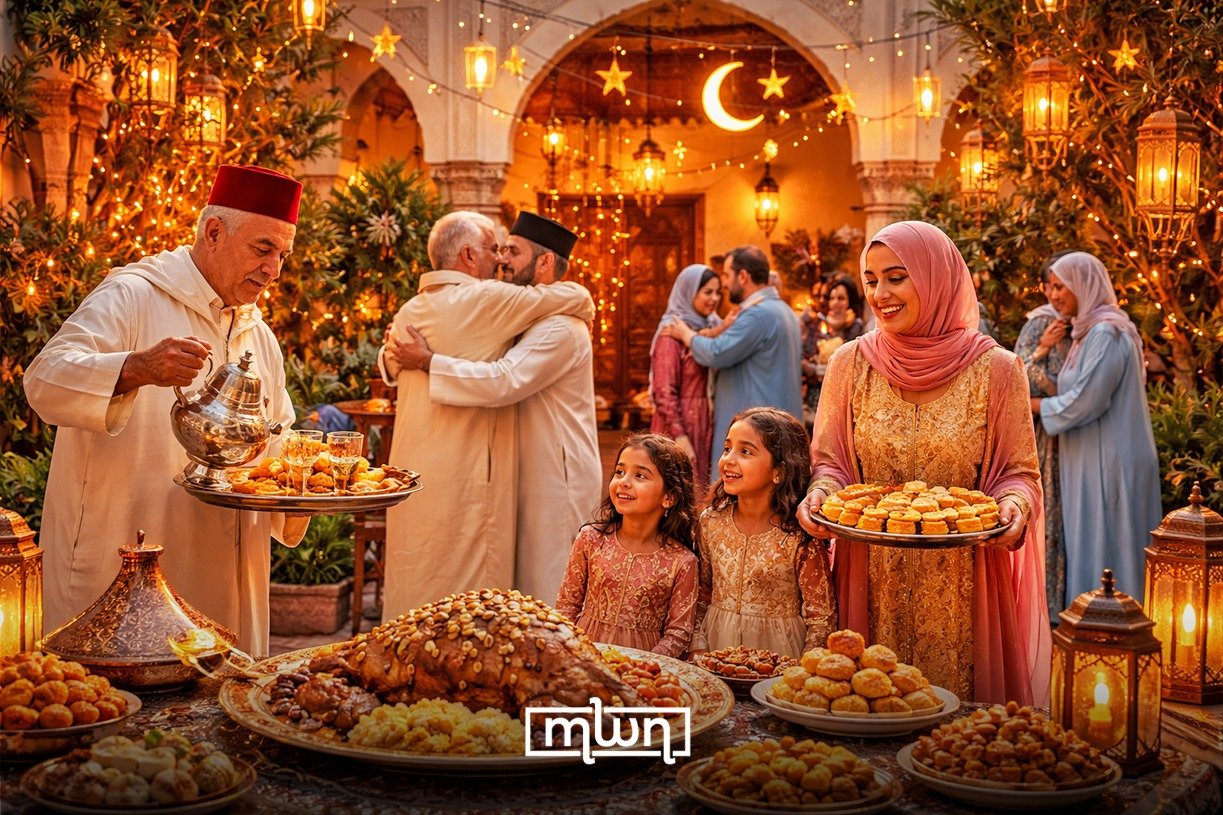
Casablanca – After a month of fasting from dawn to sunset, Muslims mark the end of Ramadan with a day that is both deeply spiritual and unmistakably festive. Eid Al Fitr, literally the “festival of breaking the fast,” is not just a holiday. It is a reset button, a reward, and a collective exhale.
Its roots go back to the early days of Islam. The celebration was established in 624 CE, shortly after the Prophet Muhammad’s migration to Medina, as a moment of gratitude and unity after a period of discipline. Since then, it has grown into one of the most important events in the Muslim calendar, observed by nearly two billion people across continents.
Before the day even begins, there is an obligation: Zakat Al Fitr, a mandatory charity commonly given a few days before the Eid. Traditionally, it is calculated as the value of about 2.5 kg of staple food (like wheat or rice) per person, often paid in cash based on local prices. It is a simple idea to ensure that even the poorest families can take part in the Eid spirit, and no one is left out.
In Morocco this year, the minimum contribution is set at around MAD 25 per person, adjusted to reflect the cost of living.
A shared morning celebration across borders
On the morning of Eid, across much of the Muslim world — though not always on the same day — there’s a shared rhythm that’s hard to describe unless experienced.
People wake early, take a ritual bath, or “Ghusl”, wear clean clothes — often new — giving the day a sense of fresh start.
Then comes the prayer, held shortly after sunrise. It spills out of mosques into open spaces, stadiums, public squares. Rows upon rows of worshippers, shoulder to shoulder.
The prayer itself is different from the daily ones. It has two rak’ahs, like usual, but includes extra “Takbirs” or chants of “Allahu Akbar” — typically seven in the first rak’ah and five or six in the second, before the recitation. There is no call to prayer beforehand, and the sermon comes after, not before.
Afterward, the world loosens up. People take different routes home, greeting neighbors, exchanging “Eid Mubarak,” hugging, sometimes awkwardly, sometimes tightly, depending on how long it’s been. Old tensions get smoothed over, at least for a day.
Still, Eid does not look the same everywhere. In Turkey, it’s called the “Sugar Feast,” with children going door to door collecting sweets. In Indonesia, millions travel back to their hometowns in a mass migration known as mudik.
In the Gulf, homes are decorated with bright fabrics and henna patterns bloom on hands. In parts of Africa, stadium prayers turn into massive social gatherings.
Across all of it, the core remains intact: prayer, food, family.
And then there’s the quiet economics of it all. In the final days of Ramadan, tailors work late into the night to finish traditional outfits, markets and souks stay crowded with last-minute shoppers, families spend on clothes, sweets, and gifts, and transport systems strain under the rush of people traveling home — entire cities adjusting their tempo around the holiday.
Morocco slows down, then opens its doors
In Morocco, Eid Al Fitr is often called Eid Sghir, the “little Eid.” The name is misleading, as there is nothing small about it.
The days leading up to Eid are busy, almost frantic. In cities like Casablanca, Fez, and Marrakech, medinas turn into a blur of last-minute shopping. Tailors race deadlines, finishing djellabas and kaftans late into the night.
Parents prioritize new clothes for their children above almost everything else. It’s not just about looking good, It’s about continuing a culture passed down through generations.
Then, the morning arrives, and everything slows down. Shops close, streets empty out, even taxis become rare. For a few hours, the country feels paused, like it’s holding something sacred. Travelers often find this stillness and absence of noise surprising.
But it doesn’t last. By midday, homes come alive, and this is where Moroccan Eid really unfolds.
The breakfast table is the first act, and it’s everything but subtle. Msemen, layered and buttery, sits alongside Baghrir, soft and spongy, soaking up honey, while Chebakia glistens with sesame and syrup next to small bowls of Sellou. There’s Feqqas, crunchy with almonds, and delicate Briouats filled with sweet almond paste, often sharing space with Kaab Ghzal, scented with orange blossom and crumbly Ghriba.
Then come the comforting dishes some families swear by. Hrbil, creamy cracked wheat with milk and butter, or Mhamsa small-grain pasta simmered in milk, or Assida, a sweet warm semolina porridge. Boiled eggs, dates, and dried fruits round it all out. Everything sweet, rich, unapologetic.
And always, mint tea. Poured from a height, creating that signature foam. A small performance repeated in every home.
Lunch shifts gears as the table gets heavier, and more deliberate. Across homes, the tagine holds its ground as a centerpiece, often lamb with prunes or dried fruits, a sweet-salty balance Moroccans have mastered over centuries. Saffron, rose water, slow cooking — flavors layered with patience.
But many families turn to roasted chicken, especially when guests are coming and numbers are hard to predict. It’s prepared ahead, then finished just before serving, golden and fragrant.
If Eid happens to fall on a Friday, couscous usually takes over without debate. Otherwise, dishes like Pastilla — delicate, flaky, filled with chicken and sweetened almonds — or Rfissa, rich with shredded Msemen and chicken, make their way to the table. In some homes, Seffa follows, sweet angel hair pasta with cinnamon and almonds.
Read also: Morocco to Officially Celebrate Eid Al Fitr on Friday
Food is everywhere, but it’s not just about eating, it’s about hosting. There’s a concept in Islam called “silat ar-rahim” — the duty to maintain family ties — a good deed that’s always encouraged.
But in Morocco, it takes on a whole new intensity during Eid. It becomes almost logistical with a full schedule of visits. Younger people go to elders first, while married couples split time between families, keeping doors open longer than usual.
In some Amazigh communities, that sense of connection stretches even further. Strangers are welcomed in for tea and sweets, no questions asked, no invitation needed.
There are also quieter traditions. One of them is Haq al-Milh, the “right of salt.” A husband gives a gift to his wife, often jewelry or clothing, as recognition for her work during Ramadan. It’s a symbolic thank you that carries weight.
By the afternoon, the mood shifts again as children take over the streets. Games, laughter, a kind of chaotic joy. In some places, traditional performances like Fantasia or Tbourida bring crowds together, horsemen charging in sync, gunpowder cracking the air.
And somewhere in the background, music. Old songs, new ones, a mix of nostalgia and modern rhythm.
Even the digital world has found its place here. Social media fills with “Eid fits,” curated outfits blending tradition with global trends. And beneath it all, a subtle race for likes and interactions, as everyone tries to capture the perfect look, the perfect moment, the perfect post.
At its core, Eid al-Fitr is not just about ending Ramadan. It’s about what comes after. The attempt to carry forward a little bit of that discipline, that generosity, that clarity.
For one day, at least, the world feels softer, more connected, a little more forgiving. And then, slowly, everything starts again.
Morocco World News is also on X — check out our latest posts now! Get MWN on iOS and Android for instant access to breaking news.
