


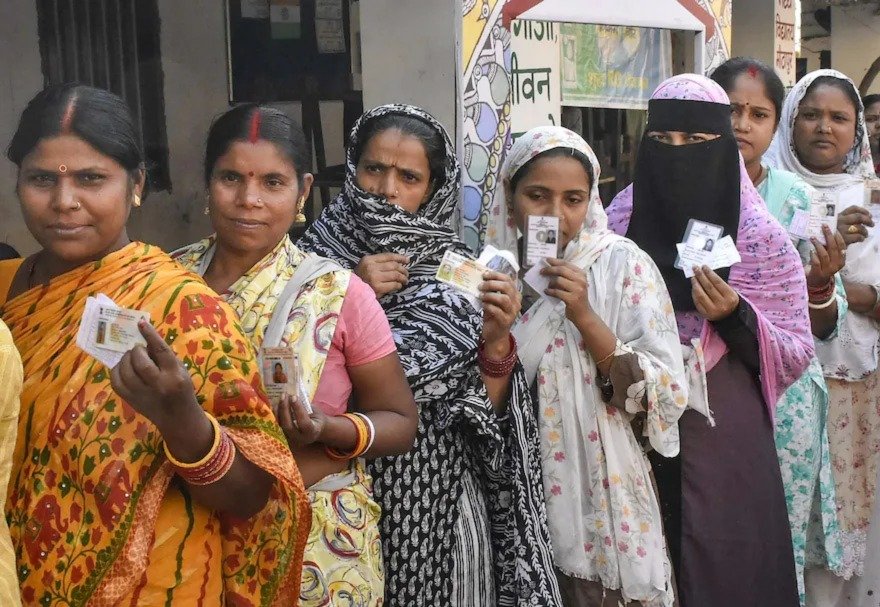
Rabat – Allegations of voter suppression have emerged in India’s West Bengal, where a controversial electoral roll revision removed millions of residents from voting lists ahead of a critical state election this week.
According to converging reports, the Election Commission of India (ECI) removed more than nine million names during its Special Intensive Revision (SIR) process – nearly 12% of the state’s 76 million registered voters.
Nearly six million of these nine million voters were declared absentee or deceased, while the remaining three million will not be able to vote until special tribunals hear their cases. With elections starting Thursday in West Bengal, it is impossible that cases will be resolved in time.
Many of these voters submitted enumeration forms but the SIR used an AI-driven process that flagged “logical discrepancies.” Despite re-verification efforts, 2.7 million citizens remain excluded from voter lists.
Experts say the AI algorithm did not recognize cultural discrepancies, including that there is no standard transcription of Bengali names into English script, and that Bengali surnames adapted over generations, which creates spelling inconsistencies between family documents.
The process also flagged parents under 16 or with more than five children as a “logical discrepancy” even though both were common in older generations.
The ECI claims the revision process is meant to remove duplicate or deceased voters, and ensure the addition of people previously left off voter lists. However, the process has experienced ongoing controversies and legal challenges.
Allegations of political targeting and migration debate
Opposition parties and Muslim groups argue that the EIC systematically removes people unlikely to vote for Prime Minister Narendra Modi’s Bharatiya Janata Party (BJP), especially muslims.
Since coming to power in 2014, Modi’s government has faced repeated accusations of advancing policies that marginalize Muslims. Critics cite measures such as controversial citizenship policies notably expelling hundreds of ethnic Bengali Muslims to Bangladesh without due process in 2025.
Around 25 million Muslims live in West Bengal, which the right-wing, Hindu nationalist, BJP has never won.
West Bengal has been governed by chief minister Mamata Banerjee of the Trinamool Congress party (TMC) since 2011, facing firm opposition from Modi’s BJP.
Banerjee claims the BJP is manipulating the process for political gain.
“The SIR process was selectively applied in West Bengal to benefit the BJP,” she said at a campaign rally last week. “The BJP is plotting to forcefully capture votes through fraudulent means as they don’t have the guts to fight and win the elections democratically.”
The BJP home minister, Amit Shah has described the SIR as “not only necessary for the country’s security,” but also essential to “prevent infiltration in order to protect the country’s democratic system from being polluted.”
Party leaders point to a perceived threat of millions of undocumented migrants along the state’s 2,200-kilometer border with Bangladesh. The BJP often used the language of “illegal infiltrators,” sometimes using terms such as “Bangladeshis” and “Rohingya” interchangeably.
Following violent persecution by the Myanmar army in 2017, Bangladesh became home to the world’s largest refugee camp, housing almost one million Rohingya refugees.
Many lifelong Indian citizens who find themselves removed from voting records are in a state of panic, fearing that they will be treated as illegal immigrants from Bangladesh and pushed out of the country.
Constituency data shows that approximately 65% of the 2.7 million awaiting reinstatement are Muslims.
The SABAR Institute, an independent research organization based in Kolkata found that “Muslims from the mapped population have been disproportionately deleted.”
Analysis of two key constituencies being contested by the BJP leaders show that while Muslims make up just 25% of Nandigram’s population, more than 95% of the names deleted from the list were Muslims. Similarly, Bhabanipur has 20% Muslims, but 40% of voters deleted were Muslim.
Chaos ahead of Thursday elections
India’s Supreme Court declared that individuals awaiting tribunal decisions could not vote in the April election.
The ruling contributes to an already chaotic political scene and further steeps a sense of distrust for the government, particularly from disenfranchised voters.
Authorities are taking heightened security measures, with 111 out of 2,787 polling booths identified as sensitive. Over 1,800 district police personnel have been deployed in rural areas and 1,084 city police personnel stationed in urban regions. Additional forces, including Home Guards, paramilitary personnel, Central Reserve Police Force, Central Industrial Security Force, and ex-servicemen, have also been posted to maintain law and order.
Banerjee spoke out against the increased security presence at a rally in North 24 Parganas district. She alleged that “around two lakh (200,000) central force personnel have been brought into Bengal for the elections,” adding, “this is unprecedented. Are they trying to intimidate me by deploying so many forces?”
“Elections are a festival of democracy, not for killing anyone,” she said, urging attendees to file complaints if they faced challenges while voting.
Shah accused Banerjee of widespread “syndicate raj,” corruption, and deteriorating law and order in the poll-bound West Bengal.
All 234 assembly constituencies in Tamil Nadu and 152 of the 294 seats in West Bengal will vote on Thursday, with the remaining seats going to the polls on April 29.
