


Marrakech – There is a peculiar audacity in setting your own house ablaze and then lecturing the neighborhood on fire safety. That, in essence, is what the Senegalese Football Federation (FSF) and the Senegalese government have spent this week doing – hurling accusations of corruption, neo-colonial manipulation and institutional rot at the Confederation of African Football (CAF) and at Morocco, while their own federation was, quite literally, tearing itself apart from the inside.
The CAF did what it had to do. By stripping Senegal of the 2025 Africa Cup of Nations (AFCON) title and declaring Morocco rightful champions through the application of Articles 82 and 84 of the AFCON regulations, the continental body pulled African football back from the edge of a catastrophic precedent – one where a team could walk off the pitch, hold a continental final hostage for 17 minutes, trigger a pitch invasion, and still walk away clutching the trophy. That is not football. That is hooliganism, thuggery, and debauchery laundered through a jersey and sold to the world as righteous protest.
Dakar’s fury: Corruption cries and presidential theatrics
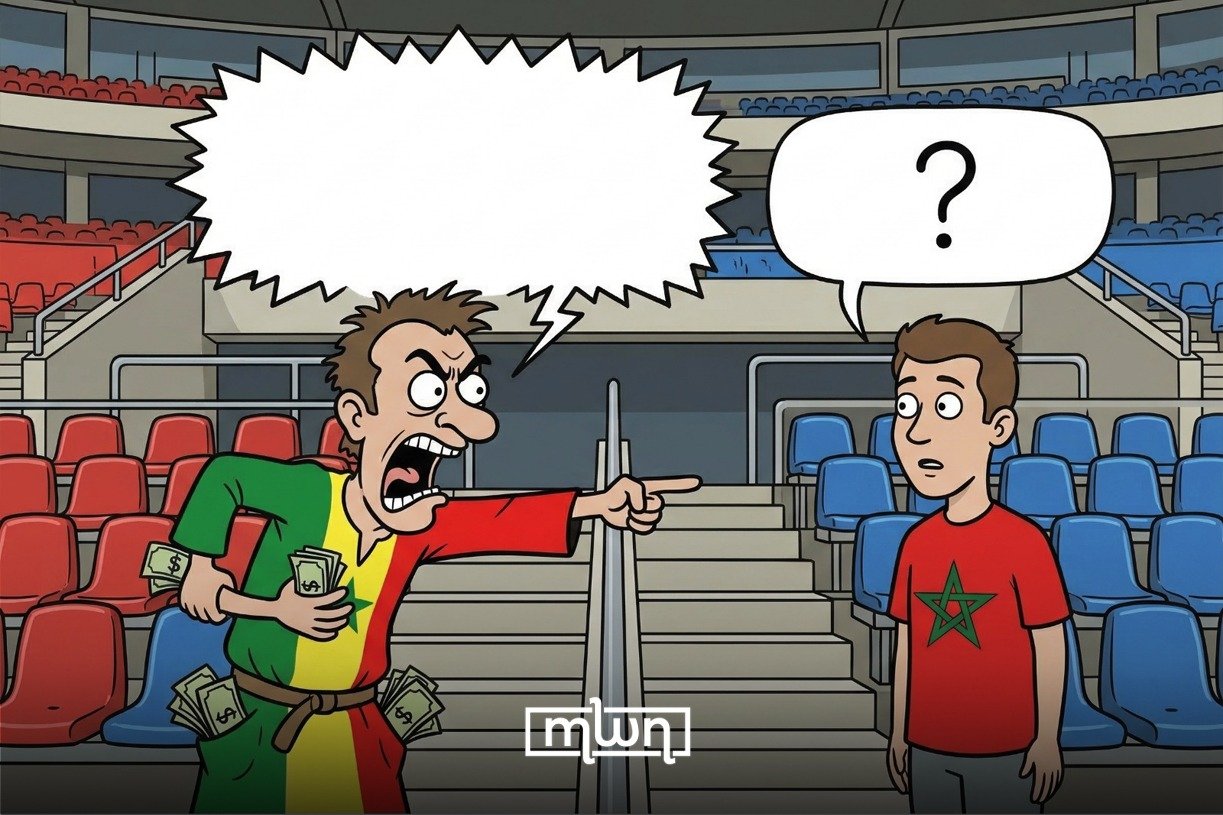
Yet, as FSF president Abdoulaye Fall sees it, this was all a grand Moroccan conspiracy. “Morocco controls everything,” he declared on camera after the January 18 scandalous final, painting the North African country as some sinister puppet-master pulling the strings of a 54-member continental body from the shadows.
The government in Dakar went further still this Wednesday, demanding an “independent international investigation” into “suspected corruption within CAF’s governing bodies” and denouncing what it called a “grossly illegal” act of “unjustified dispossession.” Secretary General Abdoulaye Sow himself branded the CAF “corrupt,” assuring Senegalese citizens that “the fight is far from over.” He labeled the ruling “a travesty” and “a shame for Africa.”
The FSF formally put the CAF “on notice” to freeze all trophy handover procedures, calling the verdict “unfounded in law, arbitrary and manifestly disproportionate.” And at Thursday’s press conference that opened with a projected photo of the Senegalese team hoisting the trophy and erupted into chants of “Allez Sénégal!,” Abdoulaye Fall declared the decision “iniquitous, unprecedented and incomprehensible,” insisting with breathtaking certitude: “On the level of law, Senegal cannot lose this match on the green table.” He even dismissed the entire affair as already settled: “We received the medals, the trophy and the prize money. For us, this is a closed matter.”
And lest the theatrics remain confined to federation halls and government statements, President Bassirou Diomaye Faye himself entered the fray with a gesture that amounted to little more than a head of state trolling a continental institution. In the immediate aftermath of the CAF verdict, the Senegalese president updated his official social media profile picture to one showing him seated at his presidential desk – with the AFCON trophy conspicuously displayed on a cabinet shelf behind him. The symbolism was as subtle as a sledgehammer: the cup is here, come and get it. For a leader who campaigned on fighting corruption and reclaiming sovereignty, reducing the office of the presidency to a prop in a trophy dispute is a peculiar brand of statesmanship. When the leader of a nation communicates through posed photographs rather than measured diplomacy, it tells you everything about the seriousness with which the affair is being handled – which is to say, none at all.
The rhetoric is unmistakable. Morocco, in their telling, is not a fellow African nation that hosted a tournament praised universally for its organization. No – Morocco is cast as a hegemonic force, a continental overlord bending institutions to its will. The framing flirts openly with the language of colonialism, positioning Senegal as the valiant defender of African integrity against some imperial arbiter. It is as intellectually dishonest as it is historically illiterate. Morocco is as African as Senegal. Both are sovereign members of the same continental union, both equal stakeholders within the same 54-nation CAF family. The suggestion that one African country exercising its legal right to appeal constitutes neo-colonial domination is not just absurd – it is an insult to the actual victims of colonialism across the continent.
But the most jaw-dropping dimension of this entire spectacle is not the accusations themselves. It is their timing.
The day the FSF devoured itself from within
On the very same day the CAF Appeals Board rendered its verdict – Monday, March 17 – and before the decision was even announced that evening, the FSF’s own Executive Committee (COMEX) convened in Dakar for a session that lasted from 10:00 a.m. to 6:15 p.m. What unfolded during those eight excruciating hours was not a meeting. It was a demolition derby. L’Observateur, one of Senegal’s most widely read newspapers, devoted its front page to what it called a “déballage explosif” – an explosive unraveling.
Let the record speak for itself. Amadou Kane, president of ONCAV, publicly accused Secretary General Abdoulaye Sow – the same man now calling the CAF “corrupt” – of having “lied to reach the position of Secretary General.” Sow’s retort was to call Kane a “liar” in return. Yaya Baldé, representing the Kolda league, escalated from verbal abuse to physical threats so menacing that the meeting room nearly became a boxing ring. The newspaper’s own sources described the proceedings as “a debate fit for ragpickers.”
It only got worse. FSF spokesperson Bacary Cissé publicly branded fellow official Pape Sidy Lô a “fumier” – the French equivalent of calling someone human waste – accusing him of whispering slander to the federation president. Lô, reportedly “stunned into silence” during the meeting, has since announced he will sue Cissé for defamation. Cissé himself delivered the session’s epitaph with devastating accuracy: “The federation is walking on its head. It needs to be set right.”
And then there is the matter of money – always the matter of money. Modou Fall of AS Pikine ripped open the question of COMEX members’ allowances during the AFCON, sparking a vicious exchange with Ligue Pro president Babacar Ndiaye. The patron of Teungueth FC denounced a “policy of isolation,” revealing he had been removed from the WhatsApp group used to coordinate match preparations despite holding a commission presidency. Meanwhile, Bamba Bâ – who simultaneously chairs the FSF’s marketing commission and runs the ticketing platform Jotali, a conflict of interest so brazen it would make a Wall Street regulator blush – was forced to defend himself against accusations of self-enrichment, insisting under pressure: “I don’t earn a single cent there.”
And if the COMEX meltdown were not damning enough, the very legitimacy of the man leading this federation is itself under a cloud. Micky Jnr, the journalist commanding the largest following in sub-Saharan Africa, flagged on social media that the situation inside the FSF is escalating well beyond boardroom tantrums. The election of Abdoulaye Fall as president has been heavily contested, with allegations of voter influence – travel and accommodation reportedly covered to secure votes – and irregularities during vote counting. Most critically, an extra ballot was included in the tally, a procedural violation that, under the FSF’s own statutes, should have triggered the outright cancellation of the election. The very man now demanding international corruption probes against the CAF may be sitting in a chair he was never legitimately elected to occupy.
The federation that lectures the world on integrity
This is the federation that now lectures the world on transparency. This is the institution demanding international corruption probes. The irony is not subtle, but volcanic. It is the equivalent of the Titanic suing a passing canoe. Your own ship is literally going underwater, and instead of plugging the holes, you are suing the small boat nearby for creating dangerous waves. The absurdity is that the person with the biggest problem is accusing someone with no problem of having a problem – while ignoring their own catastrophe.
Senegal’s football leadership spent Monday morning publicly accusing each other of lying, threatening physical violence, hurling obscenities, quarreling over per diems and exposing governance failures so deep that even their own spokesperson declared the institution dysfunctional – and then, that same evening, turned around and told the planet that it is the CAF and Morocco who lack integrity.
There is a proverb attributed to various cultures but universally understood: those who live in glass houses should not throw stones. The FSF did not merely throw stones. It launched a full artillery barrage – from a house made of wet tissue paper, in the middle of an earthquake of its own making.
It is, of course, psychologically understandable. When the verdict goes against you, when the trophy is pried from your hands, the human instinct is to reach for the darkest explanation available. Conspiracy is the refuge of the defeated mind – it is easier to believe the game was rigged than to accept that your own conduct rigged it against you. Psychologists have a name for this: proportionality bias, the cognitive tendency to assume that large, painful outcomes must have large, sinister causes.
In this train of thought, a lost AFCON title cannot simply be the consequence of your own players walking off a pitch – no, it must be the work of shadowy forces, purchased judges, a puppet-master country pulling continental strings.
This impulse is human. It is forgivable in a heartbroken fan screaming into social media at midnight. It is, however, unforgivable in a government issuing official statements, and inexcusable from a federation president standing behind a microphone. Leaders are not elected to validate the mob’s worst instincts. They are supposed to be the adults in the room – and in Senegal’s case, the adults were too busy calling each other liars and “fumier” to show up.
What the CAF actually did, and what Morocco never did
In his first public remarks on Wednesday, CAF president Patrice Motsepe defended the verdict, stressing that it was rendered by an independent appeals body composed of “some of the most respected jurists and magistrates on the continent,” chaired by a judge, and operating autonomously from the confederation itself. He affirmed unequivocally that no African nation would receive “more privileged, more advantageous, or more favorable” treatment than another.
Morocco, it bears remembering, felt the sting of injustice too – when the initial disciplinary commission refused to apply its own regulations. The FRMF did not storm press conferences or cry conspiracy. It appealed, presented its case, attended hearings, and defended its position through every legal channel available – until the rules were correctly applied.
The CAF’s decision was not an act of corruption. It was an act of institutional courage – a rare moment where African football’s governing body chose rules over convenience, precedent over appeasement. For decades, the CAF was criticized, often rightly, for institutional weakness and selective enforcement. In this instance, it did the opposite. It applied its own regulations to the letter, and in doing so, sent an unequivocal message to every federation, every coach, every player on the continent: you do not get to abandon a final and keep the crown. “The events and incidents during the final highlight the work that remains to be done in the face of suspicion and lack of confidence. This is a legacy of the past,” the CAF president himself said.
The Moroccan federation FRMF made clear that its legal challenge was never about the scoreline. “The approach undertaken was never intended to contest the sporting performance of the teams, but solely to demand respect for the rules,” the federation stated. It had consistently pushed for one thing since the chaotic events of January 18 in Rabat: “the strict application of the regulations governing the competition.”
Senegal can appeal to the Court of Arbitration for Sport (CAS). That is their right, and no one disputes it. But the victim narrative they have constructed – the portrayal of Morocco as some all-powerful overlord, the cries of corruption from a federation whose own members cannot sit in a room for eight hours without calling each other liars and threatening fistfights – is not a legal strategy. It is a smokescreen. And the smoke, on closer inspection, is coming entirely from within their own house.
Read also: Why Spain’s Sports Media is Melting Down Over Morocco’s AFCON Win
