


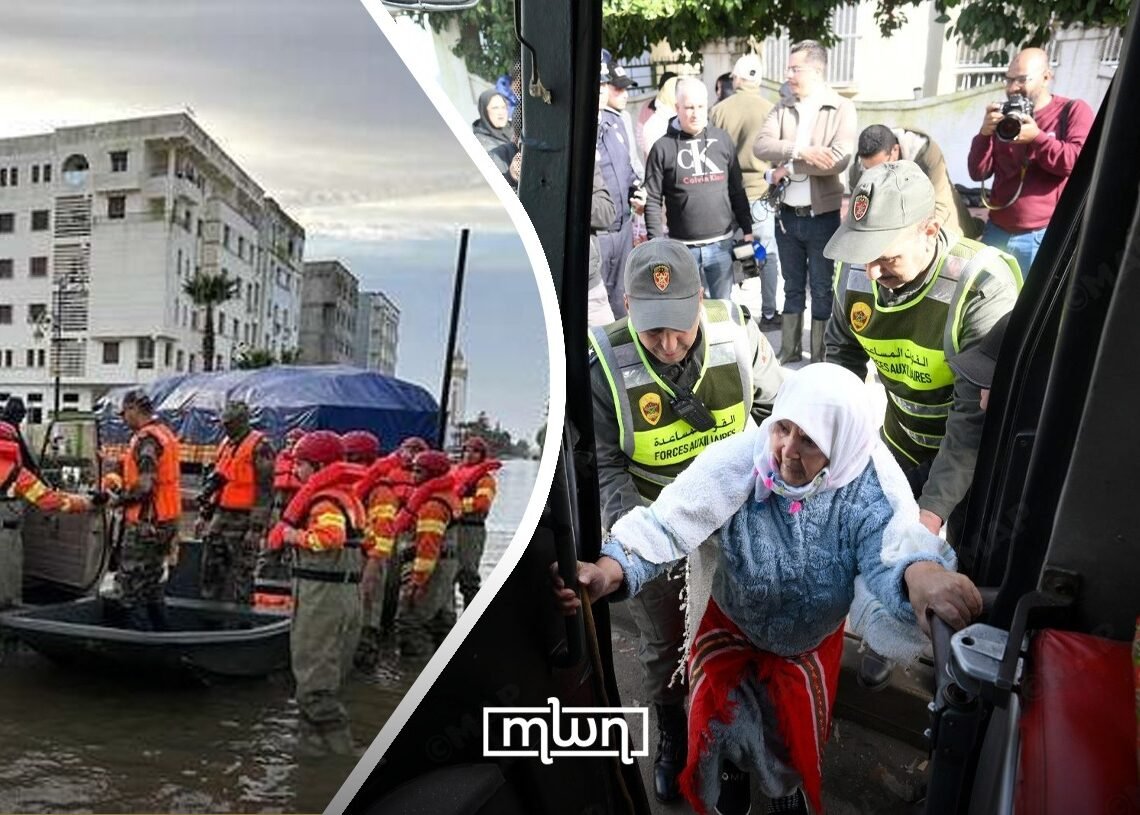
Rabat – Climate researchers said extreme rainfall linked to a series of winter storms that struck northern Morocco has intensified in recent decades, as the country continues to assess the impact of flooding that displaced hundreds of thousands of people earlier this year.
The analysis, published as Scientific Report No. 83 by World Weather Attribution (WWA), examines nine named storms that affected Spain, Portugal and Morocco between mid-January and mid-February 2026. The storms brought heavy rainfall and strong winds across the western Mediterranean, with Morocco among the hardest hit countries.
More than 300,000 people were displaced in Morocco during the storm sequence, according to the report. Floodwaters inundated approximately 110,000 hectares of agricultural land, and 43 deaths were reported.
The government activated a restoration plan valued at about €280 million to address damage to housing and infrastructure.
In northern Morocco, some locations recorded nearly a month’s worth of rainfall in three days. The Oued Makhazine dam exceeded its capacity by 60%, prompting controlled water releases downstream.
Cities including Ksar El Kebir experienced disruptions to transport, electricity, water supply and schools, while parts of Safi Province, including Medina neighborhoods, were heavily affected.
The study assessed trends in the annual maximum one-day rainfall during the October to March wet season across two regions, including a southern zone covering southern Portugal, southwestern Spain and northern Morocco.
Read also: Larache Authorities Say All Ksar El Kebir Can Return Home Starting Today
Using observational datasets from 1950 onward, researchers found that extreme one-day rainfall intensity in the southern region has increased by an estimated 23 to 49% compared with a climate 1.3°C cooler than present conditions.
When synthesizing observational products, the authors report a best estimate of about a 36% increase in intensity in the southern region, though they state uncertainty remains high and climate models do not consistently reproduce the observed trend.
In the northern Iberian region, which includes parts of Portugal and Spain, observations show an increase of roughly 29% in extreme rainfall intensity associated with warming.
A weighted synthesis of model and observational data indicates an overall increase of about 11% in that region.
The report notes that early warnings were issued across the three countries, enabling evacuations and emergency measures that limited casualties.
More than 12,400 people were evacuated in Spain, while in Portugal, authorities recorded thousands of storm-related incidents and significant infrastructure damage.
Researchers said that while trends in extreme rainfall are subject to regional variability and data uncertainty, multiple lines of evidence indicate that the most intense rainfall events in the southern study area, which includes northern Morocco, have increased in magnitude in the current climate.
