


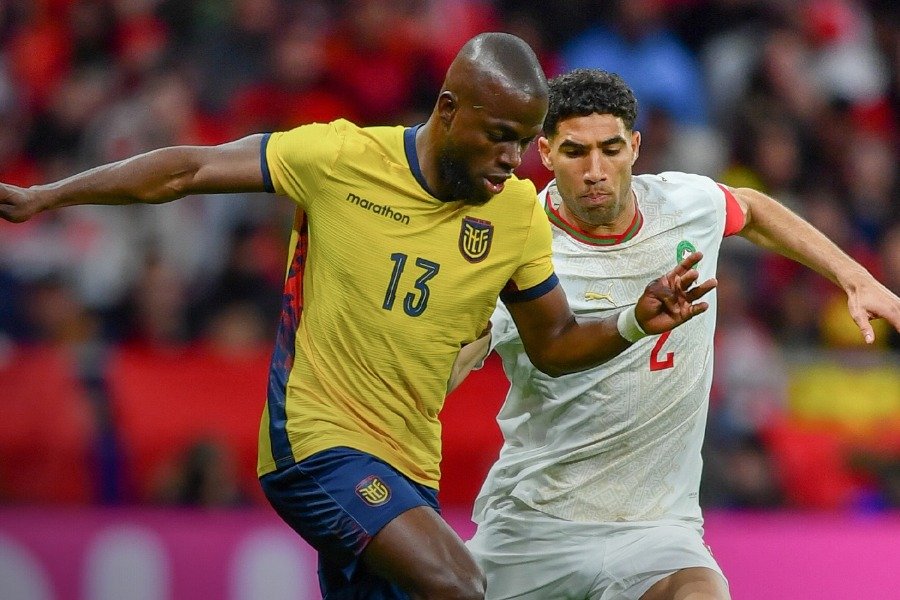
Morocco’s 1–1 draw with the Ecuador national football team left a strong impression in Spain, where media coverage focused less on the result and more on the way the game unfolded, especially Morocco’s reaction after the break.
At the Riyadh Air Metropolitano, the atmosphere itself was already something to talk about. According to Marca, the stadium felt more like a competitive fixture than a friendly, with Ecuadorian fans turning it into a “boiling” environment.
Marca also pointed out that Morocco arrived with a lot going on. A new coach, a new system and new faces, yet still produced a performance that was about ambition and tactical understanding. The outlet wrote that coach Mohamed Ouahbi “didn’t hold anything back in his debut,” lining up an attacking XI that showed confidence and maturity. “This Morocco showed personality,” Marca added, impressed with how the side recovered after conceding.
A game that shifted after half-time
If the first half felt cautious, the second was anything but. Diario AS described the match as “high-voltage football played at World Cup rhythm.” They noted that while the first half was cagey, the second brought a level of intensity and tempo that exceeded expectations for a friendly.
Ecuador had the better of the opening period, and Morocco struggled to connect midfield and attack. Players like Brahim Díaz and Abde Ezzalzouli couldn’t really influence the game the way they usually do. Although Ecuador controlled much of the early play, Spain’s coverage mentioned that Morocco’s response in the second half was where they truly impressed. AS wrote that Morocco “grew into the match with conviction and urgency,” and that the team’s attacking intent was “clear, purposeful, and relentless” once they began pushing for an equalizer.
Spanish papers also singled out Morocco’s ability to cope with setbacks. After a missed penalty and a disallowed goal, Marca commented that “Morocco never lost faith,” continuing to apply pressure until the late equalizer came. The build-up to the goal, according to AS, “showcased Morocco’s attacking belief and aerial threat,” with the corner converted in a moment that felt like a deserved reward for their persistence.
As AS put it, Morocco “needed to concede to start pushing,” and from that moment, the team played with more urgency and intent.
There was frustration along the way, a missed penalty, and a goal ruled out after VAR, but Morocco kept going. Marca spoke about how the equalizer, coming from a corner, “felt like a victory” given the way the team finished the game.
