


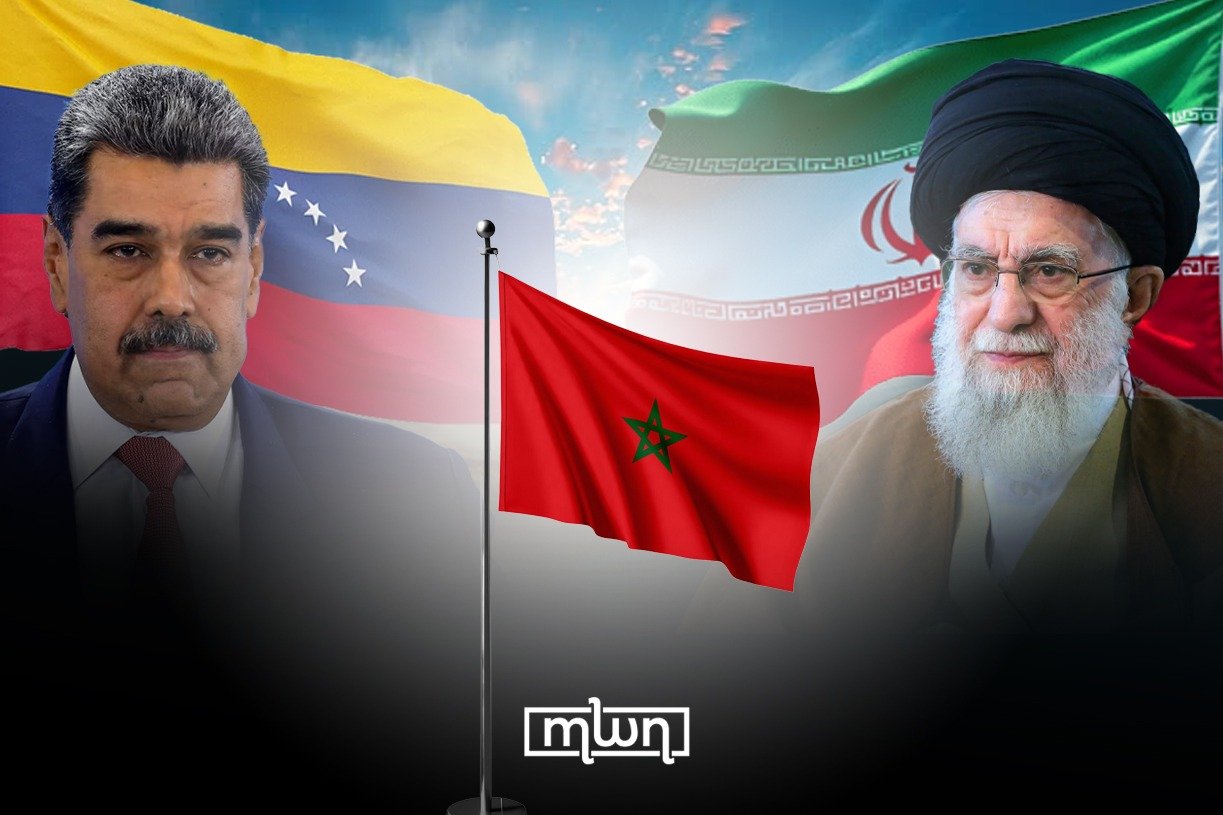
Marrakech – The downfall of Maduro’s regime – encouraged by recent US actions – has been greeted with celebration by many Moroccans, as has the wave of protests shaking Iran’s theocratic rulers.
Such reactions are understandable and hardly surprising. Both Venezuela and Iran have long stood on the wrong side of Morocco’s national cause, openly endorsing the Algeria-backed Polisario Front.
In defiance of history, regional stability, and the aspirations of local populations, the two regimes have historically supported Polisario’s separatist project that seeks to fracture Moroccan territorial integrity and perpetuate a decades-long, artificial conflict over the Western Sahara region in southern Morocco.
For Rabat, which views the Sahara issue as the prism through which it assesses its international environment, the weakening of these hostile regimes feels like vindication. Yet amid the jubilation, a deeper strategic question looms: would Morocco truly benefit if US power goes unrivaled and the world returns to a unipolar order?
A careful geopolitical analysis suggests that a multipolar world – a world of multiple great power centers and a balance of power – is far safer for Morocco’s sovereignty and long-term interests than any one-nation hegemony could ever be.
Western Sahara at the center of Morocco’s worldview
To understand Morocco’s stake in global power dynamics, one must grasp the centrality of Western Sahara to its foreign policy. Morocco’s King Mohammed VI has declared that “The Sahara issue is the prism through which Morocco views its international environment, and the yardstick that measures the sincerity of friendships and the effectiveness of partnerships.”
In practice, this means Rabat evaluates every international relationship by one criterion above all: does the partner support Morocco’s right to Western Sahara, or lend comfort to the Polisario separatists? Caracas under Hugo Chávez and Nicolás Maduro became a vocal champion of the Polisario cause, prompting Morocco to shutter its embassy in Venezuela by 2009.
Tehran’s regime, for its part, was accused of arming Polisario fighters via Hezbollah, leading Rabat to sever ties in 2018.
Since the fall of the Assad regime, mounting investigations have definitively exposed the Polisario Front as a foreign mercenary network embedded in Syria’s war machine. These revelations confirm long-standing warnings that the group functioned as an Iran- and Algeria-backed proxy, complicit in regional destabilization and grave war crimes beyond North Africa.
Thus, when Trump-era Washington turned up the pressure on Maduro – even orchestrating his capture – and as Iran’s rulers found themselves besieged by popular unrest, Moroccans understandably saw adversaries stumbling. These developments promise to erode two of the loudest anti-Morocco voices on the global stage.
Relief and even schadenfreude at these foes’ misfortunes is natural. By removing a “political gateway” through which the Polisario had courted support in Latin America and by potentially neutralizing the so-called Iranian “Axis of Resistance” – a transnational network of militias, proxies, and armed groups used by Tehran to project influence, destabilize states, and arm non-state actors beyond its borders – that armed Morocco’s enemies, these events strengthen Morocco’s hand on the Western Sahara dossier.
However, they also augur a world in which US influence grows relatively stronger – especially if Washington’s hard line against other rivals like China and Russia continues to succeed. And herein lies the paradox: Morocco’s recent diplomatic victories were achieved not by unipolar American dominance, but by skillfully navigating an emerging multipolar order.
Diplomacy in an age of multipolarity
Morocco’s foreign policy over the past two decades reveals a concerted effort to diversify partnerships and avoid reliance on any single patron. As one 2024 analysis by the Carnegie Endowment for International Peace notes, “Morocco has refrained from aligning itself with any geopolitical bloc and has positioned itself on the sidelines of the rivalry between the United States and China.”
The kingdom maintains a tight historic alliance with the US – including a free trade agreement and Major Non-NATO Ally status – but it simultaneously courts China and Russia as needed. This pragmatic balancing act was on display when Rabat normalized relations with Israel in 2020, chiefly to “secure US support for Morocco’s stance on the Western Sahara conflict.”
In exchange for opening formal ties with Tel Aviv, Morocco won Washington’s recognition of its sovereignty over Western Sahara, a diplomatic prize unthinkable in a less fluid global context.
Crucially, Morocco could make such bold moves precisely because it also has other options: it has signed onto China’s Belt and Road Initiative and attracted major Chinese investments, positioning itself as a “global connector” bridging East and West. Rabat has likewise kept channels open with Moscow and often aligns its UN votes with the broader Global South consensus rather than any Western bloc.
In a multipolar world – one with several great powers (the US, China, the EU, Russia, etc.) – middle-ranking countries like Morocco gain leverage. They can “play global hegemons off one another,” as analyst Christopher Phillips observes, maximizing benefits by not putting all their eggs in one superpower’s basket.
Indeed, Morocco’s ability to extract concessions (like US recognition on Western Sahara) and to resist pressure on certain issues stems from this freedom of maneuver. Rabat can, for example, quietly abstain from full-throated support of Western sanctions on Russia without catastrophic fallout, or decline to join military coalitions, because it has cultivated alternatives and a reputation for independent diplomacy. This strategic autonomy is a direct product of the balance-of-power dynamics in play globally.
Contrast this with the 1990s, when the United States bestrode a unipolar world after the Soviet Union’s collapse. In that era, smaller states had far fewer cards to play. Morocco remained a staunch US ally, but it had little choice – Washington’s favor was virtually the only game in town.
Any divergence from US wishes risked isolation. Today, by contrast, if one partner withholds support on an issue vital to Morocco, Rabat can seek countervailing backing from another major power. The re-entry of China and Russia into Afro-Arab geopolitics has, in effect, expanded Morocco’s diplomatic space to maneuver.
It is telling that Morocco’s Western Sahara position has steadily gained international acceptance not by American dictate alone, but through Rabat patiently building coalitions across Africa, the Middle East, and beyond – something far more feasible in a multipolar environment of competing powers, where no single superpower can enforce a consensus against Morocco.
The dangers of unipolar dominance
Moroccans cheering the setbacks of Tehran and Caracas should consider the flip side: a world in which the US faces no peer competitor could leave smaller nations dangerously exposed to Washington’s whims.
Absolute power, even in the hands of an ally, can be a double-edged sword. One illustrative episode came when President Donald Trump openly floated the idea of the United States acquiring Greenland from Denmark – a European sovereign country and NATO ally – “one way or another.”
He even suggested that if Denmark wouldn’t sell the vast Arctic territory, he might take it by force, rattling the Danes and prompting military precautions in Copenhagen. If a US president could so brazenly pressure a close ally for territory in a multipolar context, what guarantees would Morocco have that its own treasured land might not someday become a bargaining chip in a unipolar world?
It is not far-fetched to imagine a scenario where, absent any global checks and balances, an overweening Washington could tell Rabat: “Western Sahara is strategically valuable – we’re going to internationalize it (or take it outright).” While today that sounds fanciful, it underscores a principle: when one great power’s might is unchecked, the sovereignty of smaller states rests on that power’s restraint, not on any balance of forces.
History is full of such sobering lessons. The post-Cold War unipolar moment saw the US and NATO intervene militarily in the Balkans, Iraq, and Libya with minimal regard for dissenting voices at the UN Security Council. Some of those interventions toppled brutal regimes (as many Moroccans might wish for Iran’s), but they also set precedents for bypassing international consensus.
Morocco itself felt the unpredictable nature of a lone superpower’s agenda when, in the early 2000s, US diplomats briefly flirted with peace plans for Western Sahara that Rabat opposed. But those plans might have advanced, had America not needed Morocco’s strategic cooperation in the war on terror. Because the balance of power was missing or marginal, Morocco’s fate hinged on staying in Washington’s good graces.
By contrast, a multipolar order raises the costs for any one power – even a friendly one – to strong-arm a smaller nation. Should an overzealous American administration pursue a course harmful to Morocco’s interests, Rabat could seek countervailing support from another leading capital, whether Paris, Beijing, Moscow, or regional blocs.
The mere knowledge in Washington that Morocco has other powerful friends acts as a deterrent against coercive diplomacy. Multipolarity, in effect, adds guardrails that keep great powers’ ambitions in check through mutual competition.
Balance-of-power benefits: Peace and autonomy
Advocates of a multipolar world argue that it not only empowers medium-sized states, but also contributes to global stability. No superpower can launch wars of conquest or regime-change adventures with impunity if rival powers stand ready to oppose or veto such moves.
In today’s fragmented international system, for example, Russia’s military support for Syria’s government thwarted what could have been a wider Western intervention there; similarly, China’s rise has made the US more cautious in its use of force.
While multipolar competition can breed its own tensions, it at least forces dialogue and compromise, since no single actor can unilaterally impose its will without consequence. In a unipolar world, by contrast, small states often have war or sanctions thrust upon them without recourse.
A further illustration lies in Iran’s pursuit of nuclear capability and regional hegemony across the Arab and Muslim worlds. Encircled by Iran-backed actors such as Hezbollah and Hamas, Israel faces strategic constraints imposed by multipolar deterrence. In a fully Western-dominated, unipolar system, no counterweight would meaningfully restrain Israeli military expansion or escalation. While these dynamics are already visible today, they would be far more unchecked and unapologetically brutal in the absence of rival powers.
For African and Middle Eastern countries like Morocco, a multipolar order offers a chance to “gain more manoeuvrability” and extract better deals. They can solicit infrastructure investment from China, security aid from the US and Europe, and energy partnerships with the Gulf or Russia, all at once – playing each to mutual advantage. If one partner’s terms are unfavorable, another can be courted, which encourages competition rather than dependency.
This is essentially how Morocco has prospered: by being, as one scholar put it, a “middle power” at the crossroads that engages all major centers of power to serve its own interests. The kingdom’s “strategic opportunism” in foreign policy – aligning with the Global South stance on contentious issues while maintaining Western alliances – has “bolstered [its] ability to pursue economic opportunities” and protect its sovereignty. None of that would be possible in a rigid, one-pole world order.
It is important to note that multipolarity is not a panacea. A more multipolar world can be turbulent, and it complicates the resolution of conflicts when great powers back opposing sides. However, the alternative – a return to stark US hegemony – could be worse for Morocco. In a unipolar context, Morocco might find its Western Sahara policy hostage to a singular power’s grand strategy.
For instance, if Washington decided tomorrow that smoothing relations with Algeria (Morocco’s rival) mattered more to its interests, a Morocco without other patrons could be pressured to swallow an unfavorable compromise on the Sahara.
Multipolarity ensures Morocco is never left without an escape option or a sympathetic ear in the international community. It keeps alive multiple forums and channels through which Morocco can assert its case – from the Arab League and African Union to the EU, UN, and Chinese-led initiatives – thereby preventing any one power’s bias from sealing Western Sahara’s fate.
Long-term vision: Prudence in celebration
Given these realities, Morocco’s strategic thinkers have wisely embraced a vision of a “multipolar world” as the optimal environment for national success. Indeed, Moroccan diplomacy has been prescient in anticipating a “post-hegemonic world” where influence is diffuse and partnerships are flexible. It is precisely this far-sighted approach – treating every alliance as conditional and every rivalry as mutable – that has allowed Morocco to punch above its weight.
The kingdom’s gains on the Western Sahara issue, from US recognition to dozens of new consulates opened by foreign countries in the territory, were achieved by agile engagement across world capitals. They were not the spoils of any one superpower’s victory, but the dividends of Morocco’s own balanced statecraft.
Moroccans thus have every right to feel satisfaction as regimes that opposed their national cause stumble. Yet they should temper that satisfaction with realism about the global power structure. The weakening of Venezuela and Iran may remove immediate thorns in Morocco’s side, but if it comes as part of a broader collapse of checks on American power – especially with US strategists now casting China as their primary adversary – the longer-term consequences could be perilous.
A world of one dominant pole is one where a country like Morocco could no longer leverage East against West, or non-aligned solidarity against great power dictates. It would be a world where “might makes right” in international affairs, leaving smaller states to hope that the sole superpower’s interests always align with their own. History and pragmatism teach us that such hope is a fragile basis for policy.
Morocco’s true interest lies in the continuation of a multipolar order where no single nation can lord over all. Such an order, grounded in a balance of power, gives Morocco the breathing room to defend its territorial integrity and chart an independent course. It compels the world’s strongest states to court Morocco with partnerships and investments, rather than coerce it with ultimatums.
Therefore, even as Moroccans celebrate the misfortunes of distant adversaries today, they should continue to champion a multipolar global future tomorrow. Only in such a pluralistic world will Morocco’s sovereignty be more secure, its diplomacy more influential, and its national cause upheld by the enduring logic that no one power should ever reign unchecked.
As every seasoned geopolitical observer might conclude after years of watching world affairs, diversity of power is the best guarantee of a just and peaceful international system – one in which nations like Morocco can thrive.
