


Marrakech – How many more floods before Morocco invests in the city of Safi’s crumbling infrastructure? A storied Atlantic port where grinding waves, ancient fortresses, and centuries of pottery and sardine harvests embody Morocco’s enduring spirit, Safi is the closest coastal city to Marrakech, located between Essaouira and El Jadida. Some call it the “City of Ceramics;” others refer to it as Morocco’s “Pottery Capital,” and locals simply know it as “Asfi.”
Lying roughly 300 kilometers south of Rabat along Morocco’s rugged Atlantic coastline, the ancient Atlantic port has quietly powered the nation’s economy for decades while remaining largely invisible on the global stage.
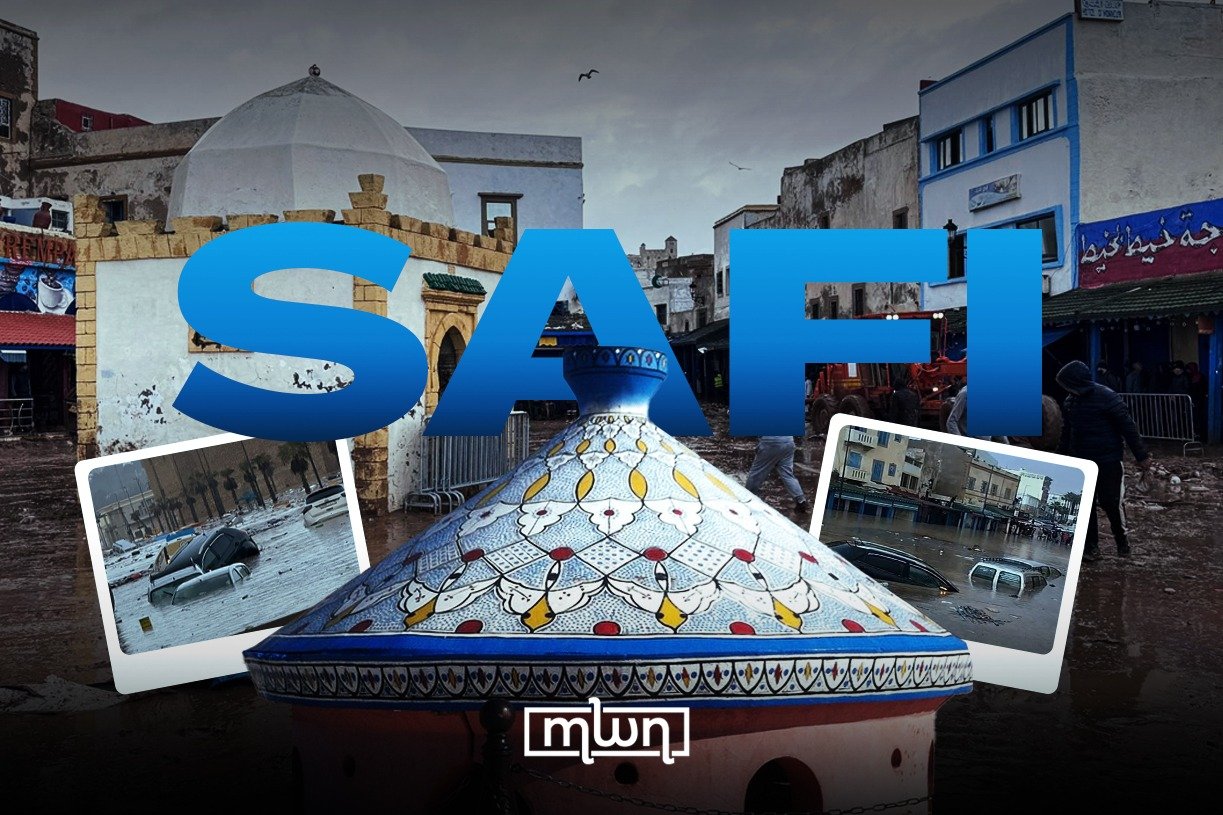
But the world finally took notice of Safi this past Sunday, though for the most tragic of reasons: flash floods killed 37 people in one of Morocco’s deadliest natural disasters in over two decades.
Yet few who mourned the victims understood what they were mourning – a city of 350,000 souls, where sardines fill the harbor, phosphate trains rumble through industrial zones, and artisans shape clay using techniques passed down for eight centuries.
Safi’s story is one of endurance shaped by catastrophe and neglect. Across its millennium-long history – from Portuguese conquest to the world wars – the city has weathered catastrophe and has repeatedly rebuilt itself around its twin identities: sardines and ceramics.
It is a story of immense national contribution and persistent marginalization, of a river that has haunted its streets since medieval times, and of a community rooted in its identity as the ever-present Atlantic – enduring, watchful, and unforgiving – yet continuing to rebuild despite receiving little recognition for what it has long given to Morocco.
When language becomes prophecy
Long before the December catastrophe, Safi lived under the shadow of water. The Oued Chaaba – a seasonal river descending from the eastern hills – has terrorized residents, its unpredictable floods carving ravines through the medina and leaving destruction in their wake.
For centuries, this river has inspired fear, carving ravines, unleashing sudden floods, and leaving destruction etched into Safi’s collective memory.
Indeed, many historians believe Safi (Āsfi) is anchored and rooted first and foremost in Amazigh (Berber) geography and memory, long before later Arabic reinterpretations.
According to historian Mohammed Ben Ahmed al-Abdi al-Kanouni, the city’s earliest recorded mention appears in Ptolemy’s Geography, where it is listed as “Taisfa” (Taisfe), a name he links to the Amazigh root “Asfu/Asfi,” meaning light or illumination – possibly a reference to coastal beacons erected to guide ships along the Atlantic shore.
The chronicler al-Kanouni documented catastrophic floods stretching back to 1647, when waters burst through Bab Chaâba gate after evening prayers, forcing residents to flee to higher ground as the surge swept through homes.
As al-Kanouni recorded, the waters came like waves of the ocean, submerging houses and possessions. The city walls facing the sea collapsed, shops were destroyed, and a massive ravine opened between the gate and the ocean – so deep it required a bridge for crossing, still visible years later.
In 1791, violent winds and torrential rains combined to produce another catastrophic flood during the night hours. The current was so powerful that it shattered the Bab Chaaba gate itself, swept away shop doors, and destroyed merchandise throughout the commercial district.
Al-Kanouni’s chronicles record more than 100 dead – men, women, and children – with material losses described as incalculable.
The 1855 inundation wiped out the workshops of potters, armorers, cobblers, and grocers; survivors navigated streets by boat as rainwater mixed with seawater. That flood became known locally as “Aïsout,” named after its single recorded victim.
Even in 1927, floodwaters invaded the Grand Mosque, the neighboring madrasa, and the Zaouia Naciria – al-Kanouni called it a terrible catastrophe and total desolation.
The city’s Amazigh etymology is reinforced in Islamic sources. Abu Ubayd al-Bakri, in Al-Masalik wa al-Mamalik, explicitly derives the name from the Amazigh word “Asif,” meaning a temporary or seasonal watercourse – a definition materially embodied by Oued Chaaba, the capricious river which still cuts through the city today.
Historian Ahmed Toufiq further elaborates on this reading, arguing that the term refers to a “river mouth” and noting that in the Mzabi dialect, “Asfi” refers to a water basin fed by a noria, again rooting the name in hydrology rather than legend.
Only later does 12th-century geographer al-Idrisi, in Nuzhat al-Mushtaq, introduce the Arabic moralized reading of “Asaf” (regret) through the tale of Andalusian sailors whose suffering elicited the lament “Wa-āsfi” (alas, my regret).
Both meanings proved grimly prophetic this December: “Asif,” the river that returned with destructive force to haunt it, and “asaf,” the regret of a wounded city once again mourning what the waters claimed.
Sudden deluge transforms historic market into deathtrap
The catastrophe struck with brutal speed. On Sunday evening, 37 millimeters of rain fell within approximately one hour over Safi’s historic Bab Chaaba district – a labyrinthine medina quarter bisected by a seasonal river. Water surged to four meters (13 feet) in some streets, trapping merchants who had locked themselves inside their shops as the tide rose.
Jewellery store owners have lost all their stock, and the same goes for clothing store owners. Reporters surveyed streets strewn with mud, debris, and shattered terracotta tagines – the cooking vessels that made Safi famous. The floods damaged at least 70 homes and businesses and swept away 10 vehicles.
The final death toll of 37 made this Morocco’s deadliest flash flood event since 2002. Thirty-two people were injured, with 14 hospitalized and two in intensive care at Mohammed V Hospital.
Head of Government Aziz Akhannouch addressed parliament on Monday, describing the floods as a matter of fate and pointing to the geographic vulnerability of the Bab Chaaba area, where a river crossing concentrates runoff. He did not explicitly acknowledge aging or inadequate drainage infrastructure.
This defeatist, accountability-shunning explanation of Safi’s tragedy has since fueled criticism, with many pointing to the government’s absence or silence in the crucial early hours of Sunday’s disastrous scenes.
Authorities have opened a judicial investigation to determine the causes, including whether inadequate systems amplified the tragedy, as Morocco’s seven consecutive years of severe, prolonged drought have hardened soils and reduced absorption capacity when intense storms finally arrive.
From Carthaginian trading post to Portuguese stronghold
Safi’s history stretches back at least to the 11th century, when Arab geographer al-Bakri first documented the settlement. Some historians trace origins even further, suggesting Carthaginian navigator Hanno may have founded a trading post here around the 5th century BC – though evidence remains debated.
What is certain is that by the 12th century, when the great geographer al-Idrisi mapped the region, Safi operated as a busy port serving Marrakesh, then capital of the powerful Almohad dynasty.
The city’s patron saint, Abu Mohammed Salih al-Majiri (1155-1234), established a ribat – a fortified Sufi lodge – around 1194, transforming Safi into a center of Islamic spirituality. His legacy endures in the city’s religious architecture and annual festivals.
In 1488, Safi fell into the hands of the Portuguese forces, establishing commercial footholds before launching formal military occupation in 1508 under Captain Diogo de Azambuja. The Portuguese constructed the fortifications that define Safi’s skyline today.
Between 1515 and 1517, they erected the remarkable Ksar el-Bahr (Sea Castle) – a square bastion of approximately 3,000 square meters perched on cliffs overlooking the Atlantic, featuring rounded towers, artillery platforms for a dozen cannons, and residential quarters for governors. The Portuguese coat of arms remains visible on its walls.
The Kechla fortress rose between 1508-1514, its outer walls bearing the coat of arms of King Manuel I. Nearby, the Portuguese began constructing a Manueline-style cathedral in 1519, though it was never completed.
When Portugal abandoned Safi to the rising Saadian dynasty in 1541, King Manuel ordered the cathedral’s destruction – only the choir and a vaulted chapel survive as haunting ruins today. The city subsequently passed through Saadian and Alaouite rule, serving variously as a trading hub, military outpost, and spiritual center.
Sardines, ceramics, and phosphates drive the economy
Safi anchors an industry built around the sardine – long regarded as the staple fish of working-class households, prized for its affordability, accessibility, and enduring place in Morocco’s food culture.
The city operates as Morocco’s principal sardine port, with its industrial zone producing 30% of the nation’s total sardine output. Morocco dominates the global canned sardine market, exporting over 150,000 tonnes annually – roughly half of all canned sardines consumed worldwide originate from Moroccan waters. Safi essentially helps feed the planet.
The Safi fishing industry dates to the 1930s, with the city emerging as a sardine leader by the 1950s. Today, 20 of Morocco’s 47 sardine canning facilities operate here, employing thousands in processing plants that can handle 300 tonnes daily.
The Port of Safi spans 54 hectares across three basins – fishing, commercial, and chemical – with berthing docks stretching nearly 2.3 kilometers. Annual cargo traffic exceeds 6 million tonnes, much of it phosphate products bound for international markets.
Yet pottery defines Safi’s cultural identity. The ceramic tradition dates back over 800 years to indigenous Amazigh craftspeople, though the craft transformed dramatically when Andalusian artisans fleeing the Reconquista introduced tin-glazing, vibrant colors, and intricate geometric patterns.
The Colline des Potiers (Potters’ Hill) rises above the medina, featuring over 140 workshops where approximately 2,000 registered artisans practice techniques passed down through nine or ten generations.
Master ceramist Boujemaa Lamali (1890-1971) established Africa’s first ceramics school in Safi in 1920, creating over 450 unique forms and earning the city its official designation as “Moroccan Capital of Ceramics” in 1919.
Today, Safi produces over 40% of Morocco’s ceramic exports – the distinctive cobalt blue glaze, inspired by Atlantic waters, has become synonymous with Moroccan decorative arts worldwide.
The third economic pillar arrived in 1965 when OCP Group (Office Chérifien des Phosphates) launched chemical production at Safi – the state-owned company’s first processing facility.
Morocco controls access to over 70% of global phosphate rock reserves, and OCP holds 31% market share in phosphate products. The Safi plant achieved record output in 2016: 1.5 million tonnes of phosphoric acid and 832,600 tonnes of triple superphosphate fertilizer. Phosphate exports represent nearly 25% of Morocco’s total export value and approximately 3.5% of GDP.
Landmarks tell the story of converging civilizations
The medina of Safi encapsulates centuries of layered history within its ancient ramparts. Three gates – Bab Jdid, Bab Agrour, and Bab Chaaba – pierce walls originally built by the Almohads and rebuilt by Portuguese engineers. The main thoroughfare, Rue du Souq, connects traditional markets selling pottery, textiles, and spices.
The National Museum of Ceramics, relocated in 2018 to a purpose-built 900-square-meter facility within the new City of Arts complex, houses seven galleries tracing pottery from prehistory through contemporary times. Exhibits include prehistoric artifacts, medieval Islamic ceramics, and masterworks by Boujemaa Lamali.
Dar al-Sultan (Castle of the Sultan) traces origins to the Almohad period (12th-13th centuries), later becoming a royal residence for Alaouite kings. The Portuguese Cathedral ruins stand opposite the Great Mosque, offering a striking architectural juxtaposition of Christian and Islamic heritage within steps of each other.
Notable figures from Safi include Muhammad al-Jazuli (d. 1465), founder of the influential Jazuliyya Sufi order and author of the prayer book “Dala’il al-Khayrat” – one of the most widely read Islamic devotional texts after the Quran. French actor Michel Galabru (1922-2016), star of over 250 films, was born in Safi during the protectorate era.
Industrial transformation reshapes the coastline
Safi is experiencing massive infrastructure investment. A new deep-water port completed in 2018 cost MAD 4 billion (approximately $470 million), featuring a two-kilometer breakwater and berths capable of handling vessels up to 120,000 deadweight tonnes.
The expansion primarily serves the Safi Power Station – a $2.6 billion, 1,386-megawatt ultra-supercritical coal plant that became Africa’s first to deploy this advanced technology when it came online in 2018.
And yet, residents complain that the wealth extracted from their soil flows elsewhere. The medina’s infrastructure crumbles while billion-dollar industrial facilities rise along the coast.
Young Safiots increasingly migrate to Casablanca or Marrakech seeking opportunities their hometown cannot provide, despite its industrial might. The city lacks a university, adequate healthcare facilities, and modern public transportation – basic amenities that cities of comparable economic output elsewhere in Morocco take for granted.
Environmental concerns compound the sense of injustice. OCP discharges approximately 40 million tonnes of phosphogypsum waste annually into the Atlantic, containing trace radioactive elements.
Local activists have protested deteriorating air quality near the power station, while fluoride contamination has affected regional drinking water – burdens borne largely by surrounding neighborhoods that endure the pollution yet see little benefit from the electricity generated.
In response, OCP is investing heavily in sustainability. The European Bank for Reconstruction and Development provided a €200 million loan for desalination facilities at Safi, part of OCP’s Green Investment Program targeting 100% unconventional water use by 2024, renewable energy by 2027, and carbon neutrality by 2040.
The contrast between industrial modernity and urban decay could not be starker – gleaming new port facilities visible from medina streets where century-old drainage channels still carry floodwaters.
A marginalized city that feeds a nation
The tragedy exposed an uncomfortable truth: despite its enormous economic contributions, Safi has long suffered from chronic underinvestment in basic infrastructure. The same drainage systems that failed in 1647 failed again in 2025 – nearly four centuries of documented flooding disasters, yet the ancient medina’s vulnerability remained unaddressed.
The December floods arrived just days after 22 people died when buildings collapsed in Fez, raising urgent questions about infrastructure in Morocco’s historic cities. King Mohammed VI directed heightened national alert levels while authorities launched relief operations reaching 73,000 households across 28 flood-affected provinces.
For Safi, the disaster compounded challenges facing a community that has long felt overlooked despite its contributions, while also deepening the crisis facing its artisan traditions – the pottery quarter suffered extensive damage, with countless terracotta pieces destroyed. It has been rebuilt after floods in 1647, 1791, 1855, 1927 – and now 2025.
It survived Portuguese conquest, World War II’s Operation Blackstone (when American forces captured the port in November 1942), and dramatic economic transformations from fishing village to industrial hub.
Today’s Safi balances preservation of its 800-year ceramic heritage against modernization pressures, its ancient medina standing meters from phosphate processing plants.
The December floods exposed vulnerabilities in that balance – but also revealed a community where shopkeepers and artisans immediately began salvaging what remained, determined to restore both their livelihoods and their city’s identity as Morocco’s irreplaceable capital of clay.
Despite mounting pressure, the government continues to dismiss calls to officially declare Safi a disaster zone, a step activists say is essential to unlock compensation for victims of the deadly floods.
As residents endure severe human and material losses, delays in administrative decisions are deepening social suffering, with time proving a decisive factor in alleviating an escalating humanitarian crisis.
Whether this tragedy finally brings the investment Safi deserves remains to be seen.
Read also: Safi Heartbreak: Don’t Blame the Rain
