


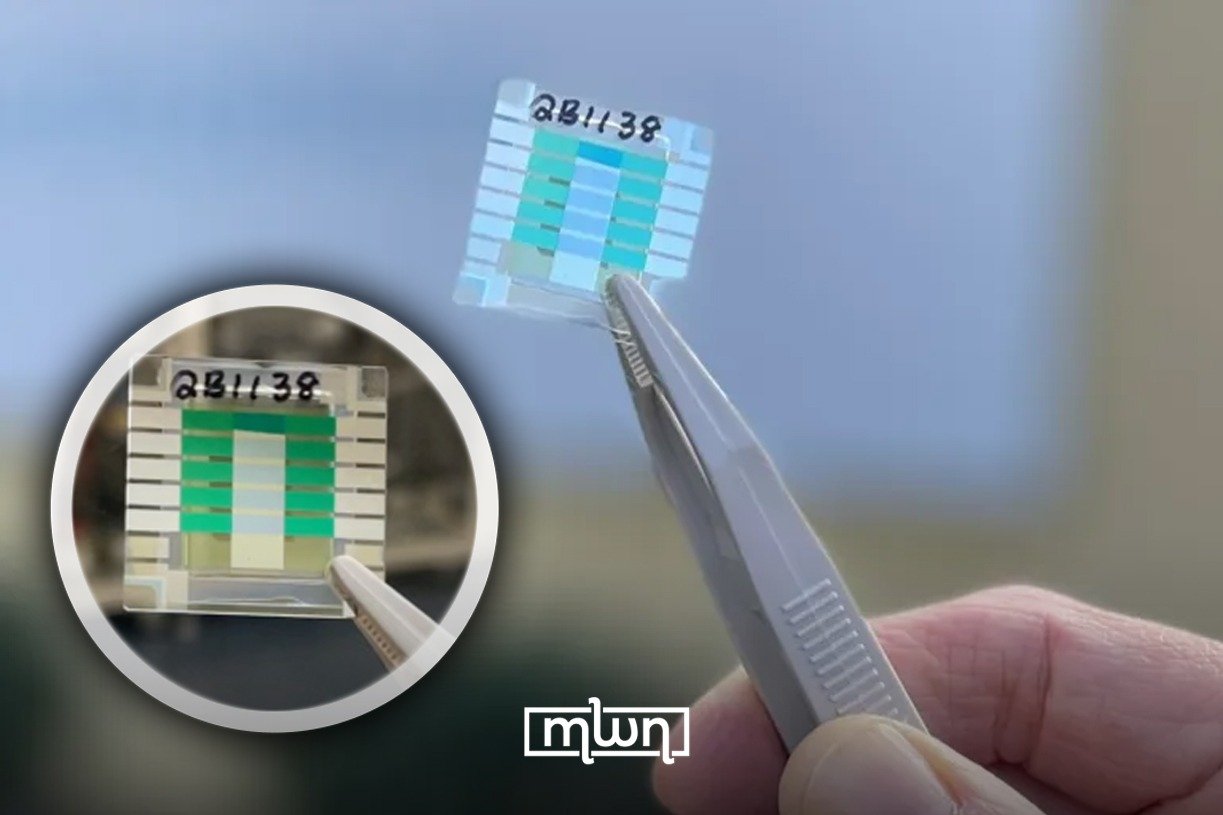
Fez– A team of Australian scientists has developed a small-scale quantum battery capable of charging, storing, and releasing energy without relying on traditional chemical reactions.
The prototype, led by Australia’s national science agency in collaboration with researchers from the Royal Melbourne Institute of Technology and the University of Melbourne, introduces a fundamentally different approach to energy storage.
Instead of chemistry, the device operates using principles of quantum physics, including quantum superposition and collective interactions between light and electrons.
At the core of the system is a compact, multi-layered organic device that can be charged wirelessly using a laser.
This design demonstrates the possibility of transmitting energy without physical connections, a departure from the wired infrastructure that underpins most existing technologies.
According to the study’s lead author, James Quach of the Commonwealth Scientific and Industrial Research Organisation (CSIRO), the system absorbs energy from light and stores it in electronic states within molecules that are strongly coupled to light inside a microscopic cavity.
This interaction gives rise to hybrid states known as polaritons, enabling the system to behave collectively rather than as independent particles.
This collective behavior significantly improves the efficiency of energy absorption and transfer.
In contrast to conventional batteries, where chemical processes govern charging and storage, the quantum battery relies on coherence and light-matter interactions to manage the entire cycle.
Laser pulses, used in experimental settings, serve as the charging mechanism.
Charging into the quantum era
While practical quantum batteries are not yet commercially available, the researchers describe this development as a turning point.
For the first time, a single device has demonstrated the complete energy cycle, charging, storage, and discharge, within a unified quantum system.
Scaling the technology remains the primary challenge. Current prototypes are extremely small, requiring the integration of multiple units to achieve practical storage capacity and longer energy retention. Addressing this limitation will be critical for real-world deployment.
In the near term, the most immediate applications are expected in powering quantum technologies and advanced microelectronics.
Over time, however, the scope could expand to larger systems, including electric vehicles, provided scalability hurdles are overcome.
The implications extend beyond performance gains. The ability to charge devices rapidly and wirelessly could enable continuous operation without the need for downtime.
More broadly, quantum batteries could contribute to more flexible and efficient energy systems, supporting the transition toward sustainable power infrastructures.
Although still in its early stages, the technology signals a shift in how energy may be stored and delivered, moving from chemistry-driven systems to ones defined by the principles of quantum physics.
