


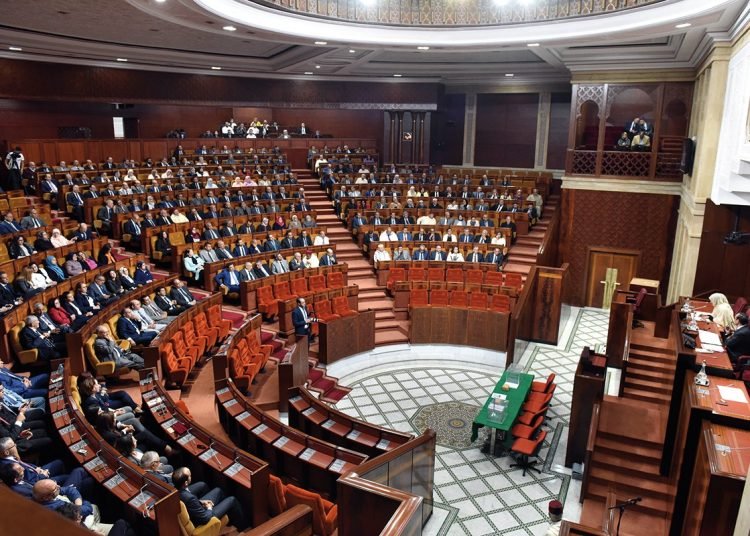
Rabat – Morocco’s House of Representatives on Tuesday approved draft law No. 56.24, which changes the legal status of the National Office of Hydrocarbons and Mines (ONHYM) and turns it into a joint-stock company.
The bill passed with 82 votes in favor and 36 against during a legislative session.
The vote confirms a structural shift for a key public actor in Morocco’s energy and mining sectors, at a time when the country faces mounting pressure from global market instability and rising energy security concerns.
A reform aimed at strategic readjustment
Presenting the bill, Minister of Energy Transition and Sustainable Development Leila Benali said the reform seeks to reposition ONHYM within both the national economy and the international energy landscape.
She described the transformation as a way to give the office greater capacity to respond to competition, improve performance, and secure broader financial resources.
According to Benali, the new status allows ONHYM to strengthen its role across the value chain of hydrocarbons and mining activities, while modern governance tools support clearer decision-making and accountability.
Gradual capital opening with state control
One of the core elements of the reform concerns capital structure. The minister said the law prioritizes asset development and resource valuation before any gradual opening of capital to private investors.
The state will remain the main shareholder, a point repeatedly raised during parliamentary discussions. This approach, she argued, aims to balance investment attraction with the preservation of public control over strategic resources.
Part of a broader public sector overhaul
Benali also placed the reform within a wider institutional context. The law follows the creation of the National Agency for the Strategic Management of State Participations (ANGSPE), which oversees public enterprises and monitors performance.
Under the new framework, ONHYM will move from public establishment status to that of a joint-stock company, with governance rules aligned with national legislation that regulates public shareholding.
New governance tools and operational scope
The draft law introduces several changes to how ONHYM operates. It allows a controlled opening of capital under existing laws, the creation of a geo-scientific information system, and the conduct of exploration activities based on mining authorizations.
The text also authorizes the creation of subsidiaries and equity participation in public or private companies. All assets, rights, and obligations of the former office will transfer to the new corporate structure.
Majority and opposition share conditional support
Lawmakers from the governing majority said the reform responds to international shifts that reshape energy markets. They pointed to growing interest in hydrocarbons and natural hydrogen, sectors that require a clear public framework to attract national and foreign investment, in line with Morocco’s Investment Charter.
Opposition groups viewed the transformation as a means rather than a goal. They stressed the need to protect strategic sovereignty, secure financial independence, and rely on qualified expertise. For them, the success of the reform will depend on execution rather than legal status alone.
The transformation of ONHYM into a joint-stock company places expectations on governance, transparency, and results. As Morocco seeks to strengthen its energy position amid uncertainty and transition, the reform now shifts from parliamentary approval to practical delivery.
Benali confronts sector challenges
What started as a standard debate on the transformation of ONHYM quickly revealed deeper tensions in Morocco’s energy sector. Minister Benali delivered a forceful address that exposed systemic problems, conflicts of interest, monopolistic control, and intertwined private and public interests that have long shaped decision-making in this strategic sector.
She described the reform not as a mere legal adjustment, but as a step to protect national sovereignty, stabilize energy prices, and ensure fair access to technology and investment.
Benali linked her remarks to the broader vision outlined by King Mohammed VI in 2020, calling for stronger governance, efficiency, and accountability in public institutions.
Her message carries political weight because it challenged entrenched networks that have profited from market concentration, emphasizing that Morocco´s energy and mineral resources belong to the state and the public interest.
The intervention left no doubt that the government intends to curb abuses, safeguard strategic projects, and anchor the country’s energy transition in principles of transparency and national interest.
