


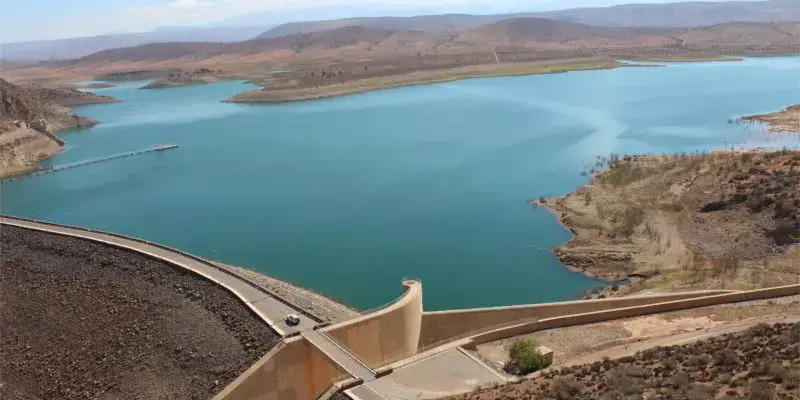
Rabat – Moroccan authorities have reassured the public that Oued Al Makhazine Dam shows no signs of structural stress, despite water levels that exceed its normal capacity.
Salah Eddine Dahbi, Director General of Water Engineering at the Ministry of Equipment and Water, confirmed today that technical inspections have detected no irregularities affecting the dam or its installations.
Speaking at the Ministry of Interior, Dahbi said that the reservoir surpassed its usual capacity on January 6. Water levels now stand four meters above the highest level recorded since the dam entered service in 1972. Despite this historic rise, monitoring systems have not identified any unusual behavior or technical malfunction.
Exceptional inflows in a short timeframe
The dam has received extraordinary volumes of water since the start of the current rainy season. Between September 1, 2025, and February 4, 2026, inflows reached nearly 973 million cubic meters. More strikingly, close to three-quarters of that volume entered the reservoir within the past two weeks alone.
This level far exceeds the annual average, with inflows higher by 184%. As a result, stored water reached 988 million cubic meters by early February, pushing the filling rate to nearly 147%.
Preventive releases to reduce pressure
Faced with this situation, the ministry launched preventive water releases to reduce pressure on the structure. The total volume discharged so far reached almost 373 million cubic meters. These measures aim to preserve the dam’s safety margin while preparing for additional inflows.
Dahbi said climate forecasts suggest continued rainfall in the coming days. In response, technical surveillance has intensified. Measurement cycles now take place twice a day instead of once per month, with specialized teams assigned to conduct precise field checks.
Advanced forecasts and flood risk mapping
According to hydrological simulations conducted by the ministry, the next seven days may bring major changes. These simulations rely on hourly data rather than daily averages, which allows for more accurate projections.
Expected inflows could reach around 620 million cubic meters. Peak inflow rates may climb to more than 3,160 cubic meters per second, while discharge flows could reach 1,377 cubic meters per second, about four times the current rate.
Authorities also prepared detailed flood maps that identify downstream areas at risk, along with expected water levels. These projections take into account both dam releases and uncontrolled flows from nearby wadis.
Officials say this work plays a key role in guiding emergency planning and protecting residents and property.
A broader shift after years of drought
Dahbi also pointed to a wider transformation in Morocco’s water situation. After seven consecutive years of severe drought, the current rainy season has brought a marked recovery. Since September 2025, accumulated rainfall reached 145.5 millimeters, exceeding the seasonal average by more than 32%.
This rainfall translated into nationwide inflows of 8.73 billion cubic meters. Dam filling rates now stand at nearly 62%, with total reserves close to 10.4 billion cubic meters. Morocco has not recorded such levels since 2019.
Controlled releases across multiple dams
The rapid pace of inflows also raised challenges. Around 95% of the total volume entered reservoirs in less than two months, starting mid-December 2025. This sudden accumulation pushed several dams to their maximum capacity.
To address this pressure, authorities carried out controlled releases to create reserve storage and protect infrastructure. Al Wahda Dam stands among the sites where such measures took place.
Continuous monitoring and coordination
Dahbi stressed that the Ministry of Equipment and Water, in coordination with river basin agencies, maintains round-the-clock oversight of dams and water facilities.
This work relies on experienced technical teams, specialized expertise, and hydrological simulations based on weather forecasts.
The objective remains to ensure the safety of hydraulic infrastructure while preserving its essential role in flood regulation and water management, in close coordination with local authorities and relevant stakeholders.
