


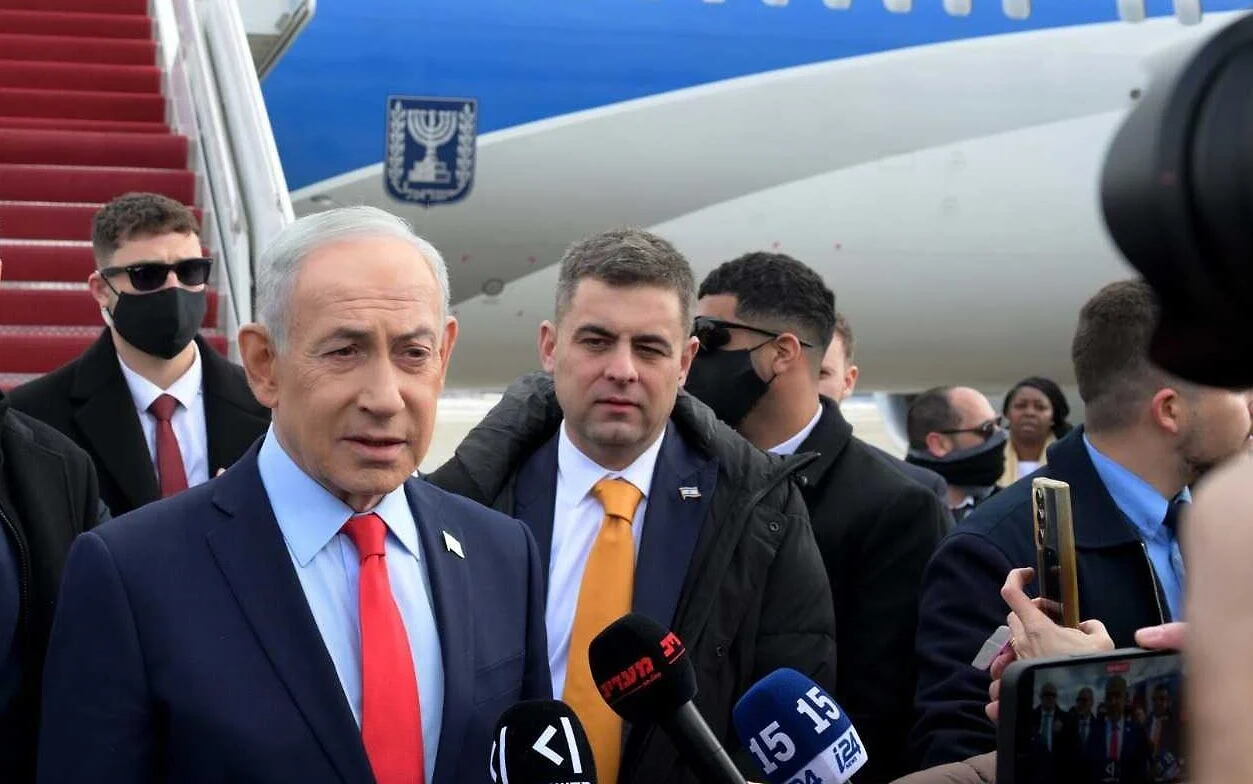
Marrakech – As if the war crimes in Gaza, the genocide against Palestinians, and the illegal settlements devouring the West Bank were not enough, Israel’s far-right establishment is now turning its venom inward. A senior aide to Prime Minister Benjamin Netanyahu has been caught making extreme racist remarks against Moroccan and Mizrahi lawmakers, exposing the hollow myth of Jewish unity that Israel has long marketed to the world.
Ziv Agmon, Netanyahu’s spokesman and acting chief of staff, allegedly called Likud MK Eli Revivo a “retarded Moroccan” and MK Nissim Vaturi a “baboon” in private conversations. He reportedly said it is unclear how such people get elected to the Knesset. Reports further suggest he called MK Eli Dallal a “nobody,” adding: “What baboons. It’s a shame we can’t just appoint the entire list and do away with the primaries.”
The remarks, broadcast by Channel 12, did not stop there. Agmon was also quoted as saying: “It’s not good that they opened Morocco to Israeli tourism. Now we know where our Moroccans came from – Africa. A baboon is a monkey.” He also reportedly said Israel should “publish a wanted ad for rapists and murderers for the Likud list for the Knesset, because there is already a thief, a burglar, and a kidnapper.”
He targeted the Sephardic ultra-Orthodox Shas party, saying it “only knows how to take money.” He described members of Benny Gantz’s Blue and White party as “monkeys.” He even went after Netanyahu’s wife Sara for owning “a Dior bag that is worth as much as a Rolex” and their son Yair for allegedly forcing former foreign minister Eli Cohen to issue him a diplomatic passport without justification. He also said that “the stupid female Knesset members understand that only flattery works with Sara. They fight over it all the time.”
Most striking were his post-October 7 remarks. Agmon reportedly declared Netanyahu “finished” and said: “The question is whether we’ll still have a state. He must go home.” He wondered who would negotiate for the hostages – “Karhi or Amsalem? The country is finished.”
He called on Egypt to release a recording of its conversation with Netanyahu, a reference to claims that Egypt warned the prime minister ahead of the attack. “And then he’s finished,” he reportedly said. Before the 2022 elections, Agmon also reportedly wrote that Netanyahu “fainted in the synagogue on Yom Kippur” and questioned why opposition leader Lapid was not exploiting the fact that Netanyahu is old.
Widespread indignation and calls for immediate dismissal
The fallout was immediate. Multiple Likud lawmakers demanded his dismissal. Revivo, who also chairs the Israel-Morocco Parliamentary Friendship Group, sent a formal letter to Netanyahu demanding Agmon’s immediate removal from all his positions. The majority of Likud voters throughout the years have been traditional Mizrahi Jews and that since the report aired he had received numerous responses reflecting “the depth of the shock among the public,” he wrote.
“Someone who speaks this way about Mizrahi Jews, about Moroccans, didn’t just have a slip of the tongue – he simply said out loud what he truly thinks in his heart,” Revivo stated. “Such a person is not fit to serve the public in any capacity for even one more minute.”
Vaturi called for Agmon to be “sent home right now.” Likud MK Tally Gotliv said Netanyahu “must fire Ziv Agmon” because “the people of Israel have no patience for racists, fools, gossips and traitors.” Freshman Likud lawmaker Dan Illouz called the rhetoric a “flashing red warning sign” and said “anyone who has forgotten what Likud is supposed to stand for cannot remain in their position for a single minute longer.”
Justice Minister Yariv Levin declared there is “no place for racism” in Israel or in the Likud movement. Coalition whip Ofir Katz said Agmon’s statements “do not represent” Netanyahu’s positions and that “anyone who dares to speak in this way has no place in the Likud.”
Opposition figures were equally blunt. Lapid noted that Netanyahu’s inner circle includes “a suspect who admitted to taking hundreds of thousands of dollars from a state that supports terrorism, a rape suspect, a racist of the lowest kind, and someone who secretly records everyone.”
Gantz called on Netanyahu to fire Agmon “tonight.” Yair Golan asserted that “Netanyahu surrounds himself with racists, criminals and vile people.” Avigdor Liberman echoed the demand for immediate dismissal.
‘Completely foreign to me’
Agmon denied the remarks in a statement issued hours later, calling them “a real injustice.” He claimed the words attributed to him regarding Mizrahi communities “are completely foreign to me – not least because a large part of my own family comes from Mizrahi and Moroccan backgrounds.” Hebrew media outlets reported Netanyahu was expected to fire him.
Agmon had replaced Tzachi Braverman as acting chief of staff only months earlier and had been appointed spokesman in July after his predecessor Omer Dostri was removed following a short tenure due to disagreements. The fact that one person held both key positions in the prime minister’s office during wartime reflected Netanyahu’s growing difficulty in recruiting new figures to his inner circle.
This was not Agmon’s first controversy either. The Israel Bar Association’s disciplinary court previously suspended him for violating the duty of loyalty to a client and for conduct unbecoming of a lawyer, after he transferred NIS 1.7 million from a client’s trust fund to a seller before receiving the necessary permits.
Hours later, Agmon reversed course. In a statement released through Netanyahu’s office, he acknowledged the quotes were real but claimed they were taken out of context. He said a person with whom he had a “long-standing friendly relationship” had passed on “partial quotes” from private conversations, most of which took place before he entered his role in the prime minister’s office. He called the allegations of racism against Moroccan Jews “ridiculous in light of the fact that my immediate family has Moroccan roots.”
But the damage was done. Agmon announced he was stepping down, saying that “a divisive public discourse had formed around me.” He apologized to anyone who was hurt by his statements, while insisting they did not represent him or his values. He thanked Netanyahu and praised Sara Netanyahu, “whose steadfast support strengthens the prime minister and the entire office.” The man who called Moroccan lawmakers baboons walked out with a bow to his boss. The racism he embodied, however, did not leave with him.
Israel’s congenital anti-Moroccan racism
But this episode is not an isolated incident. It is a symptom of a deep structural racism that has defined Israel since its founding. The Zionist project, as practiced by its Ashkenazi architects, never saw all Jews as the same. Some were always closer to the imagined ideal – European, secular, educated – while others have been historically frowned upon and cast aside as sub-humans, raw material to be re-molded in civilized, quasi-equal Jews. Moroccan Jews were brought to Israel not with promises of equality but as workers for the fields, construction sites, and the service economy. Their role in the broader Israeli fabric chillingly resembled the way wealthy Gulf states import South Asian laborers today: the elites maintain control while others perform the hard labor.
The migration was framed as rescue. But rescue into what? Into ma’abarot – transit camps that hardened into development towns. Into vocational tracks rather than elite academic streams. Into the periphery of Dimona, Yeruham, Kiryat Shmona, and Sderot, where Moroccan Jews did the heavy lifting of frontier life while the symbolic center set the terms of belonging.
They were placed in kibbutzim and moshavim to work the land, and when they rejected agricultural life and moved toward the cities, the establishment accused them of refusing to participate in “productive enterprises” and the Judaization of the land. The truth was more complex. It was an active strategy of survival in the face of separation and socialization policies the state imposed in the 1950s.
The immigration office in Marseille, which handled prospective North African immigrants, described them in 1950 as “abject human beings” who would need to be “kneaded” to shape them into Israeli citizens. Complaints circulated openly about the influx of “orientals,” “human refuse,” and “backward people.” The contempt was systemic and unapologetic.
The integration of Moroccan Jews into Israeli society was marked by severe cultural dislocation and systemic discrimination. Coming from traditional mellahs, they encountered a secular, European-oriented society dominated by Ashkenazi Jews who often viewed them as “dirty” and “illiterate.”
Despite their previous mercantile roles as merchants, artisans, and businessmen, they were relegated to menial jobs and faced housing discrimination. Some, disillusioned by their treatment, returned to Morocco in the early 1950s. Statistics show that of the approximately 40,000 Moroccans who emigrated to Israel from 1949 to 1954, about 6% – some 2,466 individuals – went back. They had abandoned stable bourgeois lives for a collectivist ideal that was experienced not as salvation but as social downgrading and dispossession.
The cultural erasure was deliberate and thorough. Israeli schools taught only Ashkenazi history as the nationalist narrative of Zionism, leaving no room for Sephardic traditions. Judeo-Arabic dialects like Darija, once the mother tongue of Morocco’s Jews, fell into disuse. Names were Hebraized, stripped of their Maghrebi cadence. The Ashkenazi establishment saw Moroccan Jews not as bearers of an ancient, sophisticated civilization of Amazigh, Andalusian, and Sephardic threads but as mere “Orientals” to be civilized or ignored.
What was once a rich cultural matrix was bleached and contorted by decades of cultural myopia. A Maghrebi legacy was forced into a Mashriqi mold, its uniqueness dismissed as part of some amorphous “Arab world” that in truth exists only in geopolitical fantasy. A Jew from Casablanca was treated as indistinguishable from one from Baghdad – both reduced to “Arab Jews,” their specific histories of no import.
From slurs to systemic exclusion
The derogatory nickname “Maroko sakin” – Moroccans with knives – became a stigma that stuck to Moroccan immigrants for decades. The stereotype cast them as quick-tempered, knife-wielding, and over-fertile. It did the work that all stereotypes do: explaining inequality as temperament rather than as policy. It is the same racist logic Israel applies to its Palestinian citizens today, framing them as inherently violent to justify discrimination rather than addressing the systemic conditions it imposes on them.
In the military, infantry brigades and border units were disproportionately filled by Mizrahi soldiers while cockpits and intelligence corridors stayed disproportionately closed for decades. Some Israelis learned to fly the state. Others learned to carry it on their backs.
The Wadi Salib uprising of 1959 erupted not out of thin air but out of a thousand daily slights and a hundred institutional choices. A decade later, in the early 1970s, young Moroccans in Musrara coined a name – Black Panthers – that refused to accept the idea that Jewish sameness erased Jewish difference. They were not merely a protest group. They were a mirror held up to Israeli society, exposing how the promise of Jewish unity had fractured into a hierarchy of Jews and “other” Jews.
The irony is that Likud itself was built on Moroccan and Mizrahi backs. The Mahapach of 1977, when Likud first came to power, was not merely a shift from left to right. It was periphery versus center, a demand by Moroccan and Mizrahi Jews to renegotiate a social contract that had excluded them under Mapai’s reign. Their demographic power made the revolution possible.
As Revivo himself noted in his letter to Netanyahu, the majority of Likud voters throughout the years have been traditional Mizrahi Jews. David Levy’s ascent within the party and the rise of Shas as a vehicle for Sephardi dignity were products of this mobilization. Yet decades later, a man sitting at the heart of the prime minister’s office calls those very voters baboons and retarded Moroccans. The people who made Likud are still being mocked by the people who run it.
These were not footnotes to national history. They were national history. Yet the hierarchy persists. Moroccan heritage is celebrated in events like Mimouna while periphery schools remain underfunded. Mizrahi music wins mainstream appeal while Mizrahi neighborhoods carry higher poverty rates. Representation has grown, but representation is not redistribution, and pride is not parity.
And the Moroccans were not alone. Ethiopian Jews endured forced sterilizations and segregated blood banks. Yemeni Jewish children disappeared in state hospitals under suspicious circumstances. Each story is different, but the common thread is the same: not all Jews were received as equals.
Agmon’s words were not a slip. They were the quiet part said out loud. Beyond its controversial existence and the atrocities it commits against Palestinians, Israel’s own internal fabric reveals a supremacist logic that considers anything non-European to be of lesser value. The grand narrative of Jewish unity that Israel promotes to the world is hollow. It always was.
A state built on the labor of those it despises, a state that calls its own citizens baboons and retarded based on their origin, has no moral authority to speak of democracy, unity, or civilization. Orchestrated by Ashkenazim, built by Moroccans – that is not a slogan meant to divide. It is a plain description of how Israel was made.
The Ashkenazi elite designed the state, ran its institutions, set its cultural terms, and occupied its corridors of power. Moroccan Jews poured its concrete, paved its roads, worked its fields, manned its construction sites, staffed its kitchens, and filled its infantry brigades. One group drew the blueprint. The other did the building. And when the builders asked for equality, they were told to be grateful they were let in at all. That is not unity. And Agmon’s words confirm it still stands.
