


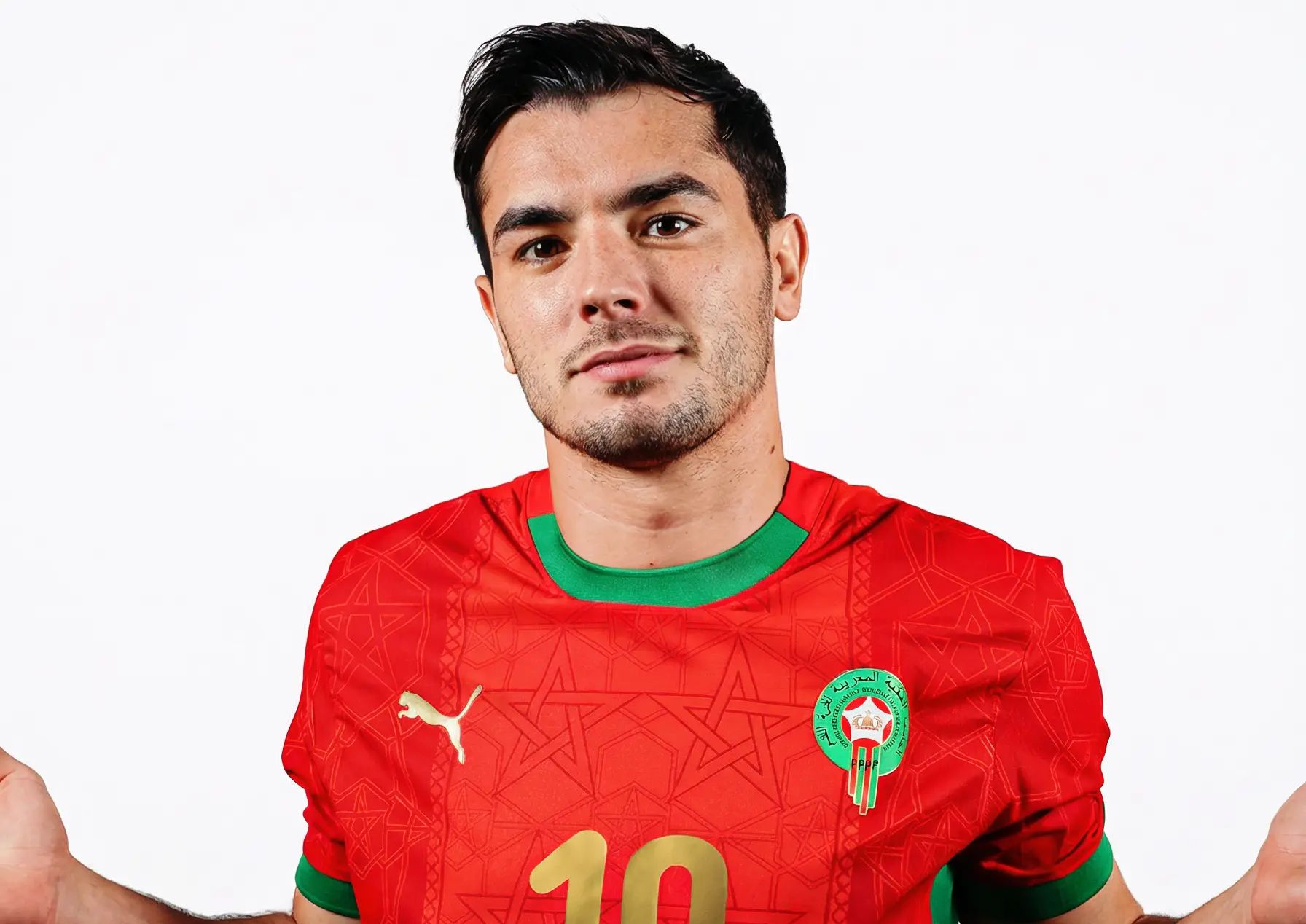
Have you ever watched a young player on the pitch and thought, “This kid is special”? That’s exactly what happened when Brahim Díaz first appeared for Morocco’s national team. Growing up in Tangier, I’ve witnessed firsthand how football unites this country like nothing else. When Brahim chose to represent the Atlas Lions, it felt like Morocco had discovered its own Messi—a player who could inspire an entire generation.
The story of Brahim Díaz and Morocco is more than just football statistics. It’s about a young man with Moroccan roots who climbed from the humble neighborhoods of Málaga to the pinnacle of world football at Real Madrid. His journey reflects the dreams of countless Moroccan kids kicking balls in dusty streets, hoping one day to wear the red and green jersey.
Let me take you through the remarkable path of Ibrahim Abdelkader Díaz—a name that now echoes through Moroccan cafés and living rooms whenever the national team plays.
From Málaga’s Streets to Football Stardom
The Early Years in Spain
Brahim Díaz was born on August 3, 1999, in Málaga, Spain, to parents who had barely turned 18. His father, Sufyan Abdelkader, carried Moroccan heritage from the Farkhana region, while his mother, Patricia Díaz, brought Spanish roots to the family. The name “Díaz” ranks as the 14th most common surname in Spain, meaning “son of Diego.”
Growing up in the Dos Hermanas neighborhood of Seville province, young Brahim was always with a ball. His grandmother watched him grow day by day, and according to family members, football wasn’t just a hobby—it was his constant companion. When he turned six, his father Sufyan enrolled him in a local club to learn proper discipline and technique.
The Málaga Foundation
After just one year at his first club, Brahim moved to Nairo, spending another year before joining Málaga CF—the team that would shape his early development. Within months, everyone at Málaga agreed on one thing: help this kid grow and give him top-level training so he could eventually join a bigger club.
Here’s where the story gets fascinating. Málaga had a legend in their ranks—Abdallah Entaki, nicknamed “Abdallah Málaga” by the late King Hassan II himself. This Moroccan football icon had transitioned into Málaga’s technical staff after his playing career. Back in Morocco during the 1980s, Abdallah was instrumental in the famous “1000 Players” initiative—a royal program that scoured neighborhoods to discover hidden talents.
When Abdallah spotted young Brahim climbing through the youth ranks at Málaga, he saw something special. The boy was imitating his idol, Lionel Messi, and showing skills beyond his years.
The Barcelona That Almost Happened
In 2011, Barcelona came knocking. The family traveled to Catalonia for the transfer, but Málaga’s Qatari owner blocked the deal. He promised Brahim’s parents that Málaga’s football project would be built around their son and that he’d play for the first team at just 16 years old.
The deal fell through, but it put Brahim Díaz on the radar of Europe’s biggest clubs. A bidding war erupted for the Moroccan talent.
Manchester City: The English Chapter
A Life-Changing Move
After reviewing multiple offers, Málaga’s management accepted Manchester City’s proposal: €3 million for a 14-year-old. This wasn’t unusual—similar to when Hachim Mastour moved from Morocco to Milan at the same age. However, while Mastour struggled with early fame, Brahim developed quietly.
The Spanish media occasionally shared clips of him with headlines like “The New Messi” or “Messi 2.0.” But Brahim’s training took a serious turn when he arrived at Manchester City’s academy in 2013. The club had invested billions since Abu Dhabi United Group’s takeover five years earlier, building infrastructure to compete at the highest level.
Under Pellegrini’s Guidance
Manager Manuel Pellegrini—who had previously coached at Málaga and knew Brahim well—understood the youngster’s value. Brahim progressed through City’s youth ranks, usually playing as a striker in friendly tournaments, though he was more comfortable as a playmaker or winger.
In February 2016, Pep Guardiola took charge of City’s technical leadership. Just ten days later, Brahim received his first call-up to Spain’s U-17 national team, wearing a national jersey for the first time. He competed in the European Youth Championship, reaching the final before losing to Portugal on penalties.
Breaking Into the First Team
The spotlight at Manchester City focused on three young talents: Phil Foden, Jadon Sancho, and Brahim Díaz. Guardiola began integrating them into friendly matches to familiarize them with the atmosphere.
Brahim played his first match on September 21, 2016, in the EFL Cup, signing his first professional contract with City days later. He balanced training with the reserve team while receiving call-ups for Spain’s U-19 and U-21 squads.
In 2018, Guardiola gave Brahim more trust, starting him in an FA Cup match against Oxford United, then against Fulham. Before the Fulham game, everyone in the tunnel encouraged him—they knew his technical quality and that stardom was just a matter of time.
He didn’t disappoint. Brahim scored two goals and was undoubtedly the match’s star player.
Real Madrid Comes Calling
Those two goals attracted Real Madrid’s attention. This wasn’t surprising—Jadon Sancho had left City the previous year for Borussia Dortmund. City wanted to extend Brahim’s contract for five more years, but his desire to play regularly stopped everything.
Just three days after signing with Los Blancos, Brahim entered as a substitute in his first match—a Copa del Rey fixture. He played several more games, remaining consistent and providing two assists across roughly 400 minutes in about 11 matches during that first season.
The AC Milan Breakthrough
Finding His Stage
After another season where Brahim didn’t get the playing time he needed at Madrid, he had to consider his options. He settled on AC Milan as a one-year loan without a purchase option.
That option would activate without hesitation after Brahim’s brilliant first season in Serie A. Milan renewed the loan with a purchase clause. During those two seasons, everything aligned for Brahim to show his ideal version—especially after receiving the number 10 jersey and playing most matches as a playmaker.
His Maradona-like skills and goals quickly made him one of the standout players alongside Rafael Leão and Theo Hernández. Success came rapidly: he earned his first call-up to Spain’s senior national team for a friendly against Lithuania.
This was the call-up he’d been waiting for impatiently—a dream come true. He shared his emotions on Instagram and played his first match, scoring a goal.
It would be his first and last match for La Roja.
Choosing Morocco: A Heartfelt Decision
Why Morocco Made Sense
Some might find it strange, but I see it as completely natural for any young person who built their football memory in childhood and based their dreams and ambitions on it.
Players who grew up in the 1990s and witnessed Morocco’s golden era in 1998 would easily choose the national team over any other. They surely dreamed of being like Bassir or Hadji during their childhood. The same goes for the 1980s generation.
During Brahim Díaz’s childhood, he watched Spain’s national team in their legendary period with the golden generation—winning everything with players like Xavi and Iniesta who would never come again. As a child playing football in Málaga, he dreamed of filling David Silva or Iniesta’s shoes—the players who led Spain to celebrate the 2010 World Cup and the Euros in 2008 and 2012.
Meanwhile, Morocco was experiencing continuous failures and setbacks. Those of us who were Moroccans living here didn’t even want to watch the national team.
Everything changed 360 degrees after the recent major achievements. The spotlight shone on the 2022 World Cup when we saw Achraf Hakimi—who started similarly, playing against everyone in youth categories—choose Morocco over Spain. This didn’t diminish his career at all. On the contrary, he achieved success, and his marketing value keeps rising as he becomes the captain and inspiration for generations whose football memory includes Brahim Díaz.
Back to Real Madrid Glory
The Triumphant Return
Brahim returned to Real Madrid from loan after winning the Scudetto with Milan. So far this season, he’s played 33 matches for Los Blancos, scored several goals, and provided numerous assists.
Just four days before I’m writing this, he had his first appearance in the beloved national jersey. He delivered a massive performance—everywhere on the pitch, he just wanted to grab the ball and dribble. He finished the match leaving Moroccans thinking about future titles because everyone agreed: we’ve brought a new Messi to the national team.
What This Means for Moroccan Football
Watching Brahim Díaz in Morocco’s colors represents more than adding a talented player. It’s about visibility, inspiration, and proof that Moroccan heritage produces world-class talent. For young players across Morocco—from Casablanca’s streets to Tangier’s neighborhoods—Brahim shows that the path from here to Real Madrid is possible.
The 2022 World Cup already shifted how Moroccan kids view their national team. Now, with players like Brahim choosing Morocco despite having other options, that pride multiplies. We’re no longer the team people avoided watching; we’re a team that attracts Real Madrid stars.
A New Era Begins
The journey of Brahim Díaz from Málaga to Morocco’s national team reminds me why I love football in this country. It’s never just about the game—it’s about identity, dreams, and belonging.
Every time Brahim touches the ball wearing Morocco’s red and green, he’s writing a new chapter in our football story. He’s proving that talent knows no borders, and that sometimes the best path home takes you around the world first.
Have you watched Brahim play for Morocco yet? What did you think of his performance? Drop your thoughts in the comments below—I’d love to hear what fellow football fans think about our new “Messi”!
