


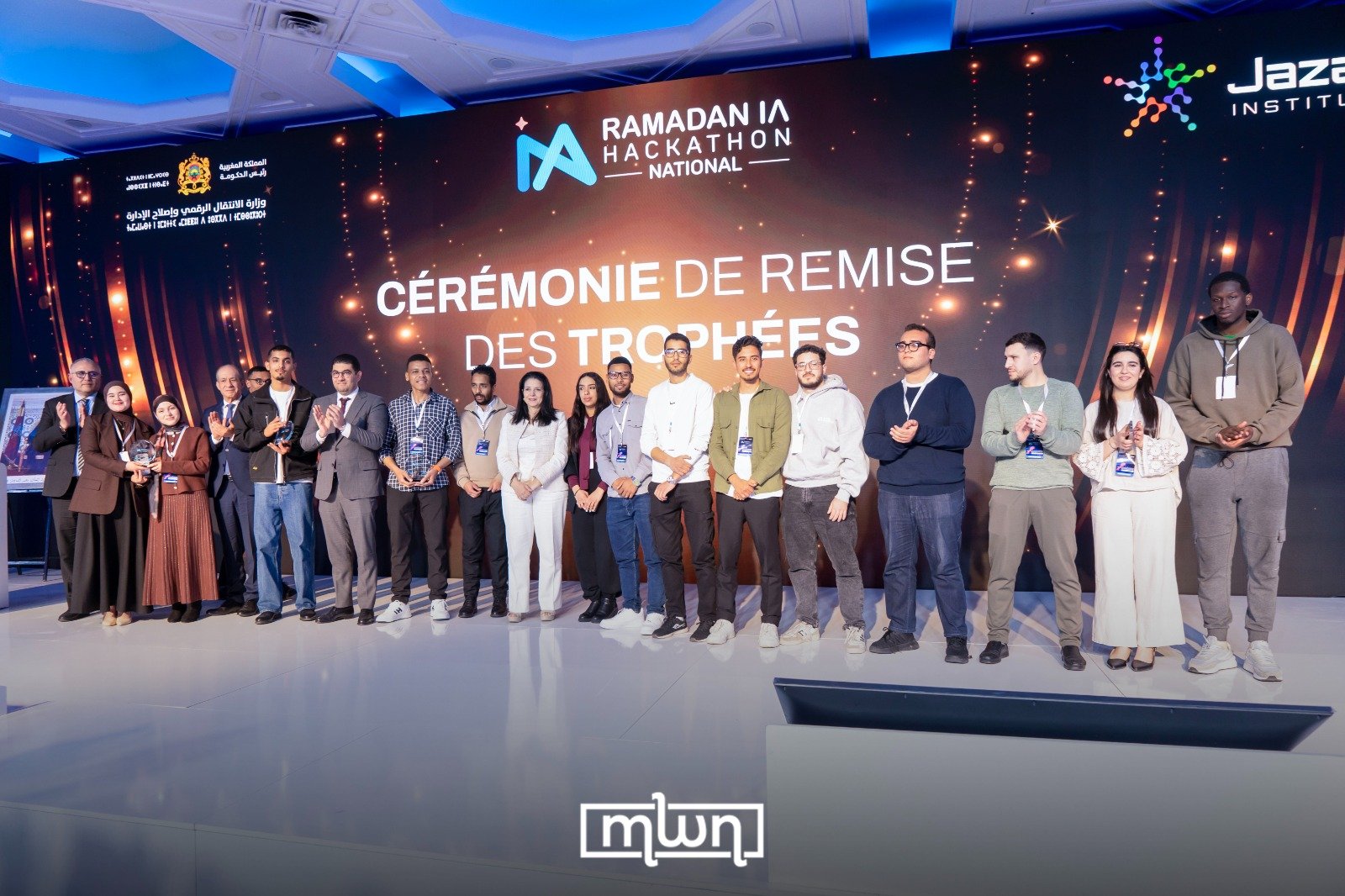
Fez — Morocco closed out the national finale of the “RamadanIA” hackathon in Rabat on Monday, capping a Ramadan-long competition designed to mobilize Moroccan talent in artificial intelligence across the country.
The initiative was organized by the Ministry of Digital Transition and Administrative Reform and unfolded through regional stages before the final award ceremony. Minister of Youth, Culture, and Communication Mohamed Mehdi Bensaid also attended this event.

Speaking at the finale, Amal El Fallah Seghrouchni, Morocco’s Minister Delegate in charge of Digital Transition and Administrative Reform, put the emphasis on youth ambition and practical innovation rather than ceremony alone.
“Today is the last day for the celebration of the end of the Hackathon RamadanIA,” Seghrouchni told Morocco World News (MWN). “We ended by 40 winning projects from all the 12 regions of the country.”
She said the final stage narrowed that pool further, with a smaller group receiving prizes and a wider set moving into the next phase of support. “Today we selected three of them to get prizes, awards and 10 projects will be incubated,” she said, later clarifying that four projects received awards.
She added that participants pitched in front of incubators, allowing the event to move beyond competition and toward longer-term project development.
Youth innovation across Morocco
Seghrouchni said one of the clearest takeaways from “RamadanIA” was the spread of innovation across Morocco’s geography.

“Depending on where we are, I mean in the south, north, east, west, all our young people have very good ideas and they are willing to innovate and to find solutions for real problems,” she said.
Her remarks echoed the ministry’s earlier messaging during the regional phases of the hackathon, which described the program as a national effort to develop AI solutions with regional impact and to turn ideas into scalable prototypes through specialized support.
Seghrouchni struck an optimistic tone about Morocco’s broader digital trajectory, linking the hackathon to the country’s future rather than treating it as a one-off event. “Morocco is proud to have this young population with such ambition,” she said, adding that the country is “very optimistic on the way digital transition will take place in Morocco.”
One of the participants highlighted during the event was Jamal El Hirach, a community leader and social entrepreneur from Tarfaya, whose team won first place in the Sahara region. El Hirach told MWN that his project, “Green Sahara,” combines technology and sustainability to help specialized companies manage and process organic waste more efficiently.
He described the hackathon as an inclusive experience that gave every region visibility while also creating exchange between young people from across Morocco.
El Hirach said the experience helped participants build skills and strengthen their projects, with hopes of developing them further for international competition.
