


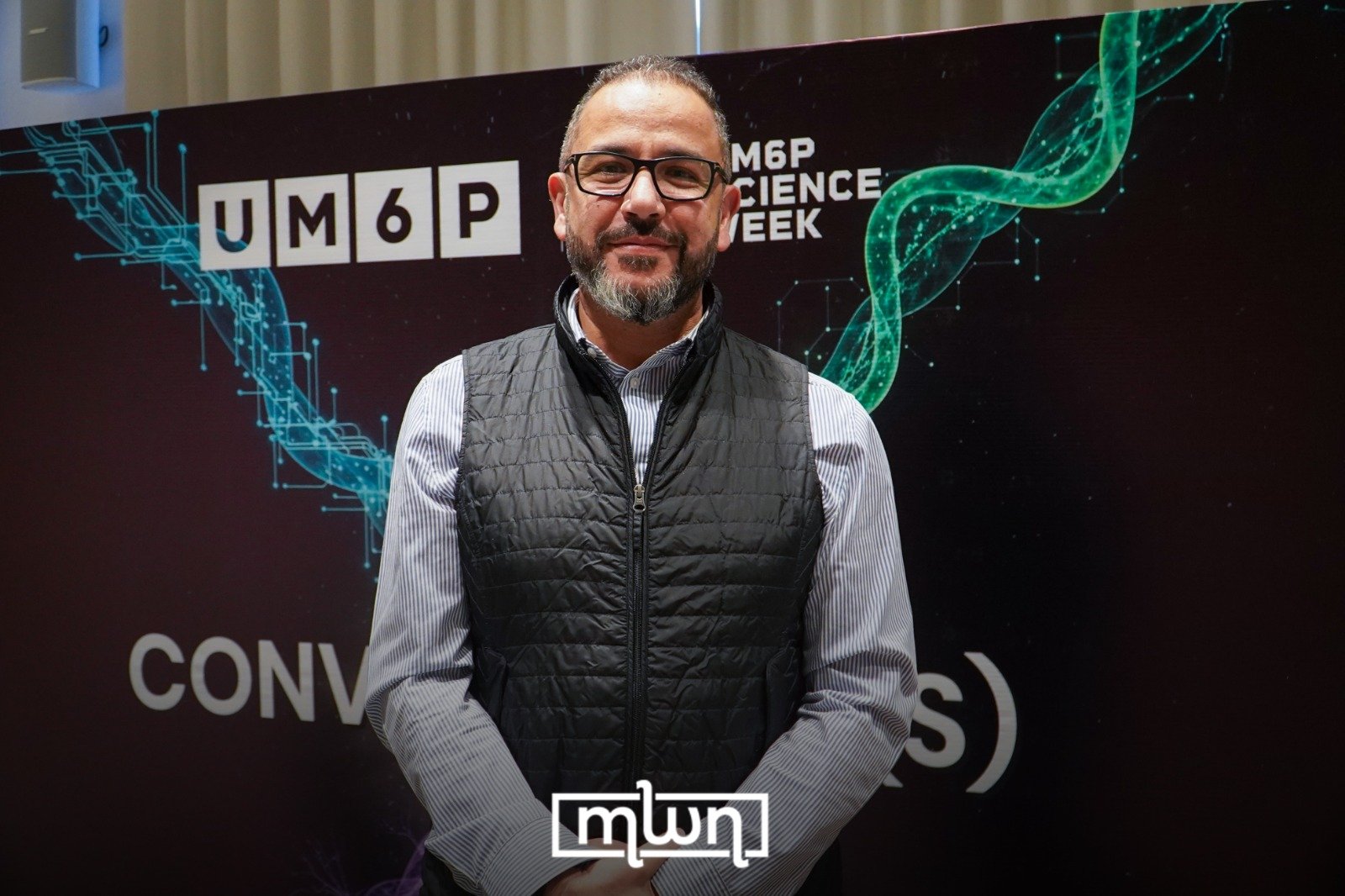
Benguerir – Morocco’s push toward renewable energy is on the right track but will not eliminate the country’s dependence on fossil fuels, according to a senior researcher at Mohammed VI Polytechnic University (UM6P).
Speaking to Morocco World News (MWN) at UM6P’s 6th Science Week, Youssef Belmabkhout, Director of the Applied Chemistry and Engineering Research Centre of Excellence (ACER CoE), backed the kingdom’s renewable energy ambitions but rejected the idea of a full transition away from hydrocarbons.
“I really believe in the energy mix. I don’t believe that one day we’ll be 100% renewable,” Belmabkhout told MWN. “Until 2100, we’ll be using fossil fuels.”
View this post on Instagram
The comments come as UM6P hosts the sixth edition of Science Week in Benguerir through April 5, bringing together more than 100 international scientists and experts under the theme “Convergence(s).” The event explores how scientific disciplines are increasingly merging at their boundaries, with sessions pairing departments across fields ranging from nanomaterials and medicine to artificial intelligence and agriculture.
Belmabkhout, a process engineer by training with a chemical engineering degree from Russia’s Gubkin Oil and Gas University and a PhD from Belgium’s Polytechnic Faculty of Mons, previously held a position as a senior research scientist at Saudi Arabia’s King Abdullah University of Science and Technology (KAUST) before joining UM6P.
During his career, he received the European Marie Curie fellowship and was honored with the 2018 Young African Researchers Award by the Egyptian Academy of Scientific Research and Technology.
The work feeds directly into Moroccan industry
Belmabkhout’s research record places him among the most cited scholars in his field. His work, cited over 25,000 times on Google Scholar, spans carbon capture, hydrogen storage, power-to-X technologies, and sustainable process engineering. He has published extensively on the design and development of metal-organic frameworks (MOFs) – a class of nanoporous crystalline materials engineered to selectively trap CO2 from industrial gas streams.
A 2013 study he co-authored in Nature demonstrated that controlling pore size and chemistry in these materials could achieve highly selective CO2 capture, a paper that has since gathered over 1,800 citations.
His more recent work at UM6P has extended into direct air capture, membrane-based desalination, methane hydrate storage in MOF pores, and electrochemical processes that integrate green hydrogen production with CO2 capture.
At ACER CoE, his team develops advanced materials for gas storage, gas and liquid separation, catalysis, sensing, and waste transformation, with applications that cut across the energy, industrial, and water sectors.
Belmabkhout described these materials as the “heart” of industrial processes, which his team then packages into proof-of-concept prototypes at the lab scale before working toward deployment.
But the road from a laboratory discovery to a functioning industrial technology is long and costly, he warned. “It’s a process that can take from 10 to 20 years of maturation,” Belmabkhout told MWN, adding that rushing through development stages risks both economic loss and reputational damage.
He outlined a gate-based evaluation process at ACER CoE that begins with early-stage technical and economic assessments, including estimates of capital and operational expenditure. The center then identifies risk parameters through process simulation and builds pilot plants to optimize the variables that remain uncertain.
“We can have in a committee, for example, a decision that this technology is worth to explore more and worth to invest in,” he noted. “Investment means that we need to probably make some prototypes at a small scale, show that it’s working, and engage our stakeholders to invest more.”
The center’s work spans several tracks, including photovoltaics, optoelectronics, decarbonization, energy storage and batteries, water engineering, and lightweight materials for Morocco’s automobile industry.
‘Morocco is going in the right direction’
Belmabkhout’s skepticism about a full energy transition sits against the backdrop of Morocco’s ambitious renewable energy targets. The kingdom announced during COP21 in 2015 its plan to source 52% of its electricity capacity from renewables by 2030, divided between 20% solar, 20% wind, and 12% hydropower. The country has since raised its long-term ambition to 70% renewable electricity by 2050.
Yet the gap between targets and current reality remains wide. As of 2024, coal still accounted for 59.3% of Morocco’s electricity generation, down from 70% in 2022, while wind and solar combined supplied nearly 25%, up from 9% in 2015. The country imports approximately 90% of its energy needs.
Morocco has also conditionally committed to phasing out coal power by 2040 under its third Nationally Determined Contribution (NDC 3.0), and signed a landmark convention in November 2025 to accelerate the provision of 5 gigawatts of green electricity to Moroccan industry by 2030.
Belmabkhout acknowledged Morocco’s solar and wind potential, including the possibility of producing green hydrogen through water splitting. “Morocco is going in the right direction in introducing more and more renewables,” he told MWN. “But this will be just one proportion of the energy mix.”
