


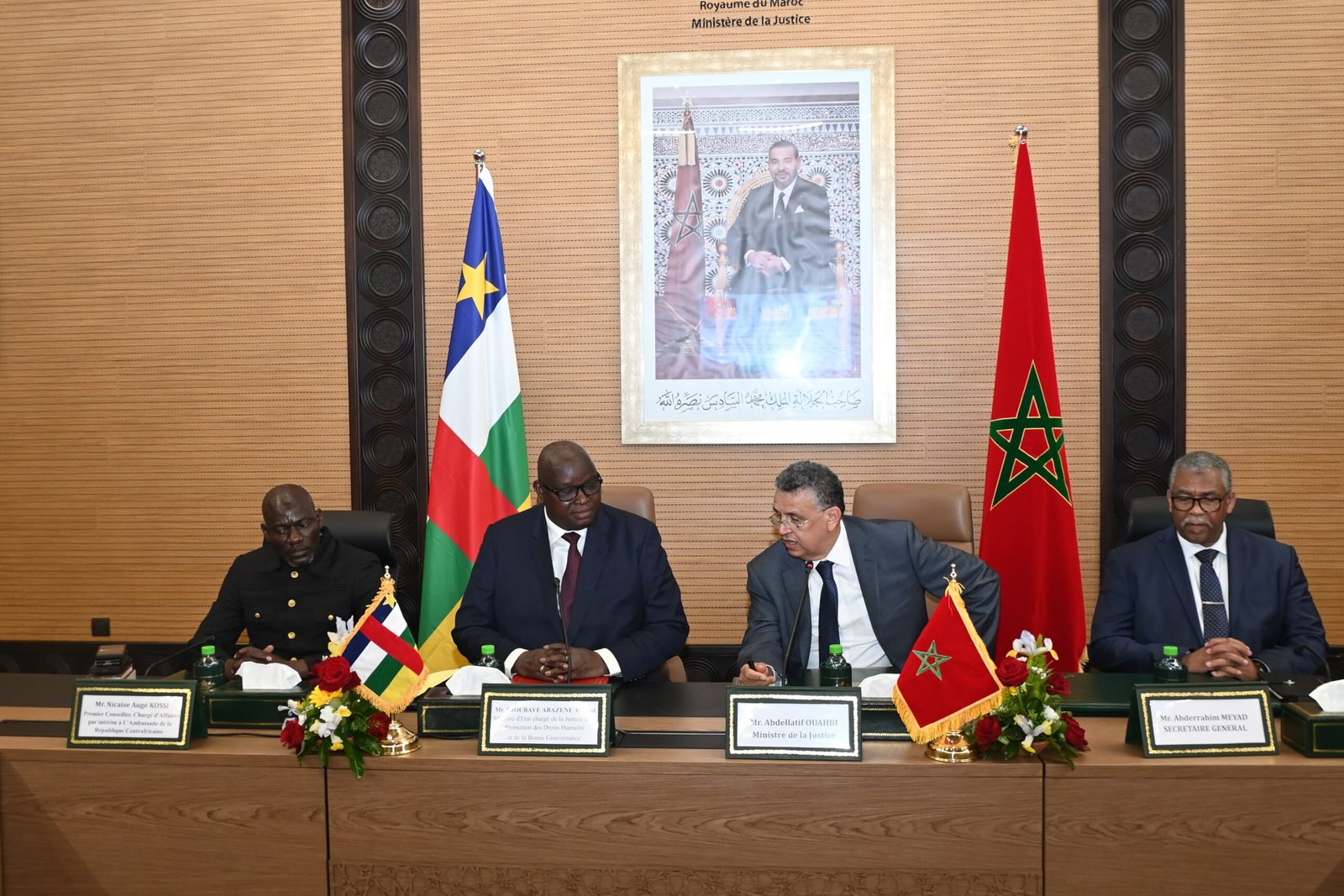
Morocco’s Minister of Justice Abdellatif Ouahbi and his Central African Republic counterpart Djoubaye Abazène Arnaud signed a memorandum of understanding on judicial administration cooperation at the Ministry of Justice headquarters in Rabat on Wednesday.
Ouahbi said the agreement reflects the depth of African relations between the two countries and a shared commitment to building a partnership grounded in solidarity and integration.
He identified the modernization of judicial administration and the digitalization of justice as priority areas under the new framework. He also called for stronger coordination between the two countries in tackling shared challenges, particularly organized crime.
The Central African minister hailed the historical ties between his country and Morocco. According to the ministry’s statement, he praised what he described as Morocco’s African leadership, particularly in promoting the development agenda within the African Union and strengthening investment and connectivity across the continent.
He also pointed to Morocco’s role in migration governance, describing it as a humanist approach focused on protecting migrants and combating human trafficking. The statement labeled the partnership as a model of effective African cooperation.
The memorandum establishes an institutional framework for exchanging expertise, developing judicial working mechanisms, strengthening human resource capacities, and improving governance of judicial services in line with international standards.
Cooperation areas include initial and continuing training for magistrates, administrative officials, and legal professionals. The agreement also covers the exchange of experience in the administrative and financial management of courts, as well as the development of alternative dispute resolution methods, particularly mediation and arbitration.
Both sides agreed to focus on improving access to justice for vulnerable populations, particularly women and children. The deal also provides for sharing expertise in judicial logistics, implementing Hague Convention provisions, and organizing study visits and academic exchanges.
A coordination and monitoring body will be established to oversee the implementation of cooperation programs.
