


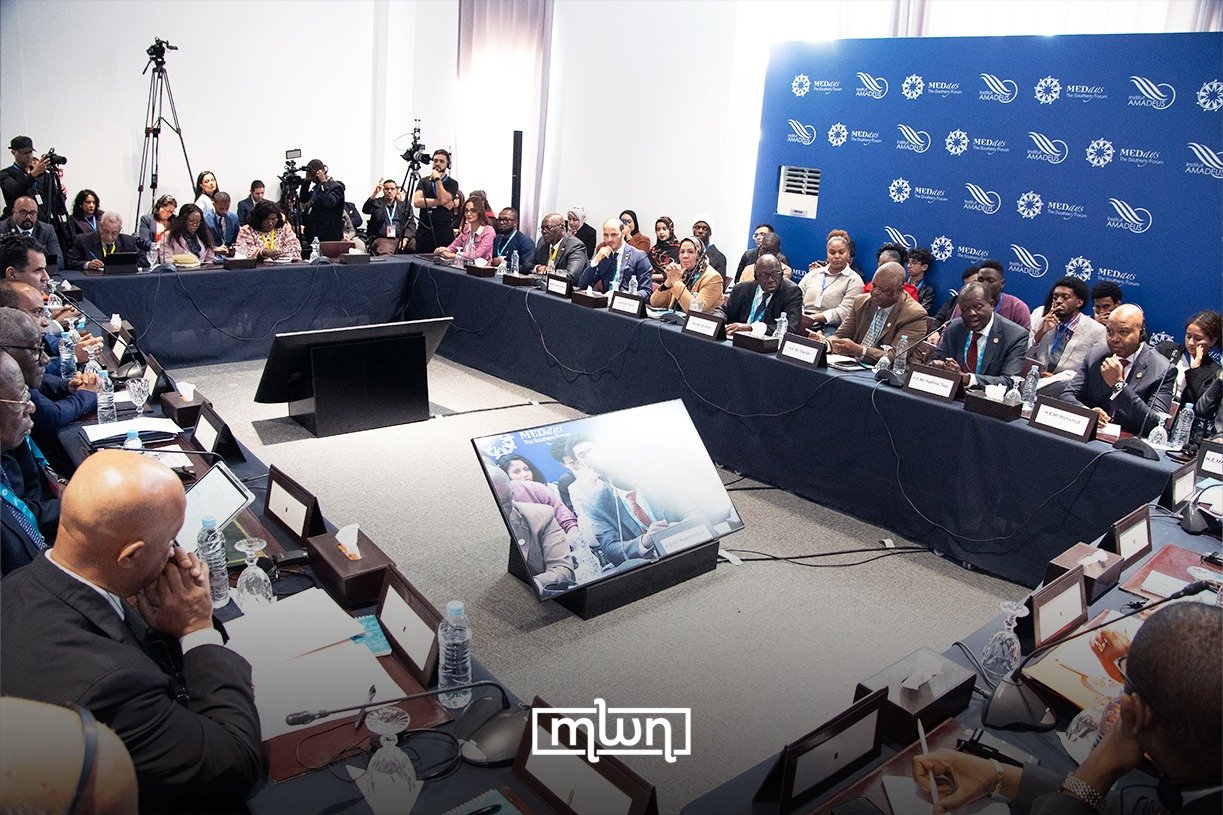
Tangier – At today’s sessions of the ongoing MEDays Forum in Tangier, African diplomats, former ministers, and policy experts met to discuss how Morocco’s diplomacy is shaping African sovereignty and the continent’s role in a changing world.
The roundtable included participants from Morocco, Kenya, Guinea, Somalia, Madagascar, Liberia, Cabo Verde, Gabon, Sierra Leone, Swaziland, the Central African Republic, and others. It was one of the largest African diplomatic gatherings in Medays this year.
The main focus was UN Security Council Resolution 2797, just adopted this past October 31, and its implications for Morocco’s sovereignty over the Sahara and Africa’s political order.
Speakers stressed Morocco’s steady presence in Africa. They noted that Moroccan diplomacy, guided by King Mohammed VI, has built wide partnerships in banking, telecommunications, agriculture, fertilizers, energy, and cultural cooperation.
The Morocco-Nigeria Gas Pipeline and the numerous OCP Africa-facilitated fertilizer plants across West Africa were cited as examples of Morocco-led projects that are deepening intra-African solidarity and strengthening African economic sovereignty.
Panelists also pointed to Morocco’s role as a stabilizing force on the continent. Former Central African Republic Prime Minister Martin Ziguele described Moroccan diplomacy as “a combination of consistency and resilience,” adding that “no country can build development without security.”
He called on Morocco to keep supporting peace efforts in unstable regions, saying the kingdom’s credibility allows it to promote African-led solutions to crises across the continent.
How Morocco’s AU strategy shifted the Balance of power on the Western Sahara dispute
Intervening in one of the roundtable about Morocco’s growing continental assertiveness and widely hailed pan-African leadership, Samir Bennis, former UN adviser and co-founder of Morocco World News, gave a detailed historical analysis of how the Western Sahara issue has factored into Morocco’s forward-looking and strategically patient diplomacy over the years.
He reminded participants that the 1979 OAU Summit in Nairobi issued a communiqué that “described the Polisario as the legitimate representative of the Sahrawis” and urged the UN General Assembly to support that view.
These resolutions were “not legal judgments, but reflections of the power dynamics in Africa at the time,” he noted, explaining that this was a time when Morocco was absent from the OAU and when Algeria used its influence to “push more African countries to stand against Morocco.”
Bennis explained that the situation changed in 2017, when Morocco rejoined the African Union.
“The moment Morocco put its feet back in the AU, the whole dynamic changed,” he said, noting that this seemingly sudden paradigm shift was in fact the culmination of decades of patient preparation.
King Mohammed VI visited over 45 African countries and signed more than a thousand cooperation agreements between 2015 and 2016, laying the groundwork for stronger bilateral alliances and a more positive attitude towards Morocco’s efforts to reclaim its southern provinces.
For Samir, it is this shift that gradually paved the way for UN Security Council Resolution 2797. “The resolution is a reflection of the new balance of power in Africa and globally,” he said, adding that it “enshrines Morocco’s sovereignty over the Sahara for the first time.”
In an interview with Morocco World News after the session, Bennis reiterated that Morocco’s return to the AU turned the very continent that once prolonged the dispute into “a leading actor in helping Morocco settle the legal debate once and for all.”
This success was the result of years of resilient, painstaking diplomacy, he argued, stressing, “There is no going back. Morocco spent years building this momentum, and it is now irreversible.”
Morocco as a model for African unity
Former Somali Foreign Minister Mohamed Abdirizak Mohamud used the roundtable to reflect on Morocco’s diplomatic approach to continental solidarity and pan-African unity.
He said the kingdom’s ability to pursue sovereignty without escalation offers lessons for other countries facing separatist pressures.
“The idea that confidence and openness can coexist is inspiring. Morocco’s story shows that unity is not only a sentiment, it is a strategy,” Mohamud said.
He added that Resolution 2797 sends a clear message to the continent: “Sovereignty grounded in patience and confidence is not imposed; it is earned.”
In later comments to MWN, the veteran Somali diplomat welcomed his country’s vote in favor of Resolution 2797, calling it “an opportunity for course correction” for the African Union after decades marked by internal contradictions.
Morocco chose diplomacy over conflict
Echoing these sentiments, former Kenyan Foreign Minister Raphael Tuju reflected on the 1982 Nairobi summit, recalling the “pandemonium” inside the OAU when the Western Sahara fabricated dispute was at its peak.
He noted the contradiction within the AU: refusing recognition to Somaliland yet adopting a different approach for the Sahara.
Tuju said: “Morocco could have faced the same fate as many countries in our region had it chosen war. Instead, it relied on diplomacy.”
He praised Morocco’s approach as proof that even long, sensitive disputes can be managed without destabilizing the state.
Several speakers from West, Central, and East Africa argued that the African Union should adjust its position on the Sahara question to reflect the new legal and political reality shaped by Resolution 2797.
Some warned that holding on to outdated positions could weaken the African Union’s credibility as a functional and reliable continental institution.
Others stressed that the “artificial Sahara dispute” should now be seen through the principles of territorial integrity and continental stability.
Morocco’s diplomacy defines a new path for African sovereignty
By the end of the day’s roundtable, a clear message came from voices across West, Central, and East Africa: the African Union will have to adjust its position to the new legal and political realities of the UN-led Western Sahara process. Several participants said that holding on to positions from the late 1970s and 1980s risks weakening Africa’s credibility when it comes to crisis resolution.
Others stressed that the Sahara dispute must now be seen through the lenses of territorial integrity, regional stability, and African-led solutions rather than Cold War alignments.
Morocco’s return to the AU, its economic partnerships across Africa, its religious and cultural outreach, and the latest UN resolution together form a new reality that many African leaders now recognize.
For them, Morocco’s experience is a template for how African states can defend sovereignty, build alliances, and reshape international debates through long-term engagement instead of confrontation.
