


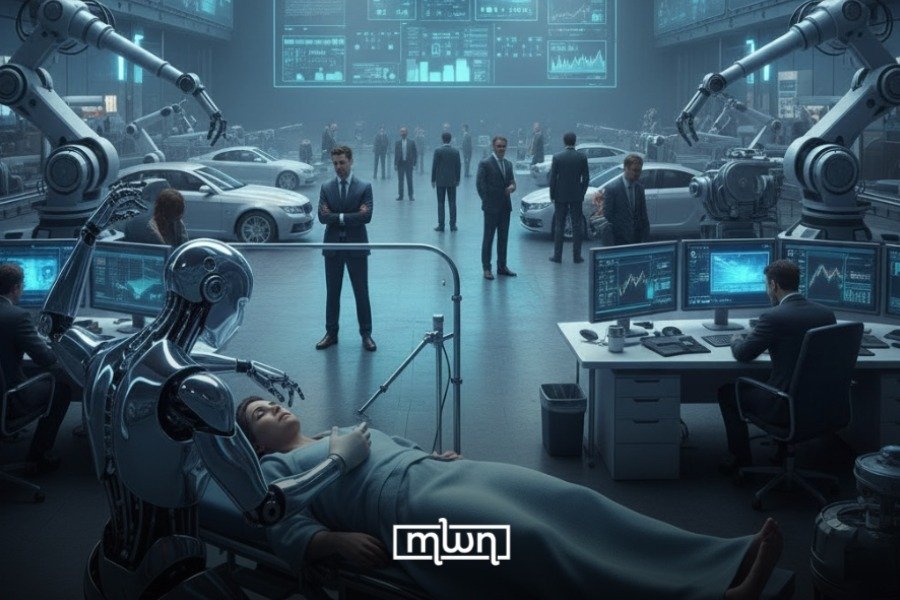
Rabat – McKinsey & Company plans to cut roughly 10% of its workforce in non-client-facing roles over the next two years as artificial intelligence tools are increasingly used to automate tasks once done by people, a move that could affect several thousand support staff and underscores broader labor shifts in large corporations.
In the past year, some of the world’s biggest firms have accelerated their embrace of AI and automation, resulting in significant reductions in human staff.
McKinsey’s contemplated cuts come at a time when the consulting giant has seen its workforce shrink from a peak of about 45,000 to roughly 40,000 amid efforts to reallocate resources toward AI-driven work and client-facing consulting.
Accenture, another major professional services firm, restructured its operations in 2025 by consolidating services into a new unit focused on AI and digital transformation.
As part of that shift, the company laid off at least 11,000 employees whose roles could not be re-skilled for the AI-centered business model, a change executives said would help position the company for future growth in AI consulting services.
Salesforce reduced about 4,000 customer service jobs in 2025 after deploying AI-powered support agents that now handle nearly half of customer interactions.
The layoffs were directly tied to the company’s adoption of automated systems, according to reporting on executive statements about the workforce changes.
Amazon, one of the world’s largest employers, recently announced cuts to around 14,000 corporate jobs amid broader restructuring that company leaders linked to increased investment in automation and AI systems.
These reductions are part of cost savings and efficiency efforts as AI tools are increasingly used to streamline internal processes.
Industry data show that in 2025, tech companies collectively eliminated tens of thousands of positions, with automation and AI adoption cited among the driving factors in workforce realignments.
Layoff trackers and business reporting indicate that firms such as Microsoft, Intel, and Google also cut roles as they shifted focus to AI development and automated systems, affecting employees in support and operational positions.
Impact on people’s lives and employment
The human impact of these industry changes is significant. Support staff, administrative workers, and customer service employees are among those most affected, as companies deploy AI systems to perform repetitive or data-intensive tasks.
Workers who once answered phones, processed information, or managed routine operational duties now find their roles shrinking or disappearing as software and machine learning tools take on those functions.
Human resources departments in affected firms have often offered severance packages, career re-training programs, and internal job placement assistance, but many laid-off workers face uncertainty about future employment in a market where AI competency is increasingly required.
Former employees have reported the emotional and financial challenges of sudden job loss, including difficulties in securing new positions, adapting to rapidly changing skill demands, and competing with automated systems that have reduced the demand for certain types of labor.
Economists say that while AI may create new opportunities in higher-skilled roles, the transition period can be disruptive for workers whose jobs are eliminated before new, comparable opportunities become widely available.
Training and reskilling initiatives supported by both private and public sectors are emerging as common responses, though access and effectiveness vary widely across regions and industries.
As AI tools continue to evolve and expand into more tasks previously done by humans, the trend of workforce reshaping is expected to persist.
Companies that once relied heavily on large human teams are now restructuring around digital systems and automation, a shift that is forcing many workers to adapt quickly or face prolonged periods of job hunting in a transforming global labor market.
The shift toward AI and automation has had real consequences for employees who are laid off or see their roles fundamentally changed.
Workers who lose jobs tied to repetitive, process-driven tasks must now navigate a job market where demand is growing for digital skills, creativity, and complex problem-solving.
Retraining programs and job transition support aim to ease this shift, but many affected individuals remain concerned about their long-term career prospects and financial stability as automation reshapes major industries.
Read also: Deloitte AI Reviews Expose a Widening Flaw in Automated Expertise
