


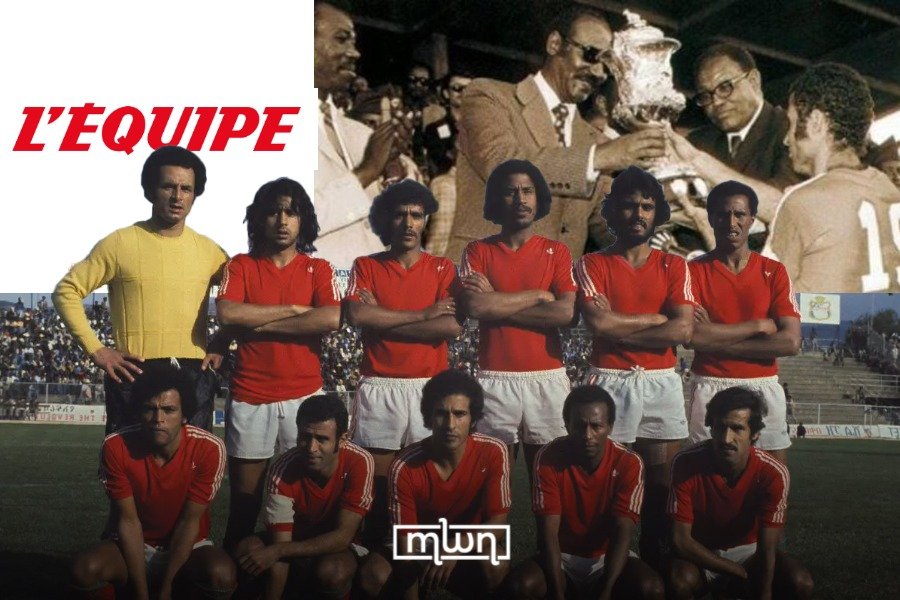
Rabat – After CAF decided to award Morocco the 2025 AFCON title under Articles 82 and 84, the reaction was immediate across the continent. Debate was expected. What followed, however, went further than football.
A new claim started to circulate again, that Morocco also left the pitch during the decisive 1976 AFCON match against Guinea and still ended up champions.
The idea spread quickly online and was picked up by several platforms. At one point, even L’Equipe shared that claim, suggesting Morocco walked off in protest before returning to draw and win the title. The reference was later removed.
That version does not match the strongest evidence available.
An eyewitness account that contradicts the narrative
The clearest response comes from Ismael Sylla, a former Guinea international who played in that match.
In an interview with TV5MONDE, he dismissed the claim directly. According to him, Morocco did not leave the pitch, and the match continued normally until a late Moroccan equalizer.
This is not just another online debate. The claim is being used to create a narrative, one that suggests Morocco benefited from the same type of situation decades ago and is now asking CAF to punish Senegal for it.
But if that comparison is going to stand, it needs facts behind it. So far, it does not.
Sylla’s words carry weight. Sylla was on the pitch when Morocco won its first AFCON. And as a key player of the 1976 Guinea team, he would have surely been one of the most vociferous critics of Morocco’s imaginary walk-off had it actually taken place.
Now that he, an eye-witness who would have loved his country to have won against the Atlas Lions, has slammed the false rumor making the rounds on social media, what will be the next “historical” proof of the new Morocco-bashing AFCON “specialists”?
Read also: Guinea’s Ismael Sylla: Morocco Did Not Walk Off in 1976 AFCON Final
The 1976 AFCON in Ethiopia did not end with a single final match. CAF used a final group format involving Morocco, Guinea, Nigeria and Egypt.
Before the last game, Morocco were leading the standings and only needed a draw to secure the title. Guinea needed a win.
The match finished 1-1. That result kept Morocco on top and gave them their first AFCON crown.
Yes, it was a tense game. Yes, there were disagreements with refereeing decisions, and there may have been moments of frustration on the pitch. But that is part of football. It is not the same as leaving the field in a way that changes the outcome of the match.
That distinction is key. A brief protest or confrontation is one thing. A full walk-off is another. The current evidence supports the first scenario, not the second.
A rumor built on repetition, not evidence
The current media frenzy started with a comment made on television that was picked up and repeated. It then moved across platforms, gaining credibility simply because it was being cited again and again. At one stage, L’Equipe included it, which gave the story even more weight.
But once challenged, the reference was removed, without a clear correction or apology.
Le journal français L’Équipe a finalement supprimé la fausse information relayée par des réseaux sénégalais, sans toutefois présenter d’excuses au football marocain.
Ce manque de professionnalisme récurrent démontre une nouvelle fois que ce média privilégie le sensationnalisme à… https://t.co/jtKlTVwawi pic.twitter.com/Apt2gu70Av— Hatim el mourabit 🇲🇦 (@HatimelMourabit) March 21, 2026
That raises a fair question. When a major outlet publishes a historical claim that turns out to be weak or unsupported, is deleting it enough?
For Moroccan observers, the concern is not just about one article. It is about a pattern. When Morocco is involved, claims seem to move faster than verification. And once a narrative is out, it becomes difficult to contain.
That is why testimonies like Sylla’s are important. They bring the discussion back to something simple, which is what actually happened.
At the end of the day, Morocco’s 1976 title was won on the pitch, within the format of that tournament. It was not an administrative decision, and it was not the result of a team walking away and coming back.
The attempt to turn that moment into a mirror of today’s controversy does not hold.
If such comparisons are going to be made, they need to be based on facts, not on recycled claims that fall apart under basic scrutiny.
