


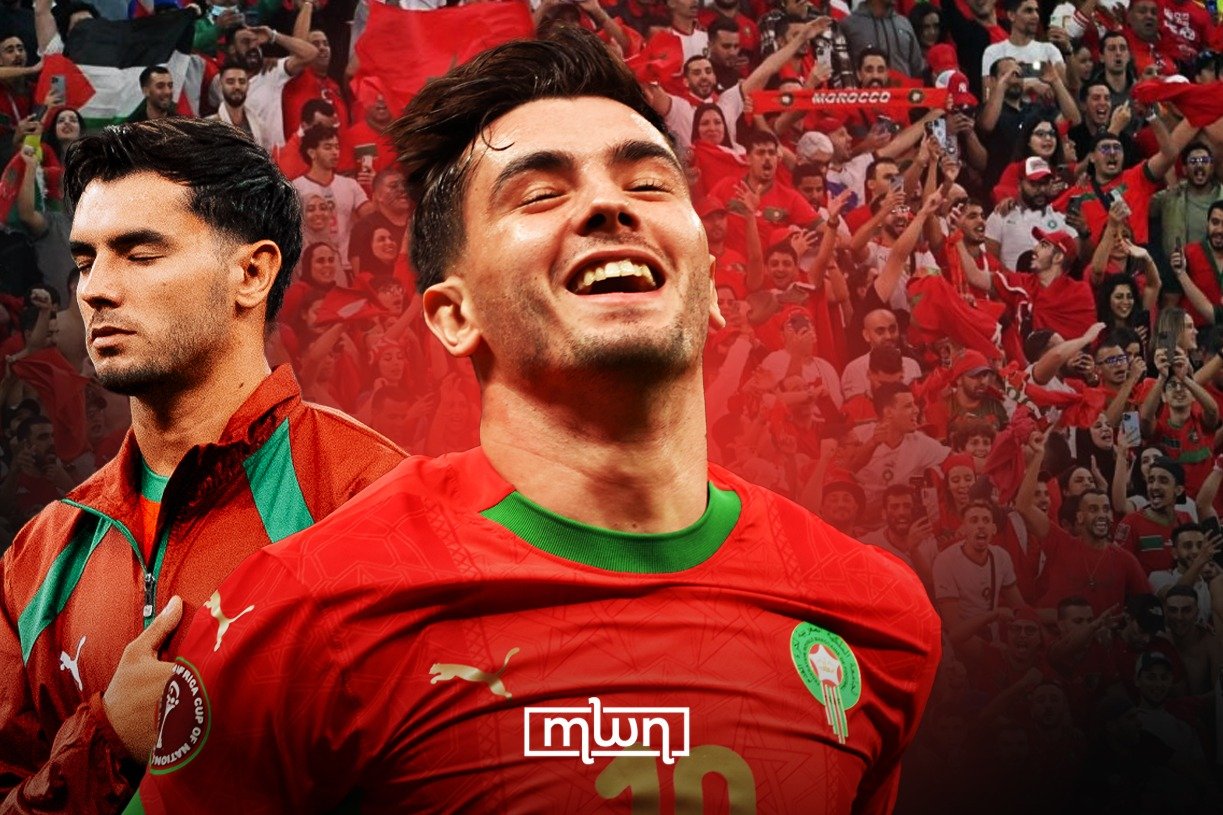
Rabat – The image everyone now remembers is Brahim Diaz walking away from the penalty spot, a nation’s breath still caught in its throat, the weight of a final suddenly turned into blame. In Morocco, penalties can either cement legends or shatter reputations. And after AFCON 2025 ended in heartbreak, Diaz became the easiest target: one kick, one moment, one narrative.
But that story is not the whole truth. Football rarely tells it fairly. The real picture of Brahim Diaz at AFCON is different: he was Morocco’s standout player, the Golden Boot winner, and the driving force behind the Atlas Lions reaching their first AFCON final since 2004.
He actually played well in the tournament
Brahim Diaz didn’t just score goals; he carried Morocco through the tournament. His goals came when they mattered most. He opened the scoring in the 2-0 win over Comoros, added another in the 1-1 draw with Mali, and then scored against Zambia to secure the top spot in the group stage.
He carried that decisiveness into the knockouts, scoring against Tanzania in the Round of 16 and again versus Cameroon in the quarterfinal. That’s what a standout player looks like: goals in the group stage, then goals when elimination or qualification is on the line.
Consistency like that is rare, especially under the pressure of hosting an event. Diaz made history as the first player to score in his first five consecutive AFCON matches, a streak widely reported as unprecedented. He wasn’t just good for Morocco; he set a record in the competition itself.
He earned two Man of the Match awards, and Flashscore noted he had eight shots on target, more than any other Moroccan player. That mix of output and constant danger is what defines a true tournament star.
The bigger picture matters too. Morocco reached their first AFCON final since 2004, ending a 22‑year wait.
Diaz’s scoring run was the driving force behind that achievement. You don’t reach a final after two decades without someone delivering consistently, and he did, from the opening match through the knockout rounds.
Even more remarkable is that this was his very first AFCON tournament. Diaz had only played in Europe, where the style of football is very different, and he had never experienced African competition until the age of 24.
If that isn’t an elite tournament impact, then what is?
The penalty miss that became a verdict
The painful moment came in the final. Senegal beat Morocco 1-0 after extra time, with Pape Gueye scoring the winner. The match was filled with controversy, including a shameful walk‑off, protests, and refereeing debates, but all the pressure and drama ultimately fell on the shoulders of Brahim Diaz as he stepped up to take the now infamous penalty.
From there, the criticism followed a familiar pattern, one missed penalty treated like a total failure that erased all the remarkable things Brahim Díaz had done throughout the tournament.
But while social media rushed to blame, the reaction from experts, coaches, and football leaders was far more thoughtful.
One of the most notable voices was Luis Enrique, a two‑time Champions League winner, current coach of Paris Saint‑Germain, and former Barcelona manager who guided stars like Messi, Neymar, and Iniesta.
“Everyone is talking about Díaz, but it reminds me of Zidane, who is considered a legend in football and who did the same thing in a World Cup final, just as Sergio Ramos did as well,” the PSG coach said in defense of Diaz.
Enrique added in another statement: “I understand that accepting what happened is difficult. But Brahim is neither a criminal nor a bad person. He is a young player going through a difficult moment.”
He also spoke about the risk of trying a panenka-style penalty: “When you score a panenka, everyone applauds you. But if you miss it, negative comments come raining down on you.”
These words matter. They come from someone who has coached the best in the game, and they remind us that football is full of highs and lows. One moment doesn’t define a player.
The numbers behind the pressure: penalties aren’t automatic
A penalty is one of the best chances in football, but it’s never guaranteed. Research from 2024 shows that about 81% of in‑game penalties are scored, which means roughly one in five ends in a miss. The success rate drops even further under the pressure of shootouts, often slipping into the mid‑70% range.
Modern analytics reflect the same reality. Expected goals models usually rate a penalty at 0.76 xG, meaning the average penalty is scored about three times out of four.
So when people say Brahim Diaz “failed,” the truth is simpler: every top player who steps up to take a penalty knows there’s a real chance of missing, and they still choose to take it.
The Messi and Ronaldo lesson
A perfect historical parallel is Lionel Messi, eight‑time Ballon d’Or winner, World Cup champion, and four‑time Champions League winner, and widely seen as the greatest player ever. The comparison matters because it shows how quickly football can turn on even a legend, especially when a nation carries years of frustration.
On June 26, 2016, Argentina faced Chile in the Copa América Centenario final. After a tense 0-0 that went to extra time, penalties decided the outcome. Messi stepped up first for Argentina and missed, sending his shot over the bar. Chile went on to win 4-2 in the shootout.
In that single moment, the narrative flipped. What had been framed as “Messi will finally lift a trophy” instantly became “Messi failed again.” But the truth, yet again, is simple: a penalty is never a guaranteed goal.
The reaction to Messi’s miss in 2016 wasn’t just about one penalty; it was shaped by Argentina’s long frustration. The team hadn’t won a major trophy since the 1993 Copa America, and by then they had already lost three finals in a row: the 2014 World Cup, the 2015 Copa America, and then the 2016 rematch against Chile.
That history made the backlash feel heavier, almost personal. So Argentinian fans’ dramatic post-match comments and theatrical critique of Messi as great for Barcelona but useless and unreliable for his country was not just about his missed shot.
It was the expression of a national trauma dictated and made thick by decades of trophy drought for a country that perceives itself as one of the best ambassadors of the beautiful game.
For Messi, meanwhile, the story was about the cruel chances of sometimes failing or not rising to the occasion when carrying, in a fraction of seconds, the dreams and hopes of millions of souls.
And the aftermath showed how deep and soul-crushing the pain had been for even the game’s greatest player ever. Less than 24 hours later, on June 27, 2016, Messi announced his retirement from international football.
Many laughed it off as a stunt, or a rushed and immature reaction to what amounted in Argentina to a national mourning of yet another failure to lift a major trophy.
But this, at its heart, was a human reaction to excessive, mindless criticism and the crushing sense that reaching finals sometimes means if you ultimately end up on the losing side.
But here’s what people often forget when they use a missed penalty against someone like Brahim Diaz: Messi came back. In August 2016, he reversed his decision, saying his love for the shirt and country was too strong to walk away.
The choice of returning to face the same pressure again went on to become the foundation of Messi’s redemption.
And the story changed. On July 10, 2021, Argentina finally ended the drought, beating Brazil 1-0 in the Copa America final to win their first major title since 1993.
The 2016 miss didn’t vanish, but it became just one chapter, not the whole book. From there, Messi’s legacy grew even greater. Argentina won the 2022 World Cup, and the same player, once blamed for “not delivering” for his country,became the symbol of delivering when it mattered most.
Cristiano ronaldo
The same pattern shows up with club legends. Cristiano Ronaldo, five‑time Champions League winner, five‑time Ballon d’Or winner, and one of the best penalty takers in history, missed a crucial penalty in the 2012 semi‑final shootout against Bayern Munich.
The tie had finished 3-3 on aggregate, and on April 25 at the Bernabéu, his kick was saved as Real Madrid went out. At the time, the club was chasing La Décima, their long‑awaited 10th Champions League title, having missed out since 2002.
All hell broke loose and waves of blame fell on him for a moment. In their obsession with La Décima, Real Madrid fans forgot that shootouts are perhaps the harshest format in football, a cruel stage where margins are tiny and pressure is hellish.
But Ronaldo’s legacy didn’t change. He went on to deliver historic Champions League campaigns and later won four more titles with Real Madrid. That’s the point critics miss when they seize a single moment of “failure” to crucify players whose only crime was to step up in the hopes of meeting the occasion.
The real lesson is that football never promises perfection, not even from the greatest. Messi missed, Ronaldo missed, and for a moment, the world treated those failures like final verdicts.
Time proved they were only snapshots, not the full story. For, as Winston Churchill famously said, “Success is not final, failure is not fatal: it is the courage to continue that counts.”
Football can break you for a night, but it always offers another match, another tournament, another chance to rewrite the story.
The game gave Messi and Ronaldo the space to turn misses into milestones; it will certainly give Brahim Diaz the same. He is still young, with many tournaments ahead, where he can learn, grow, and become even better. That is football.
Misplaced hate and the urgency of remembering
The miss mattered. Finals are unforgiving, and fans had every right to feel hurt. But there’s a difference between heartbreak and injustice.
The truth of AFCON 2025 is that Morocco reached the final because Brahim Diaz was their most decisive attacker. He scored five goals, won the Golden Boot, set a historic scoring streak, and created constant danger, with eight shots on target, more than any other Moroccan player. Morocco hadn’t been in an AFCON final since 2004, and Diaz was central to ending that 22‑year wait.
One missed penalty cannot erase that. Nor can it rewrite it. If anything, Diaz showed courage; he stepped up when Morocco needed someone to take responsibility. The kick didn’t go in, and that happens, even to the greatest.
