


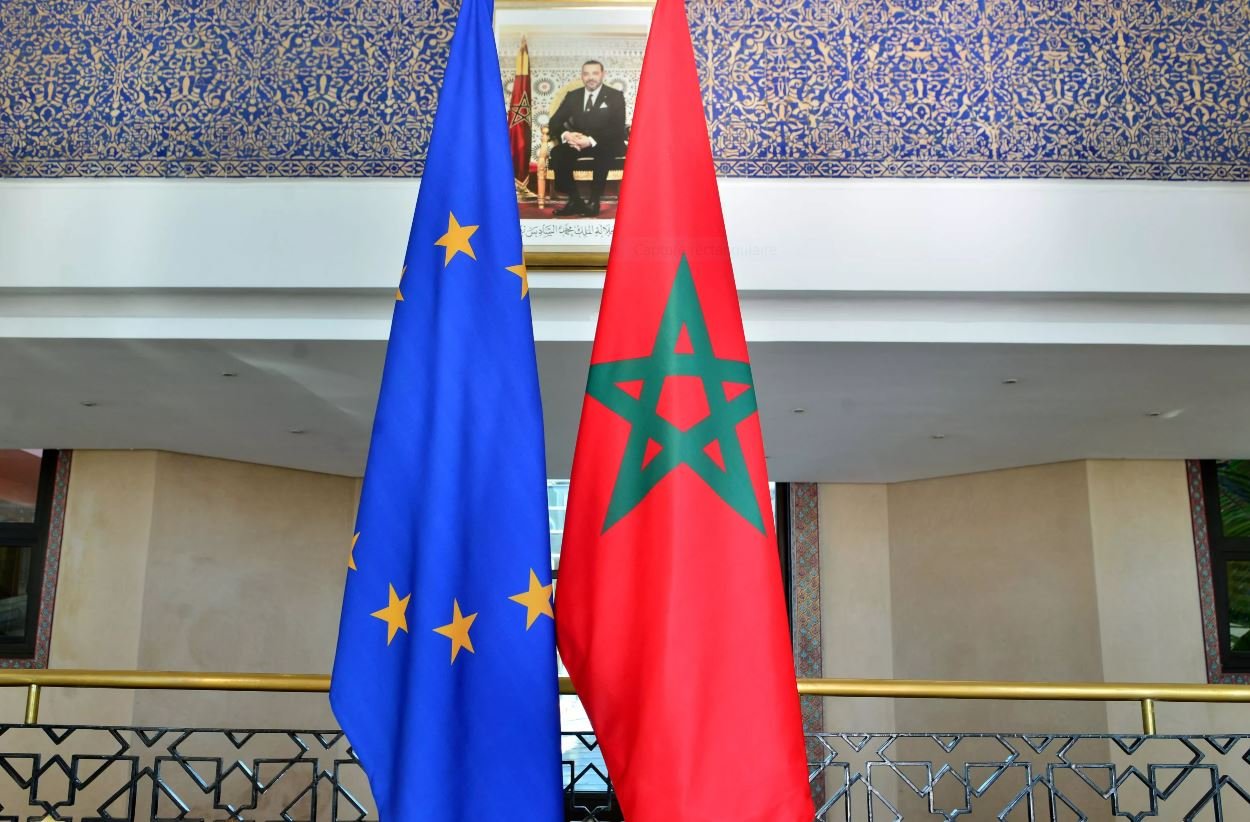
Marrakech – The European Union reinforced its strategic partnership with Morocco in 2025 by providing €233.4 million (MAD 2.48 billion) in budget support to advance major national reforms across multiple sectors.
These funds target priority areas, including human development, green transition, territorial cohesion, higher education, energy, and public administration modernization.
The cooperation builds on the EU-Morocco Association Agreement, which celebrated its 25th anniversary in 2025, and aligns with the new Mediterranean Pact aimed at strengthening the Euro-Mediterranean partnership.
The KARAMA program received €27.5 million (MAD 292 million) to support social protection reform. This initiative aims to ensure equitable access to direct social assistance and mandatory health insurance while reducing socio-economic inequalities.
Under the advanced regionalization framework, the Rural and Mountain Zones Development Support Program obtained €3 million (MAD 31.8 million).
These funds strengthen territorial governance, improve regional strategy implementation, and promote sustainable economic development in remote rural and mountainous areas.
The ESRIM program secured €22 million (MAD 240 million) to reform higher education and boost research, innovation, and academic mobility with Europe. This investment prepares Moroccan students and researchers for employment market demands and development challenges.
Following the EU-Morocco Green Partnership concluded in 2022, the Terre Verte program allocated €78 million (MAD 858 million) to support national strategies “Generation Green” and “Forêts du Maroc.”
These funds promote sustainable agricultural and forestry practices, enhance food security, and create rural employment. The Green Energy program contributed €9.76 million (MAD 103.6 million) to support the national energy policy.
Read also: Spain Prioritizes Morocco in EU’s Southern Strategy for 2026
This assistance modernizes Morocco’s electricity market, establishes sustainable electricity certification mechanisms, and supports structural reform of the National Office of Electricity and Potable Water (ONEE).
The EU intensified support for Morocco’s National Financial Inclusion Strategy (SNIF) and small and medium enterprise financing through €10.55 million (MAD 112 million) under the Financial Inclusion Support Program.
This initiative promotes economic growth and job creation. The Islah program received €7.15 million (MAD 76 million) to modernize public administration and digitize public services, supporting national administrative reform programs.
EU budget support programs consist of direct fund transfers to Morocco’s Treasury as grants or subsidies. These transfers are conditional on achieving specific objectives and key performance indicators jointly agreed with Moroccan authorities.
This financial architecture reflects Brussels’ calculated investment in Morocco’s institutional capacity-building trajectory, positioning the kingdom as a pivotal Mediterranean anchor within evolving geopolitical dynamics.
The conditionality-based framework crystallizes the EU’s commitment to results-oriented development cooperation while advancing strategic convergence across security, migration, and trade dimensions that define contemporary Euro-Maghreb relations.
