


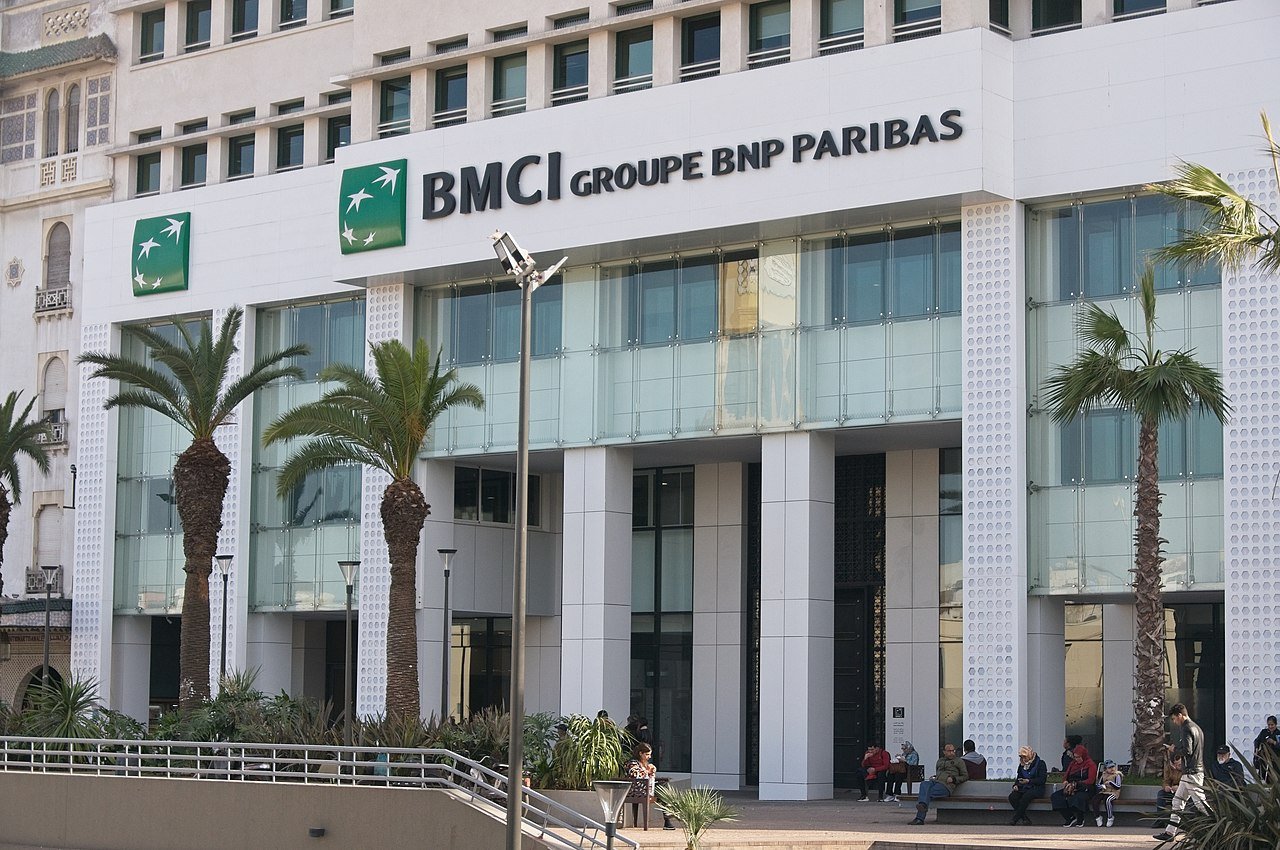
Marrakech – After Saham finalized its acquisition of Société Générale Maroc in December 2024, ending the French bank’s century-long presence in the North African country, another major French lender is now following suit.
BNP Paribas and Holmarcom Finance Company announced on Wednesday the signing of an agreement for HFC to acquire the entirety of BNP Paribas’s 67% majority stake in the Banque Marocaine pour le Commerce et l’Industrie (BMCI). The deal marks the latest chapter in Morocco’s steady reclamation of its banking sector from former colonial-era financial institutions.
The two parties entered exclusive negotiations on December 12, 2025. The transaction is expected to close in the fourth quarter of 2026, pending regulatory clearances from Bank Al-Maghrib (BAM) and Morocco’s Competition Council.
Financial terms were not disclosed, though BNP Paribas estimated the deal’s impact on its CET1 capital ratio at approximately 15 basis points upon completion.
“This acquisition marks a structuring milestone in our development trajectory, driven by the ambition to build an integrated financial group around banking, insurance, and specialized financial services,” declared Mohamed Hassan Bensalah, CEO of the Holmarcom Group.
“We approach it with a deep conviction: nothing lasting can be built without the trust of clients and the commitment of the men and women who bring our organizations to life. They are the ones who give meaning to our action and who will allow us to anchor this project in a long-term perspective, in service of the kingdom’s economic development.”
Holmarcom is no newcomer to BMCI. The family-owned conglomerate has held a minority stake in the bank for over 30 years. Through this acquisition, the group intends to accelerate its banking strategy by pursuing what the joint communiqué calls a “rapprochement” between BMCI and Crédit du Maroc, another Moroccan lender it already controls.
The objective is to create a larger banking player with reinforced expertise and expanded capacity to finance the national economy. The statement stressed that employees will be fully involved in the process through a collective approach, with particular attention to preserving client interests and maintaining service quality.
BNP Paribas is not leaving the country entirely
On the French side, Thierry Laborde, Deputy CEO of BNP Paribas, stated: “We are pleased to conclude this agreement with the Holmarcom group, whom we have known for more than 30 years as a shareholder and partner of BMCI.”
He added that the deal “opens a new phase of development for the bank’s activity, its clients, and its employees, whom we thank for their commitment.”
Laborde noted that the agreement consolidates longstanding relationships and cooperations built over time, and that BNP Paribas intends to preserve its historical presence in Morocco through a partnership with HFC to continue serving the domestic needs of its clients through BMCI.
The agreement includes a long-term commercial partnership between the two groups. Under this arrangement, BMCI clients operating in Europe and BNP Paribas clients doing business in Morocco will continue to access what the companies described as complementary, high-value-added services.
BNP Paribas has also committed to supporting BMCI’s integration into the Holmarcom group during the transition phase.
While divesting from retail banking in Morocco, BNP Paribas is not leaving the country entirely. The French group plans to maintain and develop its corporate and investment banking operations through BNP Paribas CIB. It will also continue its vehicle leasing business via its subsidiary Arval Morocco.
Holmarcom Finance Company operates across banking and insurance in Morocco. Its insurance arm includes the legacy carrier AtlantaSanad and Takafulia Assurances, a company dedicated to participative insurance. In banking, it controls Crédit du Maroc. The group also has a presence in Côte d’Ivoire through Atlanta Assurances Côte d’Ivoire.
HFC counts among its reference shareholders the Holmarcom group as majority owner and the International Finance Corporation (IFC), the private-sector investment arm of the World Bank Group.
Both are committed to developing a diversified, integrated, and responsible financial group with pan-African reach. Its growth strategy revolves around strengthening its subsidiaries in insurance and banking, diversifying its financial activities, and accelerating expansion across sub-Saharan Africa by capitalizing on synergies across its various operations.
Morocco’s banking sector breaks free from Paris
This transaction represents the final unwinding of a colonial financial architecture that has shaped Morocco’s banking landscape since the Protectorate era.
As such, the deal accelerates what many observers now call the financial decolonization of North Africa. For decades, French banking giants controlled vast segments of Morocco’s financial infrastructure, a legacy rooted in the colonial era. That era is closing.
With Société Générale Maroc already under Moroccan ownership and BMCI now on the same path, the country’s banking sector is being repatriated into domestic hands at an unprecedented pace.
Crédit Agricole SA initiated this transformation in April 2022, divesting its 63.7% stake in Crédit du Maroc to Holmarcom in a two-phase operation completed by 2024. The transaction was finalized with Holmarcom acquiring the remaining 15% stake, giving the Moroccan group complete control.
Société Générale followed suit, announcing the sale of its local subsidiary to Moroccan financial group Saham for €745 million. The former Société Générale Morocco operations were subsequently rebranded as Saham Bank under the ownership of Moulay Hafid Elalamy’s conglomerate.
The withdrawal also demonstrates the erosion of France’s traditional sphere of hegemony across the African continent, as local capital markets mature and assert greater autonomy.
The systematic retreat of French banking institutions signals a profound reconfiguration of financial power, as domestic capital takes control of institutions that once served as instruments of metropolitan economic influence.
But the shift goes beyond reclamation. Moroccan financial groups like Holmarcom, Attijariwafa Bank, and Bank of Africa are no longer simply replacing their former European controllers. They are building pan-African financial empires of their own, expanding into West and sub-Saharan Africa with integrated models spanning banking, insurance, and specialized financial services.
What was built under colonial oversight is now being dismantled, restructured, and repurposed by Moroccan hands to serve Moroccan and African interests.
The continent’s financial future is increasingly being written from Casablanca, not Paris. In other words, Africa is financing itself, on its own terms, through its own institutions.
