


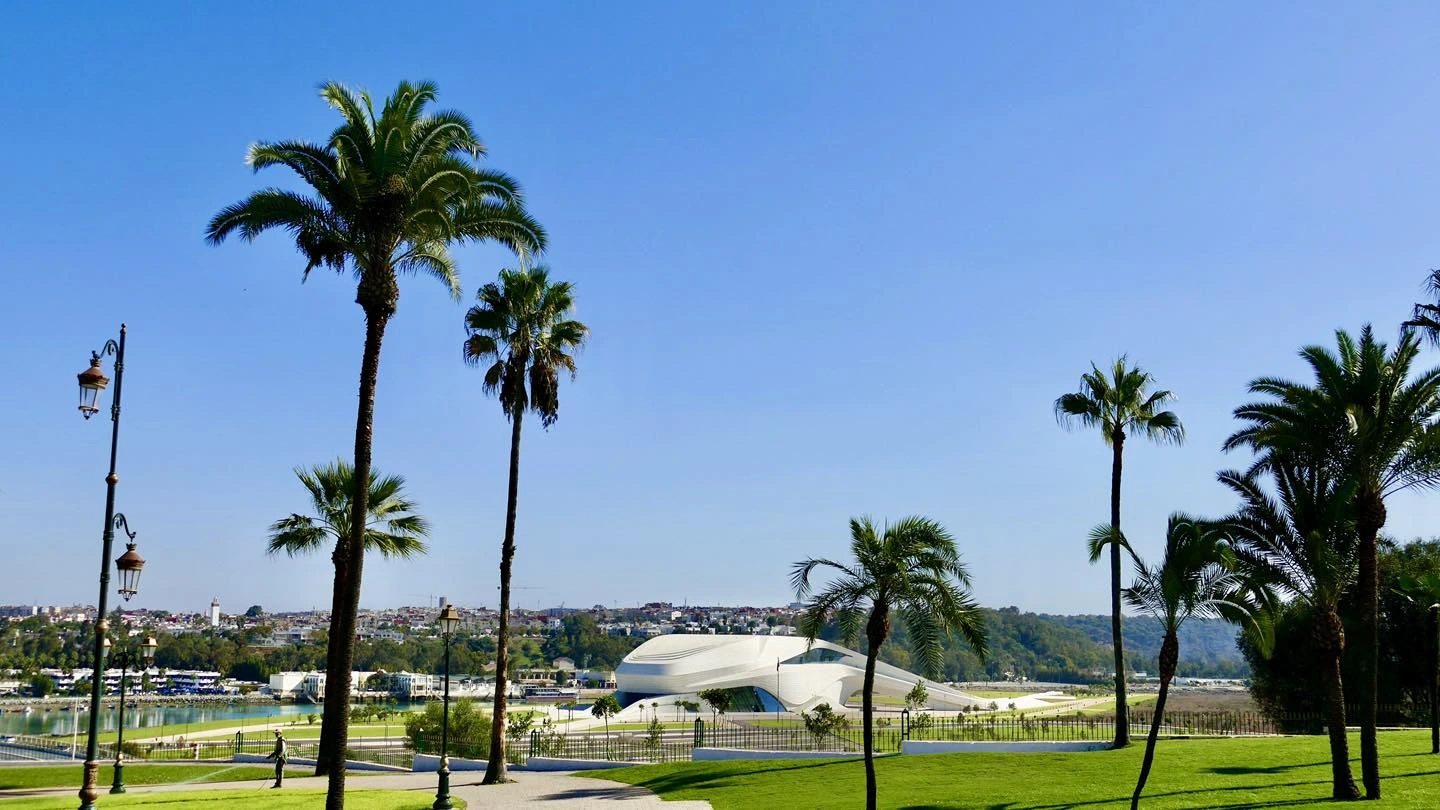
There’s something special about traveling from Rabat to Tangier—a journey that takes you from Morocco’s political heart to its gateway between two continents. When I first made this trip, I expected beautiful scenery. What I got was so much more: a story of Morocco itself, told through ancient ruins, modern marvels, and the warm faces of people along the way.
Most travelers rush through Rabat on their way to flashier cities. That’s their loss. Morocco’s capital has a quiet charm that grows on you, like a good friend who doesn’t need to shout to be heard.
Mohammed V Avenue: The Heart of Modern Rabat
Standing on Mohammed V Avenue feels like stepping into a living museum. The street runs right through the city center, and just behind it sits the Mohammed VI Museum of Modern and Contemporary Art. The wide boulevard, lined with Art Deco buildings from the French protectorate era of the 1920s, tells the story of Rabat’s colonial past and independent future.
What surprised me most was learning about Chaïbia Talal, a Moroccan woman who never learned to read or write, yet her paintings were compared to Picasso’s. She broke every rule and showed art in a completely different way. Standing in front of her work, with its bold colors and raw emotion, I understood why people called her the grandmother of naive art.
Sweet Traditions and Ancient Horses
Before leaving Rabat, I stopped at a traditional sweet shop. In Morocco, almonds are everything when it comes to desserts. Unlike Syrian sweets that use pistachios, Moroccan pastries center on almonds from the Souss region. Each bite is a taste of Moroccan generosity—sweet, rich, and made to share.
Tbourida: Where History Gallops
About two hours from Rabat, I witnessed something that changed how I see Moroccan culture. Tbourida isn’t just a sport—it’s living history.
The word “tbourida” comes from the Arabic word for gunpowder. Picture this: a line of horsemen dressed in traditional white djellabas, riding in perfect formation. They charge forward at full speed, then fire their rifles into the air in perfect unison. The sound echoes like thunder.
The equipment alone tells stories. Each saddle is hand-embroidered and takes six months to make by one person. The boots, called “tmaak,” are crafted specifically for this tradition. The lead rider wears different clothing so everyone knows who’s in charge—like the captain of a football team.
When I asked a rider why he does this, he had one simple answer: “For the crowd.” Tbourida reminds everyone of the Battle of the Three Kings in 1578, when Morocco crushed Portuguese invaders and ended their empire. That victory is in every charge, every rifle shot, every perfectly trained horse.
Chellah: Where Three Empires Sleep
Back in Rabat, I took a green taxi (they’re everywhere and very affordable) to one of Morocco’s most important archaeological sites. Chellah doesn’t look like much from the outside, but inside those walls, 2,700 years of history waits.
Three great civilizations lived here. The Phoenicians came first, before Christ was born. Then the Romans arrived and renamed it Sala Colonia, making it part of their vast empire. Finally, the Marinid dynasty built on these ancient foundations and called it Chellah, while the neighboring city became Salé.
Walking through Chellah feels like time travel. Roman columns stand next to Islamic minarets. Ancient stones mark streets where merchants once traded. But the real stars of Chellah are the storks. Hundreds of them nest in the ruins, their white bodies contrasting against old brown stones. Some live here year-round, others migrate from southern Europe once a year. They’ve made these ruins their home, just like the three empires before them.
Hassan Tower: The Dream That Never Finished
Not far from Chellah stands one of Morocco’s most famous landmarks. Hassan Tower was supposed to be the minaret of the world’s largest mosque. Construction started in 1199, but it stopped before completion. The tower stands alone, surrounded by 160 columns—all that remains of what should have been 365 columns, one for each day of the year.
The columns were meant to support a covered mosque, a grand space for thousands of worshippers. Instead, they stand open to the sky, silent witnesses to an unfinished dream. But here’s what I learned: you don’t need to finish a dream for it to leave something behind. Hassan Tower and its columns have become symbols of Rabat itself—beautiful, dignified, and timeless.
The Journey from Rabat to Tangier: Africa’s Fastest Train
When it was time to head north, I boarded Al Boraq—the high-speed train that connects Rabat to Tangier. This isn’t just any train. It’s the fastest in Africa, reaching speeds that make the 1 hour and 20 minute journey feel effortless.
Inside, everything is modern and comfortable. The seats are spacious, there’s WiFi, and the windows are large enough to watch Morocco’s countryside roll past. Fields of green, small villages, distant mountains—the landscape changes constantly. For someone who’s taken many trains, this experience stood out. Morocco has built something special here.
Arriving in Tangier: Where Two Worlds Meet
The poets call Tangier “the bride of the north.” They’re not exaggerating. This city sits at the very tip of Morocco, where Africa nearly touches Europe, where the Mediterranean Sea meets the Atlantic Ocean. From the highest points in Tangier, you can see both continents, both bodies of water.
The Kasbah: Guardian of History
Tangier’s Kasbah has guarded this strategic point for centuries. The fortress was built as a symbol of power and protection. Its walls kept enemies out and rulers safe. Today, those same walls protect something else—a living community.
What amazed me about Moroccan kasbahs is that people still live inside them. In most countries, old fortresses become empty museums. Here in Morocco, families cook dinner, children play in the alleys, and life continues inside these ancient stones. During the time of Sultan Moulay Ismail, the Kasbah housed Morocco’s elite. Now it’s a mixed neighborhood where locals and expatriates live side by side.
The Kasbah’s walls are covered in murals showing traditional Tangerine life—women wearing the distinctive red headscarf called “shashiya,” scenes from daily life, symbols of the Rif mountains. These aren’t just decorations. They’re declarations of identity.
Ibn Battuta: Tangier’s Greatest Son
One of the Kasbah’s most interesting spots is dedicated to Ibn Battuta, perhaps the greatest traveler in Islamic history. This man from Tangier visited China before any European reached it, traveling for decades across three continents.
In a small museum, I saw illustrations of his journeys. From Tangier to Egypt, to beloved Tunisia, to Palestine, to Mecca, across Asia, to the Far East—this 14th-century Moroccan saw more of the world than most people today. He wrote it all down, preserving his observations for future generations. Standing there, I felt proud. This global adventurer started his journey right here, in these same streets I was walking.
Mint Tea the Tangerine Way
No visit to Tangier is complete without trying the local version of Moroccan mint tea. In the Kasbah, an older man showed me how they do it here. The secret? Fresh Tangerine mint, placed right in the middle of the teapot. They also add “louiza” (lemon verbena) for extra flavor.
“We make three glasses at once,” he explained, pouring the hot tea with practiced skill. The tea was sweeter, mintier, and somehow more refreshing than any I’d tasted before. When you drink tea in Morocco, you’re not just drinking a beverage—you’re participating in a ritual of hospitality that goes back centuries.
Cap Spartel: Where Oceans Embrace
If you only visit one place in Tangier, make it Cap Spartel. This lighthouse sits at one of the most important maritime points in the world. For centuries, this was considered the most dangerous passage for ships. The currents here are fierce, where Mediterranean waters push against Atlantic waves.
Ancient sailors called this “the end of the world.” They believed that when ships reached this point and faced these powerful currents, the world simply ended. Of course, it wasn’t the end—it was the beginning of the Atlantic Ocean.
The lighthouse itself has been guiding ships since the 19th century. It’s so important to Morocco that its image appears on the 200 dirham banknote. Inside, there’s a gallery showing historical photos of the lighthouse through different eras, documenting the countless ships it’s guided safely past these dangerous waters.
The Meeting of Two Seas
The most magical moment at Cap Spartel is seeing where the Mediterranean meets the Atlantic. You can actually tell the difference by the colors—the Mediterranean is a lighter blue, the Atlantic darker and wilder. This is Point Zero, where distances to Africa are measured. Sailors used to think this was where the world ended. I felt something powerful standing there, a sense of freedom mixed with respect for the sea’s raw strength.
A Day Trip to Chefchaouen: Morocco’s Blue Pearl
From Tangier, many visitors make a side trip to Chefchaouen, and I’m glad I did. This mountain town is painted entirely in shades of blue—walls, doors, stairs, everything. The name “Chefchaouen” comes from Berber words: “chaouen” means horns, referring to the mountain peaks above the city, and “chef” means look—”look at the horns.”
Walking through Chefchaouen feels like moving through a living painting. Every turn reveals another blue alley, another perfect photo opportunity. The city was founded by Andalusian refugees in the 15th century, and their influence remains in the architecture and culture. The famous red and white striped “shashiya” hat comes from those Andalusian roots.
In an old bookshop, I met a local scholar who recited poetry about his city: “Chefchaouen, city of poets, with walls the color of sky, shrines of holy men, land of grandfathers and fathers, in stillness and sorrow and light.” He wasn’t just describing a place—he was describing a feeling.
Tangier Grand Stadium: Modern Pride
Before leaving Tangier, I visited the Grand Stadium, which holds 45,000 spectators. The captain who showed me around spoke with obvious pride. “Tangier used to be just about tourism,” he said. “Now we compete with Casablanca, Rabat, and Marrakech in everything—tourism, business, and sports.”
He’s right. The stadium represents new Morocco—ambitious, modern, and ready to host international events. But what made me smile was when he said, “Many tourists come to visit Tangier and then never leave. They come for vacation and end up living here.”
I understood what he meant. Tangier has that effect on people.
Practical Information for Your Journey from Rabat to Tangier
Getting There:
- Al Boraq train: 1 hour 20 minutes, most comfortable option
- Regular train: About 4-5 hours, cheaper but slower
- Bus: 5-6 hours, budget-friendly
- Car: Around 3.5 hours, best for stopping at places along the way
Best Time to Visit:
- Spring (March-May) and fall (September-November) have perfect weather
- Summer can be hot but beaches are at their best
- Winter is mild but bring a jacket for evenings
What to Pack:
- Comfortable walking shoes (both cities require lots of walking)
- Modest clothing for visiting religious sites
- Camera (you’ll want it everywhere)
- Cash in small denominations (many small shops don’t take cards)
Budget Tips:
- Green taxis in Rabat are very affordable for short trips
- Street food is delicious and cheap
- Al Boraq tickets should be booked in advance for better prices
- Many museums have student discounts with ID
Language:
- Arabic and French are main languages
- English is spoken in tourist areas
- Learn basic phrases like “Salam” (hello) and “Shukran” (thank you)
- Moroccans appreciate any attempt to speak their language
Final Thoughts: More Than Just a Journey
The trip from Rabat to Tangier isn’t just about traveling 250 kilometers. It’s about moving through layers of time—from Phoenician traders to Roman conquerors, from Marinid sultans to French colonizers, from traditional horsemen to modern high-speed trains.
In Rabat, you find Morocco’s dignified present. In Tangier, you discover its dynamic future. And everywhere between, you encounter its rich, complex past. The journey taught me that Morocco isn’t one story—it’s thousands of stories, all woven together like the threads in a Berber carpet.
Have you traveled from Rabat to Tangier? What was your favorite discovery along the way? Or are you planning this journey soon? Share your questions and experiences in the comments below—I love hearing from fellow travelers and I’m happy to help with any questions about this amazing route!
