


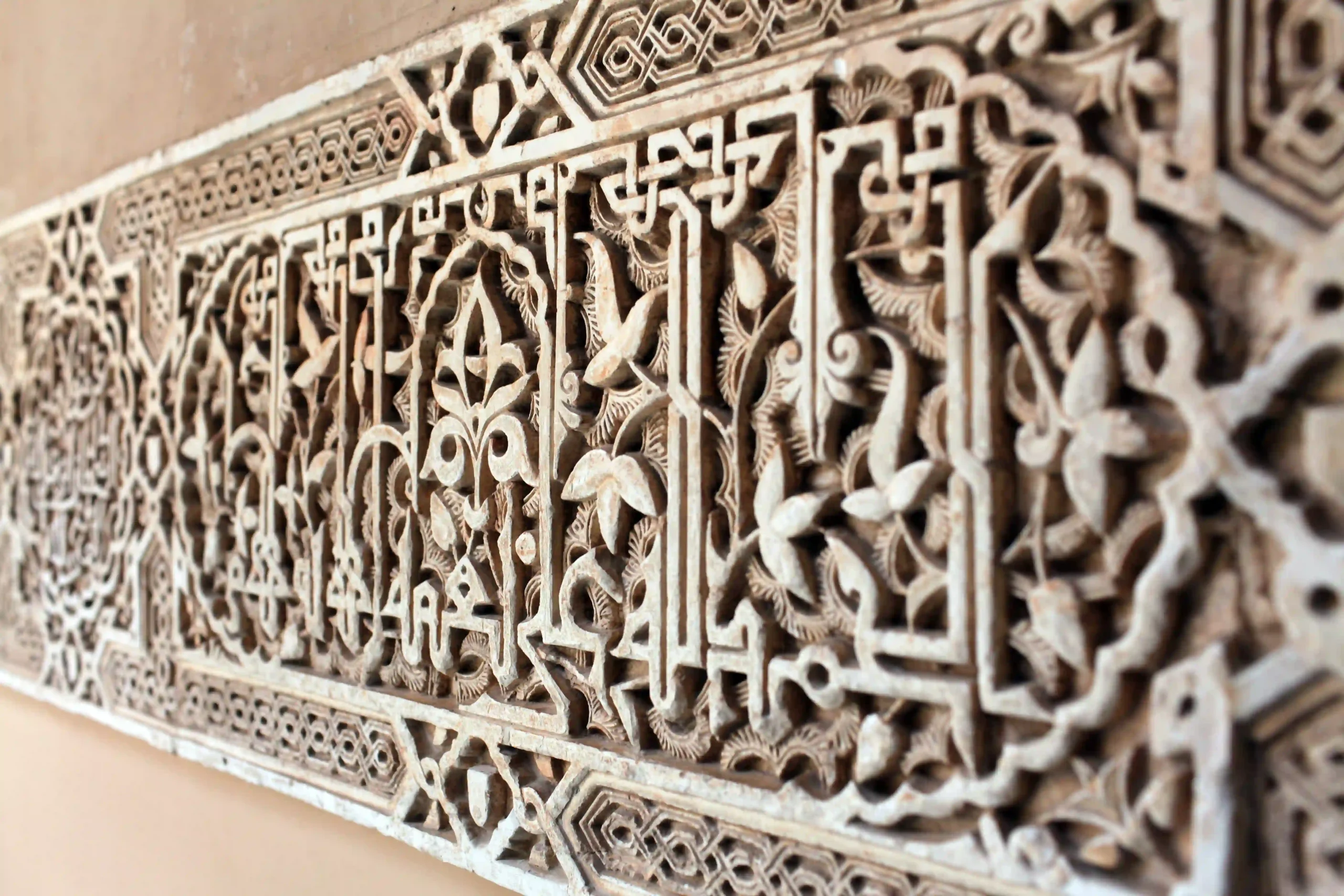
There are crafts you admire from a distance — and then there are crafts that stop you completely. Moroccan plaster carving is the second kind.
Walk into almost any traditional riad, grand mosque, royal palace, or old museum in Morocco, and you will see it. Those breathtaking carved walls. Those flowing geometric patterns. Those delicate floral designs wrapping around doorways and climbing up ceilings. That is Moroccan plaster carving — and it has been here for thousands of years.
But behind that beauty is a story that not enough people know. A story of skill, pride, and a real concern about what happens next.
What Is Moroccan Plaster Carving — And Why Does It Matter?
A Heritage That Belongs to Morocco
Moroccan plaster carving is not a recent trend. It is an ancient craft — inherited from generation to generation, father to son, going back thousands of years. The artisans who practice it today will tell you this themselves with quiet certainty.
One master craftsman put it this way: this craft is like a glowing ember he holds in his hands. He cannot let it die. It is both an inheritance and a responsibility.
It sits at the heart of Morocco’s cultural and civilizational heritage — not on the margins of it. And it shows up everywhere: in small private homes, luxury villas, grand palaces, hotels, and museums. Wherever beauty is built into Moroccan architecture, Moroccan plaster carving is almost certainly part of it.
Why No One Can Truly Copy It
Here is something remarkable. According to the craftsmen who dedicate their lives to this art: no one outside Morocco can fully replicate it. Not in terms of the final result. It is simply not possible.
Part of the reason is the raw material itself.
The Secret Is in the Plaster
Not All Gypsum Is the Same
The plaster used in authentic Moroccan plaster carving is not ordinary building gypsum. The best quality comes from a very specific region — between Fez and Meknes, near a place called Ain Allah. The gypsum from this area has a unique color and quality that craftsmen specifically seek out. Clients request it by name.
This is not a small detail. The material is everything.
How the Plaster Is Prepared
The process begins with an empty wooden board — a blank canvas. The gypsum is kneaded and prepared carefully, then sifted to remove any rough particles. Only then is it pressed into the center of the board and left to dry.
And here is something that surprises most people: this plaster stays slightly damp — for its entire life. Touch it with your hand and you will feel it. That natural moisture is not a flaw. It is what makes the material pure. It contains no chemical additives. None at all.
Once the surface is ready, the real work begins.
H2: The Art of Moroccan Plaster Carving — How It’s Actually Done
From Blank Board to Intricate Pattern
After the plaster dries enough to work with, the craftsman takes measurements and transfers the design. This is where the carver’s skill truly shows.
The patterns vary depending on what the client wants. Some prefer tawriq — flowing leaf and floral designs. Others want tastir — precise geometric line work. There is also Kufic script, the ancient Arabic calligraphy style woven beautifully into architectural ornamentation. Some pieces combine all of these together.
Every design is tailored. Every piece is custom.
Matching the Space
A good craftsman does not just carve — he advises. Before a single mark is made, he looks at the space where the work will go. A wall that is three meters high needs a different design than one that is four or five meters. The composition has to fit the architecture.
This is part of what makes Moroccan plaster carving impossible to mass-produce. It is not a product. It is a relationship between the craftsman, the material, and the space.
A Business Built on Trust, Not Advertising
Starting Small, Growing Slowly
One of the most respected cooperatives working in this craft started in 1990. They did not start with a big marketing campaign. They built their reputation slowly — project by project, client by client.
Their growth came entirely through relationships. A satisfied client introduces a family member. That family member brings a friend. The work spreads through trust, not through advertisements. To this day, a new client almost never just walks in off the street. They arrive through someone who already knows the quality of the work.
By the year 2000, the cooperative had earned a name in the market — working with some of the finest clients in Morocco at the highest level.
The Challenge Facing This Ancient Craft
A Generation Gap That Worries the Masters
Ask the master carvers what keeps them up at night and they will tell you: it is not competition. It is the next generation.
Young people today are different. The way they learn is different. The old methods of teaching — the patient, hands-on transmission of knowledge from one generation to the next — no longer fits easily into modern life. And without that transmission, this irreplaceable craft is at real risk.
The craftsmen are not angry about this. They are worried. There is a big problem coming, and they have not yet found the solution.
This is the message they want to share: Moroccan plaster carving must be preserved. Not as a museum piece — but as a living, breathing craft practiced by skilled hands.
What to Know If You Want to See This Craft Up Close
Where to Look
You do not need to book a special tour to see Moroccan plaster carving. It is all around you in Morocco’s historic cities — in the medinas of Fez and Marrakech, in grand riads, in the ornate interiors of mosques and palaces open to visitors.
But if you want to go deeper, look for cooperatives and traditional craft workshops. Some artisans welcome visitors and are happy to show you how the work is done.
A Few Tips
- Ask before photographing craftsmen at work. Most are proud to share their art, but always ask first.
- Look closely at the walls of old buildings. The difference between machine-stamped plaster and hand-carved work is visible once you know what to look for. Hand-carved plaster has depth, variation, and life.
- If you are renovating or furnishing a Moroccan home, always consult the artisan about the space first. The right design depends on the height and proportions of the room.
Final Thoughts: A Craft Worth Protecting
There is something humbling about standing in front of a carved plaster wall and knowing that the skill behind it goes back thousands of years. That the craftsman who made it learned from his father, who learned from his father before him.
Moroccan plaster carving is not just decoration. It is identity. It is history pressed into walls. And right now, the people who carry this tradition are asking a very honest question: who will carry it next?
The next time you walk through a Moroccan riad or palace and pause at a carved wall — take a moment. Look at it properly. Because what you are seeing is not just art. It is a living heritage fighting to survive.
Have you ever seen Moroccan plaster carving up close? Did you notice it in a riad, a palace, or somewhere unexpected? Drop a comment below — I’d love to hear where you spotted it and what it looked like to you.
