


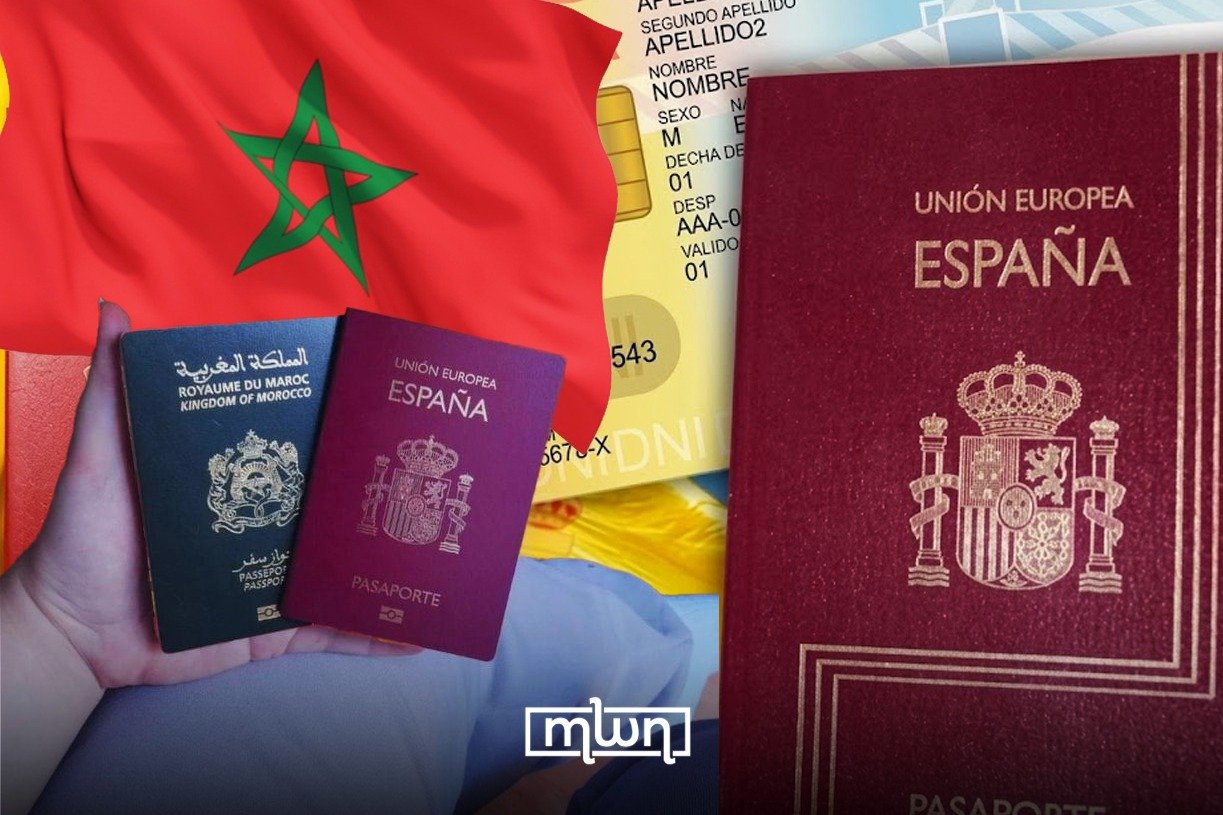
Last October a civil engineer from Casablanca walked into my office with a small leather folder tucked under his arm. Inside were his family booklet , his wife’s birth certificate, three school transcripts, and a Banque Populaire statement. He had driven from the ferry port in Algeciras that morning. “Mrs. Lagunas,” he said, in the careful Spanish he had been practicing for two years, “my cousin told me you are the person who actually knows how this works. I want to bring my wife and my three daughters. Legally. I do not want any more shortcuts.” I remember the word he chose, shortcuts, because that is the word that defines too many Moroccan migration stories, and it does not have to be that way.
Moroccans are already the largest foreign community in Spain. According to the National Statistics Institute (INE), there are close to 900,000 Moroccan nationals legally registered in Spanish municipalities, and when you add the second generation with Spanish nationality, the real Moroccan-origin population exceeds 1.2 million people. That is bigger than the Romanian community. Bigger than the British. Bigger than the Venezuelan, Chinese or Ecuadorian communities. Spain, in many ways, is already a second country for Moroccans. And yet every single week I meet Moroccan families who are doing things the hard way, or the expensive way, or the informal way, when a cleaner legal path was sitting right there on the table.
This article is for them. If you are a Moroccan professional in Rabat thinking about remote work from Valencia, a mother in Tetouan trying to join your husband who is already regularized in Málaga, a doctor from Tangier who wants to retire somewhere she can still drive home in six hours, or a young entrepreneur in Fez who wants to open a second location of the family business in Madrid, the law in 2026 has a door for you. Let me walk you through the four that matter most.
The one every Moroccan family asks about first: reunification
If one member of your family already holds a Spanish residence permit, the family reunification visa spain is usually the most logical, cheapest and fastest way to bring the rest of the household over. And it is, by a wide margin, the number one use case my firm handles for Moroccan clients. The legal framework is simple on paper. A foreigner legally resident in Spain for at least one year, who has renewed for a second year, can apply to bring a spouse, minor children, parents over 65 who are economically dependent, and in some cases parents of the Spanish-resident spouse.
What tends to trip Moroccan applicants up is not the law but the documents. Spanish consulates in Rabat, Casablanca, Tangier, Nador, Tetouan, Agadir and Larache have very specific formatting expectations. The birth certificate must be recent (typically issued within the last three months), translated into Spanish by a sworn translator recognized by the Spanish Ministry of Foreign Affairs, and either apostilled under the Hague Convention (Morocco joined in 2016, which was a real change for the better) or legalized through the traditional chain when the consulate insists on it. Proof of housing must come via a formal habitability certificate from the local town hall in Spain, not just a rental contract. Proof of income must show enough to support the whole family unit, currently around 150 percent of IPREM for the first family member plus 50 percent for each additional, which in 2026 works out to roughly 1,200 euros per month for a couple and around 1,500 euros for a family of four.
One case I remember vividly: Karim and Fatima El Amrani, a couple from Casablanca. Karim had been in Málaga for three years on a work visa tied to a construction company. His wife and two daughters were still in Morocco, and every time he went home for Eid the children cried when it was time to leave. We filed for reunification in October 2024, the consulate in Casablanca issued the visas in less than four months, and the girls started school in Málaga in time for the spring term. The small, boring detail that made the difference was the habitability certificate . Karim had been sharing an apartment with two cousins, which would have been rejected. We helped him move to a proper two-bedroom rental and get the report from the city council before filing. Without that, the case would have been denied.
“Moroccans are already the largest foreign community in Spain. The question is no longer whether to come. It is how to come legally.”
For entrepreneurs and self-starters: the self-employment route
There is a stereotype, both inside and outside Morocco, that Moroccans move to Spain only to do seasonal agricultural work or to send remittances home. The numbers tell a different story. Moroccan-owned businesses in Spain, from cafes and bakeries to import-export firms and logistics companies, generate several billion euros in turnover every year. If you already run a business in Morocco and want to expand, or if you have a solid business plan and the personal capital to launch from scratch, the self employed visa spain is the route you want to look at.
The visa requires three things that I will state plainly, because most consultants are vague about them. First, a real and costed business plan that shows viability. The Spanish commercial attaché reviewing your file will look for realistic revenue projections, evidence of market research, and proof that your proposed business meets demand in the specific Spanish province where you want to set up. Second, personal capital or financing sufficient to launch the business. There is no fixed minimum, but for most small businesses we advise clients to have at least 30,000 to 50,000 euros of liquid funds, and significantly more for restaurants or import ventures. Third, all the professional qualifications, licenses and sector-specific authorizations you would need as a Spanish national doing the same work. If you want to open a dental clinic, your Moroccan dental degree must be homologated. If you want to run a trucking company, your CAP certificate must be recognized.
I worked last year with Mohamed Chraibi, a restaurateur from Fez who wanted to open an authentic northern Moroccan restaurant in the Malasaña district of Madrid. He had the recipes, the suppliers in Chefchaouen, and 60,000 euros saved over a decade. What he did not have was a business plan a Spanish consulate would take seriously. We worked with a Madrid-based accountant to build one, documented his sourcing chain across the Strait, and his visa came through in five months. The restaurant opened in May 2025 and now employs seven people, four of them also Moroccan, three of them local Spaniards. That is the quiet good news that almost nobody writes articles about.
For the young professional who works online: the digital nomad visa
Morocco has a young, educated, digitally fluent population that has been underserved by the traditional migration conversation. If you are a software engineer, designer, consultant, marketing professional, copywriter, financial analyst or any other role that can be done remotely, Spain’s Startups Law visa (better known as the digital nomad visa) is probably the fastest residence permit you will ever see. I have personally handled cases approved in under 20 working days. The requirements are specific, and the Spain digital nomad visa income requirements are where most applications go wrong, so read carefully.
You need to demonstrate a monthly income of at least 200 percent of the Spanish minimum wage, which in 2026 sits at approximately 2,763 euros gross per month for the main applicant. Add around 1,037 euros for a spouse and 345 euros for each child. The income must come from clients or an employer based outside Spain, and if you are employed, the employer must consent in writing to your working from Spain. You need a university degree or three years of demonstrable professional experience in your field. You need a clean criminal record from Morocco (Casier Judiciaire N°3) apostilled and translated, plus the same from any country you have lived in during the past two years. You need full private health insurance authorized for Spain, and a rental contract or evidence of accommodation.
The bonus that nobody advertises loudly enough is the Beckham tax regime. A Moroccan digital nomad can apply to be taxed at a flat 24 percent on Spanish-source income (up to 600,000 euros), rather than under the progressive Spanish scale, for the first six years of residence. For a freelance web developer billing 80,000 euros a year in euros and dirhams combined, that is a difference of roughly 11,000 to 14,000 euros of net income per year. Youssef Benjelloun, a client from Rabat I helped last summer, runs a small SaaS business with customers in France, Belgium and the UAE. He moved to Barcelona in September, pays 24 percent flat, and tells me every month his net take-home has never been higher. He is also counting days toward Spanish nationality, which brings me to a point Moroccan readers need to hear honestly.
The hard truth about Spanish nationality for Moroccans
Spanish law grants a fast track to citizenship (two years of legal residence instead of ten) to nationals of Ibero-American countries, Andorra, the Philippines, Equatorial Guinea, Portugal, and people of Sephardic origin. Morocco is not on that list, and this surprises many of my clients. A Moroccan passport holder must complete ten years of legal, continuous residence in Spain before applying for nationality, unless they qualify through marriage to a Spanish citizen (one year of residence plus one year of marriage) or through descent.
This is the single most common disappointment in my first consultations with Moroccan families. There is no shortcut based on the shared history of Al-Andalus, despite the occasional political debate on the subject. What does exist, and what I always remind families about, is the figure of arraigo, which has been modernized in the 2025 Immigartion Regulation. Moroccans who have been in Spain for two or three years, even without a formal permit, may qualify for regularization through social, work or family arraigo, and those years start counting for nationality the moment they are formalized. Spain rewards long roots. For many Moroccan families already in Spain, the ten-year clock is closer than they think.
There is also the matter of dual nationality. Morocco, legally speaking, does not let its citizens renounce Moroccan nationality. Spain, on paper, asks applicants from non-privileged countries to renounce their original citizenship at the oath ceremony. In practice, the renunciation is symbolic. Moroccan authorities do not process it, and a new Spanish national continues to hold a Moroccan passport for all intents and purposes. I mention this not to encourage anyone to dodge the law but to answer a question I am asked at almost every family consultation.
For those who have capital: the non-lucrative visa
Not every Moroccan coming to Spain is coming to work. A growing number of my clients are senior professionals, retired civil servants, landlords, or business owners who have sold their companies and now want a European base close to home. For them, the non-lucrative visa spain is the cleanest option. You prove you can support yourself from passive income (pensions, rental income, dividends, savings) at roughly 28,800 euros per year for the main applicant and 7,200 euros per dependent, contract private health insurance, and obtain residence without the right to work locally. For a retired Moroccan doctor with a clinic sold in Tangier and a rental property in Marrakech, it is a straightforward file.
Salma Alaoui, a pediatrician who practiced for 35 years in Tangier, moved to Almería in 2024 on an NLV. She chose Almería specifically because the ferry from Málaga gets her home to see her elderly mother in under seven hours, door to door. Her pension, rental income from a building she owns in Gueliz, and a small portfolio of Moroccan government bonds comfortably covered the threshold. Her visa was approved in Rabat in three months, she is now in her second year, and we have already begun mapping the long-term residence renewal for 2029.
Pitfalls specific to Moroccan applicants
After thousands of cases I can tell you the top three errors that sink Moroccan applications, and all three are avoidable. The first is document quality: copies instead of originals, missing apostilles, stamps from the wrong ministry, or translations done by a relative who speaks Spanish but is not a sworn translator. Spanish consulates are strict, and strict is the right word. The second is timing: many Moroccan civil status documents must be issued within three months of the visa appointment, so getting everything apostilled too early means doing it twice. The third is financial documentation: Spanish consulates want to see consistent balances over time, not a sudden deposit a week before the appointment. If a relative is helping you, we structure the transfers months in advance.
The fourth pitfall, which is not about paperwork but about expectations, is the assumption that physical proximity to Morocco makes the process emotionally easier. It does not. Even when your family is three hours away by ferry, the first year of legal residence in Spain is a transition. There is a language to learn (or improve), a social security system to navigate, a school enrollment to manage, a driving license to exchange. Plan for it. Most of my clients come back to me a year later with a completely different life, but the road is real.
Why this matters and why we exist
MySpainVisa is a boutique Spanish law firm with offices in Barcelona. Every case is handled by a lawyer admitted to the Spanish Bar, not by a sales agent or a paralegal overseas. Our team speaks Spanish, English, French and Arabic (Darija and Fusha), which matters when you are sitting across from a Moroccan family negotiating paperwork under stress. We have guided more than 3,200 families through the Spanish system over the past decade, maintain a 98.7 percent approval rate across our main visa categories, and have successfully litigated appeals on files that other firms had given up on. We know the consulates in Rabat and Casablanca by name, and they know us.
I will also tell you, as I tell every Moroccan family who sits in my office, that we do not take every case. When a family’s finances are not yet where they need to be, we will tell them so. When a medical condition is better treated in Rabat than in Madrid, we will say that. When an applicant is better off waiting twelve months and strengthening their profile, we recommend waiting. A good immigration lawyer knows when to say not yet. That is part of the job, and it is why our clients come back and send their cousins.
If Spain is on your mind
The Strait of Gibraltar is fourteen kilometers wide at its narrowest. You can see Tarifa from Tangier on a clear morning. The distance between Morocco and Spain is, geographically, almost nothing. The legal distance, for a family that does not know the rules, can feel enormous. It does not have to.
Whether you are bringing your wife and children, opening a restaurant, moving your remote job to a sunnier city, or retiring to an apartment with a view of the sea, Spanish law in 2026 has a specific path designed for you. Know which one is yours before you book the ferry. And if you do not know, ask someone whose job it is to know. That part costs nothing.
