


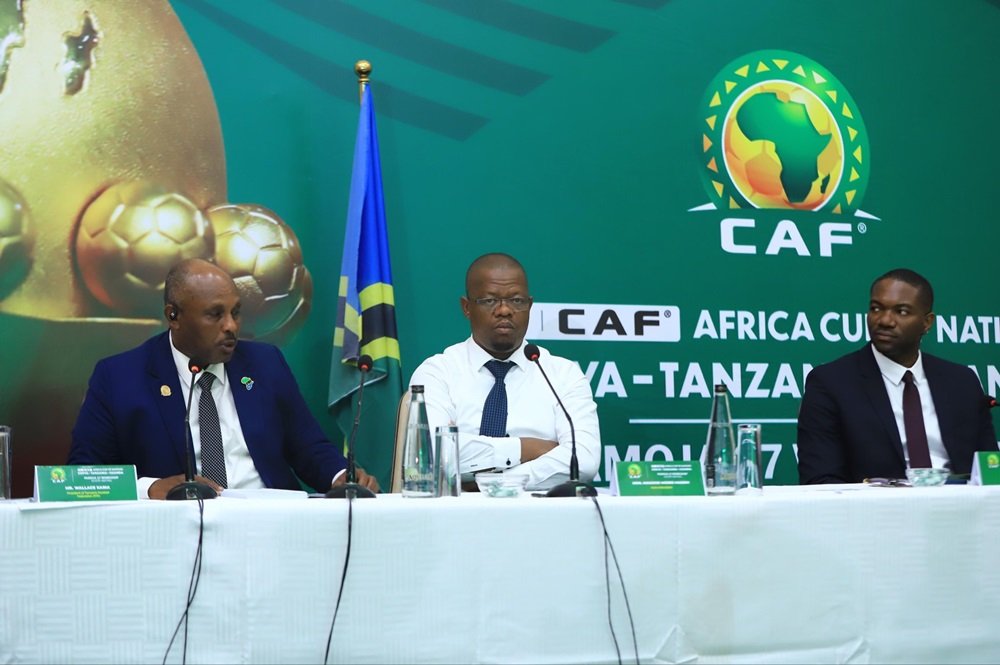
Moses Magogo isn’t downplaying the scale of what’s coming. If anything, he’s raising expectations.
Speaking at the PAMOJA workshop in Kampala on April 22, the Federation of Uganda Football Associations president made his expectations public: that hosting Africa Cup of Nations 2027 will be about changing how East Africa is seen in football. “Our objective is to make East Africa the best host Africa has ever had,” he said.
That line sums up the ambition behind the 2027 tournament, which will be co-hosted by Kenya, Uganda and Tanzania under the “Pamoja” banner, meaning “together” in Swahili, and will run from June 19 to July 18 2027. It will be the first time in history the tournament is co-hosted by three countries.
Magogo’s message goes beyond football. The entire “Pamoja” project is built around regional integration, using the sport to connect economies, people, and infrastructure across East Africa.
One of the clearest examples is the planned “Visa Pamoja,” designed to allow fans, officials and investors to move freely between the three countries during the tournament. The idea is to remove barriers and treat the event as one shared space rather than three separate hosts.
Magogo tied that directly to the broader political ambition of building a more unified East African region, with football acting as the catalyst. “This is an opportunity for East Africa and the East African Community… the most beautiful game is being used to bring East Africa together,” he said.
The tournament will feature 24 teams and is expected to be spread across around 10 host cities. That scale alone makes it one of the most complex sporting events the region has ever taken on.
Magogo isn’t ignoring the pressure that comes with it. He openly acknowledged that East Africa lacks experience at this level, but insisted that ability has never been the issue.
The plan is to rely heavily on guidance from CAF, using its experience to avoid mistakes and raise standards across the board. He also pointed to support from Patrice Motsepe, who has pushed for broader access to hosting opportunities across Africa. That backing helped bring AFCON to East Africa for the first time.
I want to take this opportunity to thank the government of Uganda, Honourable Minister, on behalf of the football fraternity of Uganda, of East Africa, for having accepted our proposal that we bid host AFCON for the first time in the East Africa.
CAF awarded us the rights to… pic.twitter.com/axYCTSJtS7
— Moses Hassim Magogo (@MosesMagogo) April 22, 2026
Infrastructure still under scrutiny
Yet there’s also a reality check. As of this month, CAF inspection reports have already pointed out significant challenges, especially around stadium readiness and infrastructure.
That puts pressure on all three host nations to accelerate construction and upgrades in a short timeframe. Delivering the tournament is one thing. Delivering it at the level Magogo is promising is another.
Magogo referenced the region’s previous experience with CHAN as a starting point, not a benchmark. He knows that AFCON is on a completely different level in terms of scale, visibility and expectations. “We are ready to learn, improve and deliver,” he said. “Where we fell short during CHAN, we will improve.”
Now that the opportunity is there, the clear expectation is to deliver.
For Magogo, East Africa asked for this chance, got it, and now has to prove it belongs.
Whether the region can match that ambition with execution is what will define AFCON 2027.
