


The latest wars in the world have one thing in common; they powerfully illustrate not only the importance of AI and new military technologies like drones but also the importance of geoeconomic power and its levers, whether it is to strengthen military power or to compensate for strategic weaknesses in the face of a more powerful or resilient adversary.
Bogged down in southern Ukraine and having failed to achieve its declared objectives of regime change in Kiev, Russia would have instrumentalized the flow of grain from the Ukrainian granary to the Black Sea through Azov Sea; thus, using geo-economic leverage to put pressure on Ukraine and the international community. The same is true of Iran’s closure of the Strait of Hormuz, which is intended to put pressure on the international community, especially Europe, India, Japan, Korea, and the American consumer, to force the United States to end this asymmetric war.
These events, inter alia, have led me to ask myself whether Africa and Morocco would one day suffer the other side of the coin of interdependence with the EU, if they ever would insist on definitively freeing themselves from the EU and their former metropolises, as is the case with the countries of the Sahel.
The main purpose of this paper is to examine the structural change in economic relations between the Kingdom of Morocco and the European Union, which has moved from a logic of liberal complementarity to a regime of instrumentalized and at times coercive interdependence.
By mobilizing the frameworks of the theory of weaponized interdependence (Farrell & Newman, 2019), the Brussels Effect (Bradford, 2020), and other analytical frameworks (Stanford, Callender, McCarty), we will empirically dissect how European regulatory power functions as a geoeconomic lever with its partners particularly those in an asymmetric position.
It is a question of verifying two suggestions: firstly, to what extent does Brussels’ control of the agenda lock the Moroccan productive apparatus in a “rule-taker” impasse?
Secondly, in the face of this asymmetry, does Morocco have strategic “chokepoints” leverages?
EU-Morocco: a strategic partnership under high tension, but without any apparent break
The 15th Association Council in January 2026 paved the way for a decisive transition: from the advanced status inherited from the 2000s to an ambitious “Pact for the Mediterranean”. On the 30th anniversary of the initial agreement, bilateral trade reached a record €60 billion in 2024, confirming the EU as Morocco’s leading trading partner and source of FDI.
However, it is clear that interdependence, long presented by liberal theory as a vector of peace and cooperation, can be transformed into a strategic weapon by the states that control the central nodes of global networks.
Indeed, for several years EU-Morocco relations were threatened by missteps emanating in particular from the European Parliament or the European Court of Justice, the relationship was particularly clouded by the judgments of the CJEU of October 2024 on the Moroccan Sahara and sometimes even from Brussels via regulatory pressure such as the CRD VI directive in the financial sector and the Carbon Border Adjustment Mechanism (CBAM). This friction has consolidated the acceleration of Morocco’s shift from asymmetric integration to a “pivot power” strategy, leveraging a net structural advantage to renegotiate the terms of the partnership.
When complementarity turns into instrumentalization
Between 2000 and 2026, economic relations between Morocco and the European Union have undergone a profound change, moving from a logic of mutually beneficial complementarity to an asymmetrical balance of power where Brussels uses its regulatory power as a silent but frighteningly effective instrument of pressure. This shift, which has not been sufficiently analyzed, deserves attention. Because it illustrates a broader transformation of North-South relations.
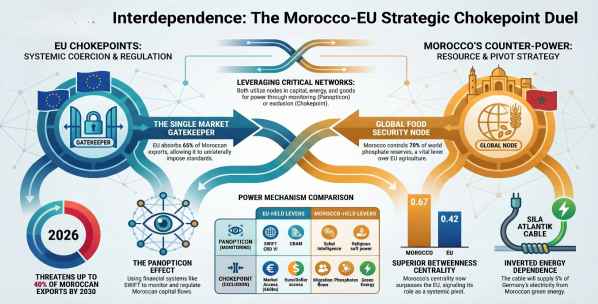
In this vain, Its worth recalling what Henry Farrell and Abraham Newman conceptualized as “weaponized interdependence“; two mechanisms structure this form of power: the panopticon effect – i.e. the ability to monitor information, financial or commercial flows through central hubs (such as SWIFT for financial transactions or carbon traceability systems) – and the bottleneck effect – i.e. the ability to exclude actors from access to critical networks. In the Morocco-EU relationship, it is this second mechanism that prevails. The EU, as a single market of 450 million consumers and the world’s main regulatory hub, perfectly embodies this position as a central node that it can instrumentalize to impose its standards and constrain its trading partners.
The “Brussels Effect” on African partners: five major levers
The Brussels Effect (Anu Bradford, 2020) offers an essential theoretical framework for understanding how the European Union deploys unilateral regulatory power towards Morocco. Bradford identifies five structural conditions that favor the export of European standards. First, the size of the European internal market – with its 450 million wealthy consumers – is too strategic an issue for Morocco to do without, especially since 65% of its exports are destined for the EU. Secondly, the Union has a regulatory capacity that is unique in the world, allowing it to design and impose such complex mechanisms as the Carbon Border Adjustment Mechanism (CBAM), the General Data Protection Regulation (GDPR) and the REACH (Registration, Evaluation, Authorization and Restriction of Chemicals) regulation. Thirdly, European standards are systematically more demanding than those of other jurisdictions, which triggers a “race to the top”. Fourth, Moroccan companies can hardly relocate or leave the European market without incurring prohibitive costs, which makes their position particularly inelastic. Finally, it would be economically irrational for multinationals established in Morocco to maintain separate production lines according to the markets, due to the non-divisible nature of value chains on a global scale.
The EU’s Unilateral Regulatory Power
Unlike traditional coercive power (military or direct economic sanctions), the EU exercises unilateral regulatory power over its African partners, including Morocco; African companies and authorities comply not out of direct constraint, but because access to the single market is very valuable to be compromised. Brussels does not need to negotiate or threaten; It only needs to legislate for its standards to be imposed ipso facto on African partners, with a few exceptions, because its partners have no power to set the agenda, are not doers, but takers, like a contract of adhesion that differs from a synallagmatic contract in roman civil law.
Indeed, in the EU-Africa relationship and more specifically in the case of Morocco, the “Brussels effect” operates on two levels. On the one hand, there is a de facto effect, at a micro level, when Moroccan exporting companies voluntarily adopt the strictest European standards for all their production, including goods destined for other markets. For example, a car manufacturer based in the Tangier Med area will apply European environmental and safety standards to all its vehicles, whether they are exported to Germany or to other African countries, because maintaining separate production lines would be too costly. On the other hand, there is a de jure effect, at the macro level, when Morocco officially incorporates certain European regulations into its national law in order to facilitate its access to the single market. The gradual adoption of sanitary and phytosanitary (SPS) standards, competition rules and technical standards is a perfect illustration of this.
When the EU dictates its standards to third countries
Despite the resistance of African countries, which unfortunately negotiate in a dispersed manner, in particular the EPAs, the EU takes advantage of its central position thanks to certain mechanisms contained in bilateral and regional agreements; It imposes its rules of origin and its technical, sanitary and phytosanitary standards. This situation is reinforced by what Stanford (2022) calls the “experimentation trap”: when a dominant player imposes the direction of standards alone, its partners no longer have an interest in testing their own autonomous development models sometimes, because the risk of not complying with European standards is too high. The African partner is therefore obliged to adopt European standards, which creates lasting political inertia.
This imbalance gives Brussels almost absolute power. Faced with regulatory uncertainty, the margin of blockage widens: the African partner, which fears being excluded, accepts standards that do not bring it much compared to the status quo, while Brussels reaps all the benefits of the reform. The Brussels effect completes this picture: the EU no longer even needs to threaten, it just needs to legislate to change the conditions of production in the industrial zones of African partners.
Compliance with Regulations or Market Access loss ? The core dilemma
For the purposes of this article, we have constructed a Regulatory Pressure Index (RPI), which aggregates the health, carbon, financial, migratory and industrial dimensions, which has jumped by 71% since 2000, reaching 55.4 in 2025. Since 2023, the correlation between this index and Moroccan export growth has become strongly negative (r = -0.71), demonstrating that normative inflation is now acting as a brake on Moroccan exports.
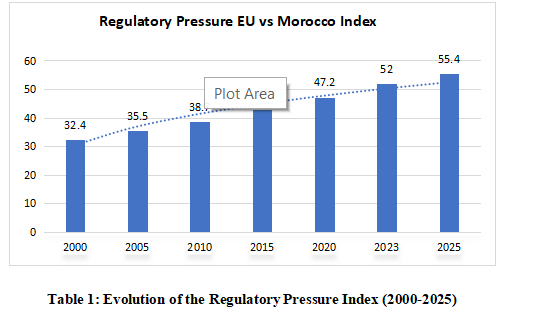
Table 1: Evolution of the Regulatory Pressure Index (2000-2025)
| Year | Score RPI | Change (%) | RPI/ Exports correlation |
| 2000 | 32,4 | – | +0,45 |
| 2010 | 38,7 | +19,4% | +0,32 |
| 2020 | 47,2 | +45,7% | +0,12 |
| 2023 | 52,1 | +60,8% | -0,23 |
| 2025 | 55,4 | +71,0% | -0,71 |
Calculations based on SPS, CBAM, FIN, MIG, IND normative dimensions
With the EU unilaterally setting the regulatory agenda, Morocco and other countries in the global South face a quiet dilemma: experiment with domestic industrial or policy models and risk isolation, or play it safe and align with Brussels to keep single market open. In a context of political uncertainty-where the link between new rules and economic outcomes is cloudy- the safer bet wins. The result? A structural lock-in: Morocco and other countries, in asymmetric economic position, become a diligent rule-taker, not because it lacks vision, but because it lacks the agenda power to reverse course if an experiment falters.
Nine instruments structure the EU’s regulatory weapons. The most salient is the CBAM, which entered the operational phase in 2026, which ultimately threatens 40% of Moroccan exports while less than 3% of national SMEs have carbon certification. At the same time, the CRD VI directive has proven to be even more formidable because by restricting the access of Moroccan banks to the European financial market, targets the vital flow of transfers from MREs, which represent 6.6% of the national GDP (Badr Mandri, the external sector of the Moroccan economy in Oxford Handbook, March 2026 PCNS) making this directive a lever of systemic pressure on the financial stability of the Kingdom because these transfers, which reached €8.9 billion in 2024, constitute the country’s leading foreign exchange inflow and contribute to the reduction of the balance of payments deficit.
By hindering these flows, CRD VI risks jeopardizing a structural buffer that is essential to compensate for the chronic trade deficit and stabilize Morocco’s external position, transforming European banking regulation into an instrument of geo-economic constraint. It should be noted in passing that the collection of assets of Moroccans living abroad living in Europe constitutes nearly a third of the Gross Net Product (GNP) of the Moroccan banking sector.
The other strategic sector that is highly exposed to the EU’s regulatory strength is only the phosphate fertilizer sector, Morocco’s secular wealth, which is the subject of recurrent regulatory pressure via the gradual lowering of the authorized cadmium thresholds.
These pressures translate into risks of export compression to the EU and critical sectoral vulnerabilities; particularly in the automotive sectors (70% dependence on the European brands Renault, Nissan and Stellantis), a simultaneous withdrawal of these manufacturers, to Romania or Turkey for example, could contract the national GDP by 3 to 5%. aeronautics (Airbus Safran) (75%), the services sector, in general, which represents 48% of GDP, is not to be outdone and also remains at the mercy of Brussels’ unilateral rules, as we have seen in the financial sector.
Lower freedom for export driven corporates
Concretely, the corporates, for which European union is the major market, may suffer from three key sources of vulnerability:
- Compliance over creativity
Faced with EU regulations such as CBAM or CRD VI, african firms increasingly prioritize meeting compliance requirements over developing independent strategies, particularly for African markets under AfCFTA. Innovation does not disappear, but it is increasingly channeled toward adapting to external rules rather than shaping new ones.
- Excellence that deepens dependence
Automotive and aerospace sectors are major industrial successes in some countries, thus far they remain deeply embedded in European supply chains. Even proactive initiatives—like OCP’s early adoption of “Low Cadmium” standards—still reinforce Morocco’s role as a strong supplier operating under rules set by others. Performance is solid, but the policy space and room for maneuver vis-à-vis the EU remain narrow.
- Uncertainty encourages caution
In a volatile geopolitical and regulatory environment, the perceived risks of pursuing independent strategies often outweigh their uncertain gains. This fosters cautious decision-making and reduces flexibility and locks industries into established patterns of alignment.
Morocco’s Strategic Response
Faced with this lockdown, Morocco is not a passive victim. Analysis of the Pivot Leverage Index (PLI) (which is a mathematical measure of a pivot’s ability to maximize profits by exploiting the competition between its two rival partners); denotes an increase in the Moroccan PLI revealing a notable acceleration since 2010. The move from 0.50 to 1.03 reflects not only an absolute improvement, but above all an increased ability to convert inter-power competition into tangible advantages.
This multi-alignment strategy, inherited from a diplomatic tradition dating back to Ahmed al-Mansour and Sidi Mohammed III, articulates a bold geopolitical division of labour: security with the United States (75%), infrastructure with China (45%), and energy transition with the EU (60%). Morocco is thus navigating between Gulf capital, Chinese technology and the American security umbrella.
To rebalance the balance of power, Morocco could activate its own chokepoints:
- Migratory and security barrier: Morocco’s cooperation is the bottleneck that Europe cannot do without, in order to externalize the control of its borders and stabilise the Sahel.
- Energy inversion: The *Sila Atlantik* project (4,800 km submarine cable) aims to supply 5% of German electricity, creating a “reverse energy dependence” that offers Rabat concrete regulatory negotiating leverage. Another project « Links » is currently being negotiated with UK.
- Battery Valley & Critical Minerals: By limiting exports of raw minerals and industrializing cobalt (coveted by Tesla, Apple, BYD), Morocco is moving from the status of a “workshop” to that of an indispensable industrial partner.
- Intangible Chokepoint: The legitimacy and prestige of Commander of the Faithful, functions as an intangible strategic asset. Morocco exports a label of moderate Islam that is essential for European social cohesion and the fight against radicalisation.
- Nearshoring and Friend shoring Platform: Faced with the disruptions in global value chains exacerbated by the health (COVID-19) and security crises (current tensions in the Red Sea and in the Strait of Hormuz, where 20% of the world’s oil and about 25% of gas transit, not to mention helium, sulfur and ammoniac), Morocco is establishing itself as a strategic platform for nearshoring (close relocation) and especially friend shoring (relocation between allies). Its geographical proximity to Europe (14 km from Spain), its political stability and its world-class transport infrastructure (Tangier Med, Africa’s leading port, Nador West Med TGV, future mega port Dakhla Atlantique, etc.) make it a hub of resilience for both exporters of energy products and European companies seeking to secure their supplies while reducing their dependence on Asia.
This position as an “industrialized buffer zone” is a major geostrategic lever in a fragmented world where the security of supply chains now takes precedence over cost optimization alone.
What options for safer and improved integration in EU?
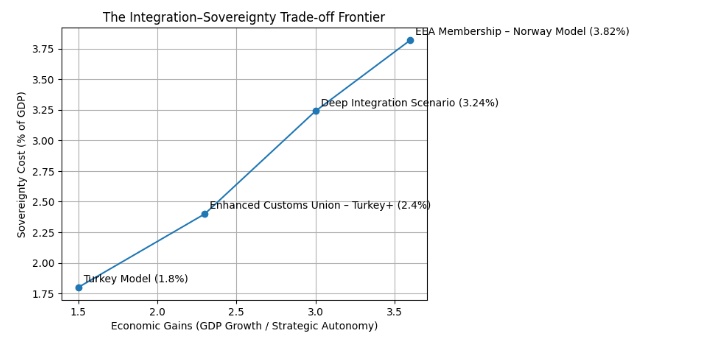
Formal EU membership remains a mutually undesirable dead end: politically unacceptable for a Europe that is very sensitive to enlargement to non-European countries nowadays, and constitutionally incompatible with Moroccan sovereignty and multi-alignment. We simulated the impact of possible options ranging from the establishment of a Customs Union similar to the EU/Türkiye model, through deep integration, and the EU/Türkiye Plus model to the European Economic Space model.
Results of the GTAP Simulations (2025-2045)
| Integration scenarios | GDP growth | Increase in FDI | Sovereignty Cost | Political Feasibility | Overall Score |
| EEA/Norway | +3,82% | +100% | Prohibitive (CJEU + €400M/year) | None | 2,1/10 |
| Turkiye base model | +1,8% | +35% | Low | Medium | 3,4/10 |
| Deep Integration | +3,24% | +55% | Medium | High | 5,2/10 |
| Turkiye-Plus | +2,4% | +45% | Low-Medium | High | 6,09/10 |
– EEA/Norway model: Although it projects +3.82% of GDP and a doubling of FDI, it imposes prohibitive sovereignty costs (mandatory CJEU jurisdiction, contribution of €400 million/year) and a catastrophic risk of brain drain and hyper-qualified labor (estimated at 85,000 executives/year).
– Turkey model (classical): it is based on a customs union limited to industrial products excludes services without an automatic revision mechanism.
– Turkey-Plus model: is the optimal option because it combines a 2.4% GDP growth with maximum preservation of political autonomy space.
Morocco from Rule-Taker to Rule-Shaper : towards a Strategic Partnership Framework Agreement (CSPA)
To avoid remaining a “captive factory” or as the late Réda Guédira said “the vegetable garden of Europe” and to transform the position of interface into real power of agenda, Morocco should stabilize its relations with the EU and make them more predictable via a CSGA articulated around a hybrid New Generation Customs Union (NGDU):
- UDNG Sectoral: Apply the European customs regime only to critical ecosystems (Tangier Med, Kenitra, Automotive, Aeronautics, Battery Valley extendable textile to Fez, chemicals and other future businesses) to secure and stabilize FDI and value chains, while preserving commercial autonomy vis-à-vis third parties.
- Prior Consultation: Establish a notice period before the adoption of any new European standard affecting EU FDI in Morocco, transforming Morocco from a passive recipient to a co-shaper of the rules.
- National SME Certification Fund: Create a dedicated financing mechanism to support the carbon and digital compliance of SMEs, reducing the competitiveness gap in the face of the CBAM.
- Establishment of a non-jurisdictional mixed dispute settlement system without recourse to the European Court of Justice.
- Nearshoring positioning: Capitalizing on disruptions in global value chains to negotiate a European “resilience partner” status, with non-tariff advantages (to be defined as lines of adaptation or R&D financing that go beyond current trade models such as Erasmus) in exchange for a guarantee of stability of strategic supplies.
Has the Era agenda power arrived for Morocco and the Global South?
I believe that the hour of a multipolar world is imminent, the events in Ukraine and the Middle East will precipitate the rise of the revisionist powers, China as a figurehead, Morocco for its part is observing with lucidity and preparing for this new configuration of the international system, it has succeeded in its “pivotal moment”, but the window of strategic opportunity will close quickly soon.
In this regard, a structural revision of the EU-Morocco relationship is on the agenda of decision-makers on both shores: either it evolves towards a win-win partnership via the CSGA and the Turkey-Plus model or other hybrid system, or it risks becoming frozen in a coercive asymmetry that would push the Kingdom of Morocco to further modulate its partnerships to the detriment of Europe by pivoting to the East and the South Atlantic.
By deploying its structural levers, Morocco is now in a position to reverse the terms of traditional dependence. The challenge now is to negotiate no longer as a simple neighbour that can be mobilized as needed, but as a strategic ally that is essential to Europe’s overall security – whether it is pure security, food, financial, energy or logistical.
In a world where interdependence is increasingly instrumentalized and where value chains are weakened by geopolitical tensions, the sharing of power on the agenda is no longer a diplomatic choice: it is the very condition for the sustainability of a balanced Euro-Mediterranean partnership.
References: Farrell & Newman (2019), Bradford Anu (2020), Callander & McCarty / Stanford (2022), Romer & Rosenthal (1978), GTAP data (2025-2045), Oxford Handbook on Moroccan Economy PCNS (March 2026), CBAM/CRD VI Directives, CJEU Judgments 2024-2026, various articles on the crises in Ukraine in the Red Sea and the Strait of Hormuz 2022-2026, GTAP database.
