


Marrakech – Moroccan households discarded approximately 4.2 million tons of food in 2022 – equivalent to 113 kilograms per person per year, up from 91 kilograms in 2021.
The figures, drawn from 2024 United Nations Environment Programme data, were at the center of a major advisory opinion presented Wednesday by Morocco’s Economic, Social and Environmental Council (CESE), which called for a targeted national action plan to address the growing crisis of food loss and waste.
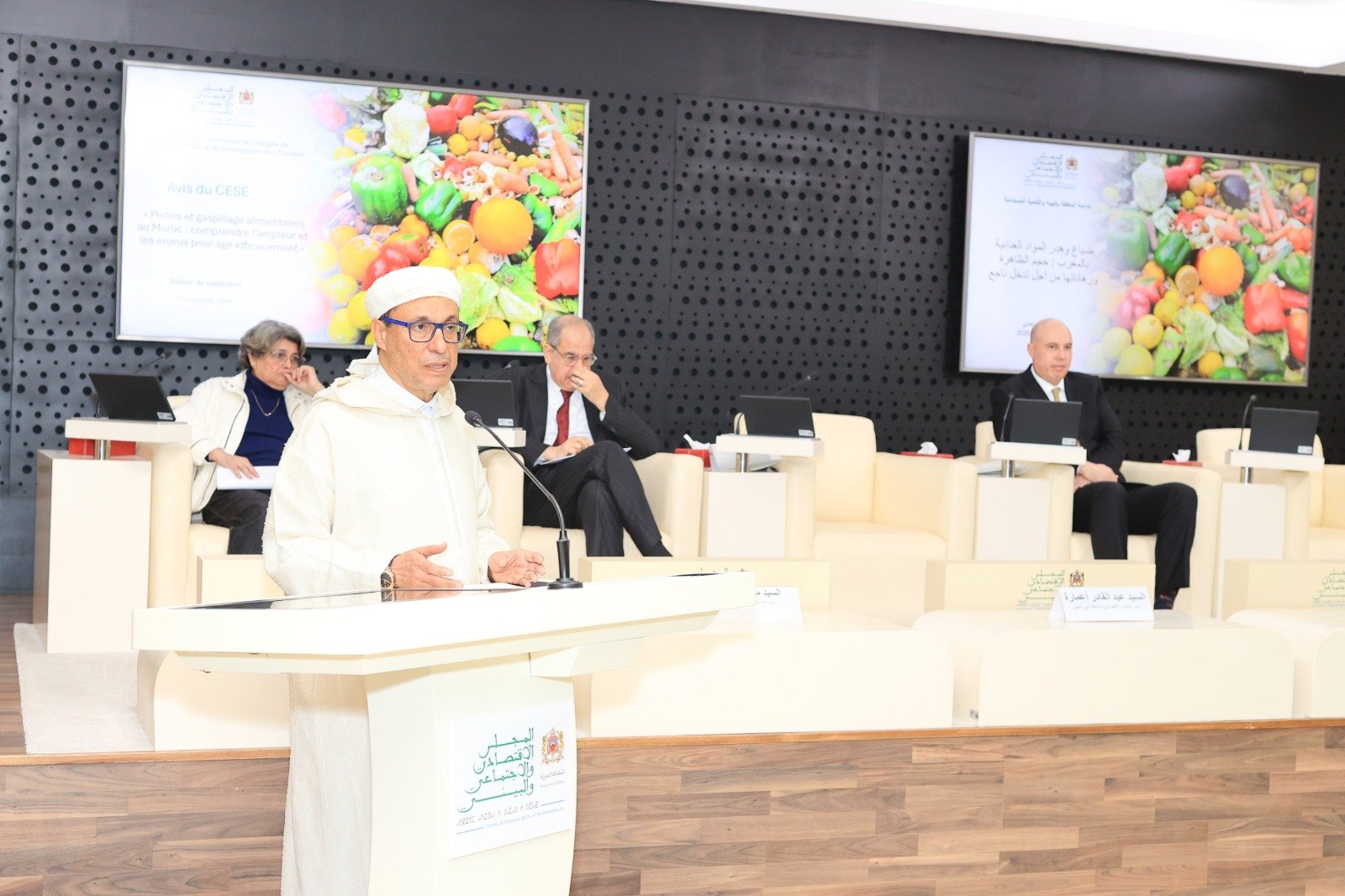
The opinion, titled “Food Losses and Waste in Morocco: Scale of the Phenomenon and Levers for Effective Intervention,” was unveiled during a communication event held on Wednesday.
CESE President Abdelkader Amara opened the session by stressing that food waste cuts across the entire food value chain – from production to consumption – and demands urgent structural responses.
The problem does not start at the dinner table. Across key agricultural sectors – including fruits, vegetables, and cereals – losses during production, harvest, storage, and transport reach between 20-40%.
Beyond the economic cost to producers and distributors, the environmental toll is severe. Over 1.6 billion cubic meters of water are consumed annually to grow food that never reaches final consumption. Decomposing food waste also contributes to greenhouse gas emissions and environmental pollution.
Why do Moroccans throw away so much food?
A citizen consultation conducted through CESE’s participatory platform “Ouchariko” gathered 1,591 responses and identified the leading causes of household food waste.
The most common reason cited was changes in the appearance or smell of food, mentioned by 25% of respondents – often leading consumers to discard products still safe to eat.
Expired use-by dates accounted for 21% of responses, reflecting widespread confusion between safety-based and quality-based labeling. Poor meal planning was cited by 16%, buying excess quantities by 12%, and insufficient knowledge of preservation methods by another 12%. Preference for fresh products and low product cost each accounted for smaller shares.
The products most frequently discarded were canned goods at 36%, ready-to-eat or quick-preparation meals at 35%, and fresh produce at 23%.
The council set no timeline but called for immediate implementation
Despite existing initiatives from both public institutions and private actors, CESE found that efforts remain scattered and poorly coordinated. No specific legal framework or integrated national vision currently governs the issue, limiting the effectiveness of existing measures.
The council proposed embedding food waste reduction at the core of a future national sustainable food strategy aimed at strengthening food sovereignty, preserving natural resources, and promoting a more resilient and equitable food model.
Among the priority measures, CESE called for enacting a dedicated anti-waste law that would prohibit the destruction of unsold food and facilitate its redistribution to associations, orphanages, and food banks.
It also recommended clarifying and harmonizing expiry date labeling by drawing a clear distinction between “use by” dates linked to food safety and “best before” dates linked to quality, while allowing for the extension or removal of dates where appropriate.
On governance, the council pressed for a multi-stakeholder mechanism bringing together government ministries, the private sector, and civil society. It also proposed creating a national food loss and waste observatory to centralize data, produce strategic indicators, and recommend corrective measures.
Operationally, CESE urged the development of storage and transport infrastructure in high-potential agricultural zones, including hermetic silos and solar-powered cold storage units. It recommended installing local processing units at the municipal level, including mobile mini-units capable of rapidly treating harvests and valorizing perishables.
The council further demanded that businesses adopt recycling and reuse practices, make food donations eligible under existing tax incentives, and integrate anti-waste objectives into public catering services, including hospitals, schools, and prisons.
On the digital front, CESE encouraged developing apps for stock management, product traceability, and redistribution of unsold goods. It also called for supporting grassroots initiatives such as community fridges and food donation platforms, and integrating food waste education into school curricula.
