


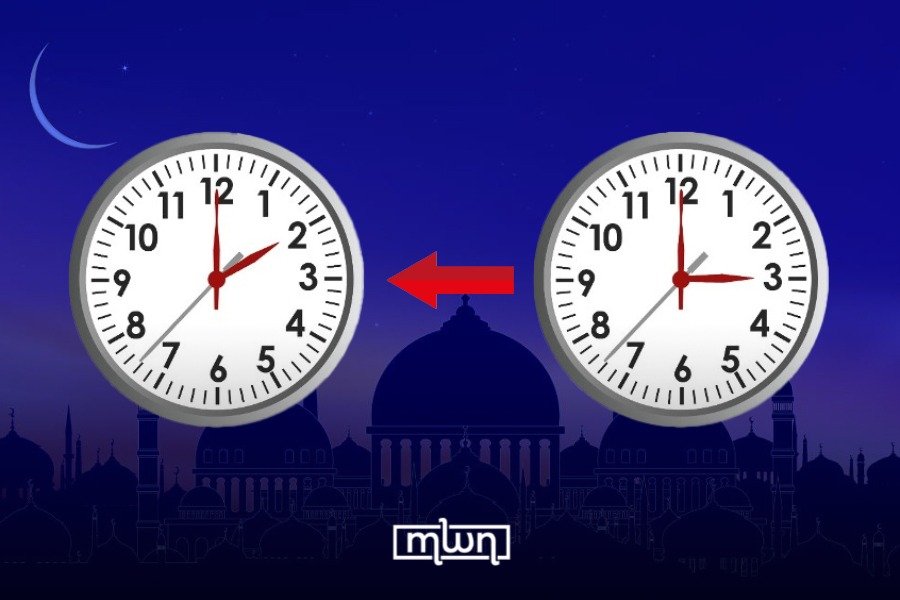
Marrakech – People in Morocco will gain an extra hour of sleep tonight, as the country switches back to Greenwich Mean Time (GMT) tomorrow, Sunday, February 15, at 3 a.m., temporarily suspending the GMT+1 system in place for most of the year.
The change, which involves setting clocks back by 60 minutes, coincides with the start of the holy month of Ramadan and follows a practice that has become routine in recent years.
Morocco will remain on GMT throughout Ramadan before advancing clocks forward again by one hour to GMT+1 on Sunday, March 22, at 2 a.m. Until then, daily rhythms across the country – from work schedules to school mornings – will realign with a time system many Moroccans describe as more natural and humane during the fasting month.
Alongside the time change, public administrations, local authorities, and public institutions have adopted continuous working hours from 9 a.m. to 3 p.m., Monday through Friday, for the duration of Ramadan.
The adjusted schedule is intended to reflect the physical and social demands of fasting, while allowing public services to continue operating without interruption. Special flexibility is also granted to enable employees to attend Friday prayers under appropriate conditions.
Morocco’s relationship with time, however, has been anything but settled. Since 2018, the country has officially adopted GMT+1 as a permanent time system, a decision the government has consistently defended on economic and strategic grounds.
Authorities have argued that a stable time regime reduces energy consumption, aligns Morocco more closely with key international partners, boosts productivity, and avoids the disruptions caused by repeated clock changes.
Yet despite these justifications, the issue has never ceased to provoke controversy. Each year, Ramadan acts as a reminder that the debate is far from resolved. Critics argue that permanent GMT+1 places a heavy burden on families, schoolchildren, and workers, particularly during dark winter mornings.
Others point to psychological strain, disrupted sleep patterns, and social imbalance – especially in rural areas – as evidence that the policy prioritizes economic calculations over lived realities. For these observers, the human cost has become too visible to ignore.
The temporary return to GMT during Ramadan has, in turn, intensified criticism rather than eased it. Many see the move as an implicit admission of failure, questioning why a time system deemed unsuitable for a single sacred month is enforced for the remaining eleven.
To them, the adjustment is not accommodation but selective concession, raising uncomfortable questions about consistency and intent.
More pointedly, some argue that the annual clock change amounts to instrumentalizing religion, bending sacred time to correct a secular policy that otherwise refuses scrutiny.
By invoking Ramadan as the sole justification for reverting to GMT, critics contend that the state appears to play with religious rhythms to offset social discontent, rather than confronting the structural flaws of the permanent GMT+1 regime itself.
For this camp, the yearly reset exposes a deeper contradiction: a clock designed to serve institutional efficiency and macroeconomic alignment, yet persistently at odds with social, biological, and spiritual rhythms.
The policy, they argue, acknowledges human limits only when fasting renders them unavoidable, not when families, students, and workers bear the strain year-round.
As Morocco once again resets its clocks tonight, the gesture is both practical and symbolic – an adjustment to a sacred month, but also a reminder of an unresolved national dilemma. The debate over time, balance, and daily life remains open, echoing far beyond the ticking of the clock itself.
Read also: When is Ramadan 2026 in Morocco?
