


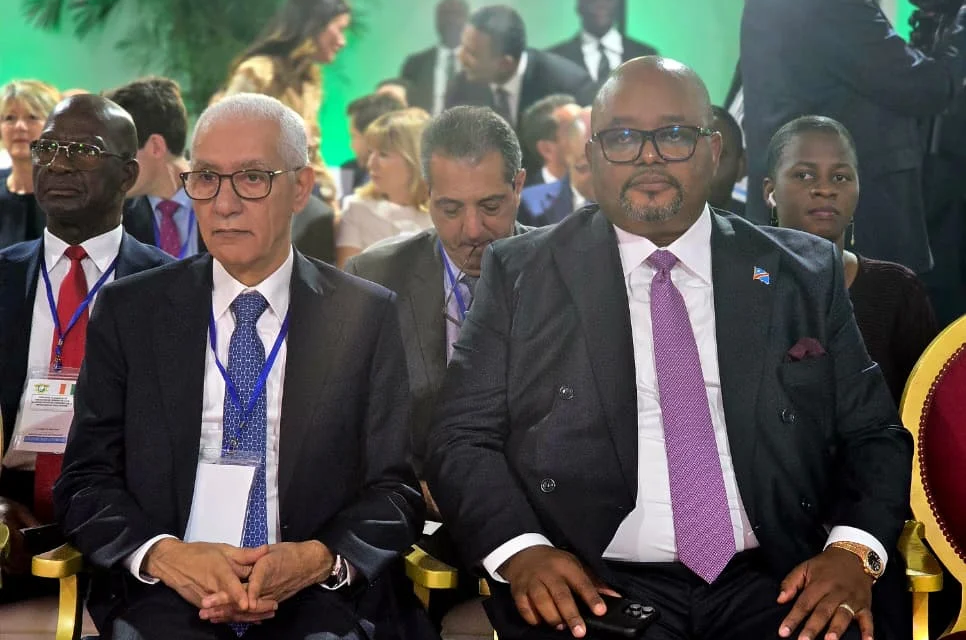
Marrakech – Rachid Talbi Alami, President of the House of Representatives, represented King Mohammed VI at the inauguration ceremony of Côte d’Ivoire’s re-elected President Alassane Ouattara on Monday in Abidjan.
Ouattara, who will turn 84 on January 1, was sworn in for his fourth five-year term at the Presidential Palace in the Ivorian economic capital.
The ceremony took place before eleven African heads of state from Angola, Congo-Brazzaville, Djibouti, Gabon, Senegal, Comoros, Ghana, Gambia, Liberia, Sierra Leone, and Mauritania, alongside former leaders, including Niger’s Mahamadou Issoufou and Francophonie Secretary-General Louise Mushikiwabo.
The Ivorian leader secured 89.77% of votes in the October 25 election, though voter turnout reached only 50.10%. Two main opposition figures, former President Laurent Gbagbo and Tidjane Thiam, were excluded from the electoral list due to legal decisions – Gbagbo for criminal conviction and Thiam over nationality issues.
In his inauguration speech, Ouattara promised that his fourth mandate would focus on “generational transmission.” He noted the country’s transformation since 2011, stating that Côte d’Ivoire had “restored state authority, consolidated peace, strengthened national cohesion and institutions, and ensured security across the national territory.”
The president outlined his foreign policy doctrine of making Côte d’Ivoire “a friend to all and enemy to none.” France was represented by National Assembly President Yaël Braun-Pivet, while the United States sent Under Secretary of State for Economic Growth Jacob Helberg, who met with Ouattara later that day.
King Mohammed VI had previously sent congratulatory messages to Ouattara following his re-election, expressing satisfaction with prospects for strengthening the strategic partnership between the North African kingdom and the West African country.
A model of exemplary South-South cooperation
Morocco and Côte d’Ivoire have built one of the closest and most structured partnerships in Africa, often described by officials on both sides as “exemplary” South-South cooperation rather than a conventional bilateral relationship.
Diplomatic relations were formally established on 16 August 1962, shortly after both nations’ independence, but the relationship deepened significantly from 2013 onward as King Mohammed VI made Côte d’Ivoire a central pillar of Morocco’s return to sub-Saharan Africa.
Since then, Abidjan has become a key stage for Moroccan royal diplomacy, symbolizing a shared African vocation and a long-term strategic bet on West Africa’s economic and political rise.
Royal visits have played a decisive role in transforming political goodwill into concrete programs. During the 2013 and 2014 visits to Abidjan, King Mohammed VI and President Alassane Ouattara chaired major Moroccan-Ivorian economic forums and high-level ceremonies that produced dozens of public-private and private-private partnership agreements.
In his Abidjan speeches, the King consistently framed Côte d’Ivoire as a strategic partner in a “shared future project,” stressing that both countries see themselves as fully African actors and natural bridges between North and West Africa.
This political narrative has underpinned a style of diplomacy where personal ties between leaders drive long-term sectoral cooperation rather than short tactical deals.
Morocco rises as a top West African investor
Economically, Morocco has become one of the most visible foreign investors in Côte d’Ivoire and in West Africa more broadly. Over roughly a decade, Moroccan outward FDI in sub-Saharan Africa has reached around $5 billion, making Morocco the second-largest intra-African investor and the leading investor in West Africa.
Flagship Moroccan groups in banking, insurance, telecoms, construction, real estate, and logistics have established strong presences in Abidjan, using Côte d’Ivoire as a regional hub.
The Ivorian-Moroccan Economic Forum institutionalized this trend, with agreements on investment promotion, export support, and SME development that aim to build reciprocal value chains rather than one-way penetration.
Agriculture and agro-industry have recently emerged as priority pillars of this partnership. The Moroccan agro-industrial investment forum in Côte d’Ivoire (FIAM-CI 2025), held in Abidjan from February 5 to 8, brought together Moroccan and Ivorian public and private actors around conferences, B2B meetings, and field visits focused on agro-industrial projects.
This forum explicitly positions Morocco’s experience in irrigation, fertilizer policy, and value-chain structuring as a toolbox for Côte d’Ivoire’s efforts to move from raw commodity exports (cocoa, cashew, etc.) to higher-value processing.
Parallel initiatives, such as Ivorian benchmark missions to the Moroccan National Agricultural Advisory Office (ONCA) to study wholesale markets and agro-pole models, show that the relationship is increasingly about technical transfer and institutional learning, not only capital flows.
Multidimensional ties reinforce the partnership
Beyond economics, religious and cultural ties form a distinctive layer of Morocco-Côte d’Ivoire relations that Rabat consciously leverages as soft power. Morocco promotes a Maliki-Ash‘ari, Sufi-influenced reading of Islam that it presents as a shared African religious heritage, and Ivorian authorities have actively engaged this offer.
The Mohammed VI Institute for the Training of Imams, Murshidīn and Murshidāt in Rabat trains religious personnel from several African countries, including Côte d’Ivoire, as part of a broader project to spread “moderate” and tolerant Islamic discourse.
The Mohammed VI Foundation of African Oulema, which coordinates religious scholars across the continent, also maintains a national section in Côte d’Ivoire and frames cooperation in religious, scientific, and cultural issues as a core component of the bilateral relationship.
Security and defense cooperation have clearly accelerated in the mid-2020s. Historically, Morocco contributed contingents to UN operations in Côte d’Ivoire (ONUCI), signaling its commitment to Ivorian stability at the height of the country’s post-conflict transition.
The two countries signed in May their first formal military cooperation agreement since 1962, covering training, joint exercises, military health, technical assistance, and expertise exchange.
This defence framework complements Morocco’s broader security role in West Africa and responds to shared concerns about terrorism, maritime security, and transnational crime. It also anchors Côte d’Ivoire more firmly within the network of African partners that see Morocco as a reliable security and intelligence interlocutor.
Judicial and governance cooperation is another area where Rabat and Abidjan have moved from symbolism to systemic collaboration. During recent high-level meetings, Ivorian officials spotlighted Morocco’s pioneering experience in digitizing and modernizing its judicial administration, and expressed their interest in using this model to reform their own systems.
Morocco, for its part, has emphasized its readiness to share know-how on court management, electronic procedures, and access-to-justice tools, framing this as part of a broader agenda to strengthen the rule of law and legal predictability for investors in both countries.
Such technical cooperation in justice complements the economic and security axes, reinforcing the idea of a “comprehensive” partnership.
The educational and human-capital dimension is less visible but equally strategic. Through the Moroccan Agency for International Cooperation (AMCI), Rabat offers scholarships, technical training, and capacity-building programs to thousands of African students and civil servants every year, with Ivorians figuring prominently among beneficiaries.
Joint workshops and training weeks organized in Abidjan by AMCI and partners – focused on themes like project management, local governance, or agricultural resilience – create networks of mid-career professionals socialized into Moroccan institutions and practices.
Over time, this produces a dense web of human connections: Ivorian alumni of Moroccan universities, Moroccan experts posted in Abidjan, and mixed teams in regional organizations and companies.
AFCON 2025 as a diplomatic showcase
Sport, especially football, has become a high-impact vector of connectivity between the two societies. Morocco will host the 2025 Africa Cup of Nations (AFCON) from December 21, 2025, to January 18, 2026, with defending champions Côte d’Ivoire playing their group-stage matches on Moroccan soil, including in Marrakech.
AFCON is a particularly cogent diplomatic project for Rabat. From infrastructure investments, VIP hospitality, to support for the continent’s federations, the pan-African championship is part of a broader strategy to project Morocco as a regional powerhouse and trusted partner.
For Ivorians, returning as reigning champions to a tournament hosted in Morocco symbolically reinforces the perception of the kingdom as a second home for African football, where West African fans, players, and businesses naturally converge.
From the perspective of international relations theory, the Ivorian-Moroccan case has become a classic example of structured South-South cooperation.
Academic work on the partnership notes that, after the failure of Maghreb regional integration, Morocco deliberately reoriented its external action toward sub-Saharan Africa, with Côte d’Ivoire emerging as one of the main anchors of this “African pivot.”
What makes the relationship distinctive is not only the volume of investments or the number of agreements, but the way political, economic, religious, and security dimensions reinforce each other.
Royal diplomacy provides the overarching narrative; state institutions build long-term frameworks; and private actors, banks, and agribusinesses turn that framework into everyday economic reality.
Both countries co-design West Africa’s future
The Western Sahara dispute remains the central prism through which Morocco assesses the reliability of its international partnerships, and Côte d’Ivoire has emerged as one of its most steadfast allies in this front.
Abidjan’s unwavering support for Morocco’s territorial integrity has transformed the bilateral relationship from a primarily economic partnership into a deeper framework of political solidarity. Its position on Western Sahara is widely viewed in Rabat as a key marker of strategic alignment.
This commitment was further institutionalized when Côte d’Ivoire upgraded its diplomatic presence, moving from an honorary consulate opened in June 2019 to a fully fledged Consulate General in Laâyoune in February 2020.
Looking ahead, the partnership between Morocco and Côte d’Ivoire is likely to deepen around three strategic clusters: green and resilient agriculture, security and defense, and regional connectivity (trade corridors, logistics, and financial services).
Recent forums in Abidjan – from agro-industrial investment events to resilience-focused conferences – already position the two countries as co-architects of West Africa’s next development phase.
At the same time, religious diplomacy, cultural exchanges, and mega-events like AFCON 2025 ensure that the relationship is not confined to elites but also resonates symbolically with broader publics.
In that sense, Morocco-Ivory Coast ties have moved well beyond traditional bilateral cooperation and now operate as a multi-layered partnership that shapes how both countries imagine their place in Africa and in the wider world.
