


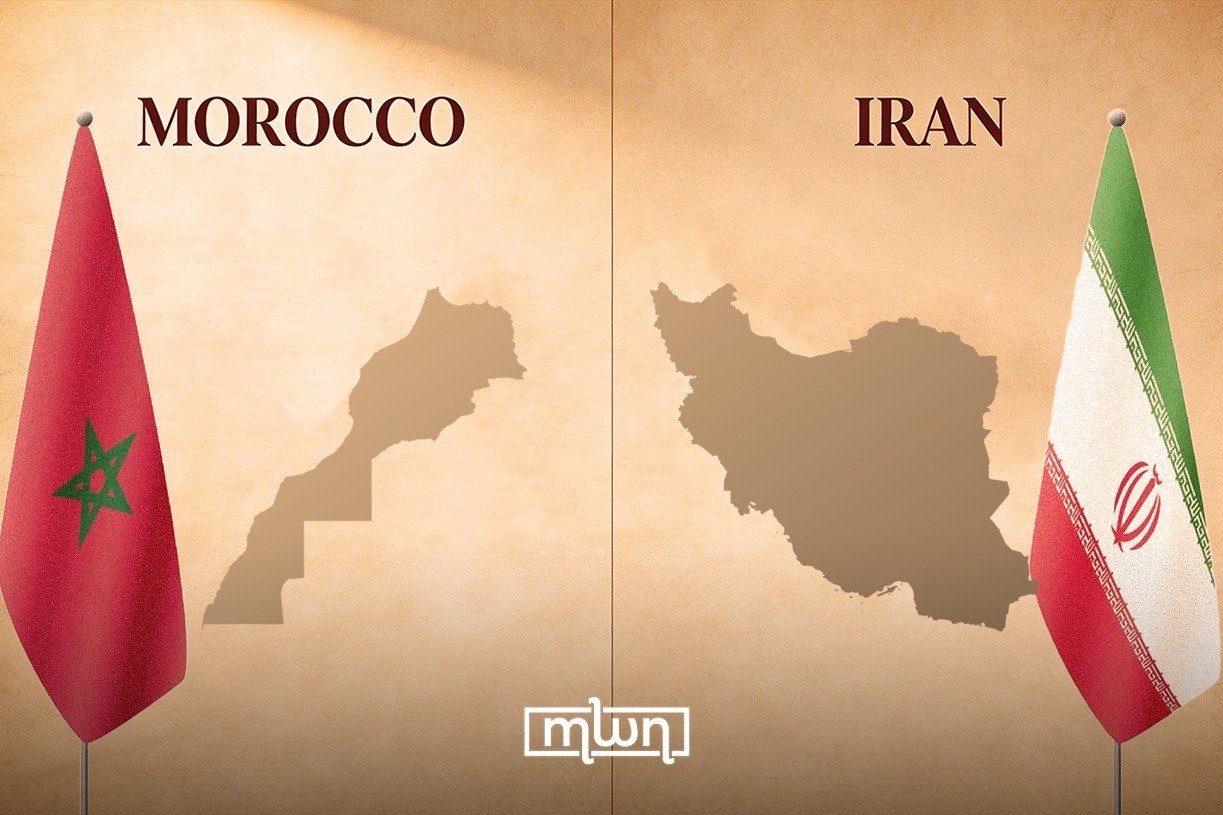
Marrakech – A majority of Moroccans do not view Iran’s political influence in the region as a critical threat to their national security. That is the central finding from the latest Arab Barometer Wave IX survey, conducted in fall 2025, which paints a picture of Moroccan public opinion that stands in tension with the kingdom’s official diplomatic posture toward Tehran.
Only 41% of Moroccans described Iran’s political influence as a critical threat. That figure places Morocco second-to-last among the seven countries surveyed, just above Palestine at 40%. Syria topped the list at 83%, followed by Iraq at 66, Jordan at 62, Egypt at 61, and Lebanon at 60.
Sixty percent of Moroccans said they view Iran’s nuclear program as a critical threat. That is a notable figure, but it remains the second-lowest in the survey. Syria again led at 85%. Egypt followed at 75, Jordan at 73, Lebanon at 71, and Iraq at 69. Palestine came in last at 55%.
These numbers matter because Morocco severed diplomatic ties with Iran in May 2018. Rabat accused Tehran of supporting the Polisario Front through its Lebanese proxy Hezbollah, citing what Foreign Minister Nasser Bourita described as hard evidence of military and logistical collusion via the Iranian embassy in Algiers.
Relations have remained frozen since then, though reports in late 2024 suggested that Iranian and Moroccan officials had met in Rabat and Riyadh to explore a possible resumption of ties, with Saudi and Emirati mediation.
But the war has redrawn the entire equation, and the calculus has changed – violently. The US-Israeli war on Iran, now in its 60th day, has deepened the fault lines between Arab governments and their publics.
Morocco was the first Arab country to express solidarity with the Gulf states after Iranian retaliatory missile strikes hit US bases across the region.
King Mohammed VI personally called the leaders of the UAE, Bahrain, Saudi Arabia, and Qatar. Bourita denounced, on many occasions, Iran’s “flagrant violation of national sovereignty” and demanded a unified Arab front against Tehran.
Yet Morocco’s streets have spoken in a language far louder than official statements. Tens of thousands have repeatedly marched through Rabat, Casablanca, Tangier, Marrakech, and other cities since the Gaza war began in October 2023.
Protesters have waved Palestinian flags, trampled Israeli ones, and chanted against normalization with the Hebrew state. And the mobilization did not end there. In the public imagination, standing with Palestine has increasingly meant standing with all those perceived to champion its cause, including the Tehran-led “Axis of Resistance.”
Since the US-Iran war erupted on February 28, Moroccans have once again taken to the streets, suggesting that public sympathy for Iran may run far deeper than any survey can fully capture.
The street now judges by stance, not by creed
The Arab Barometer data itself hints at this dynamic. Approval of the late Supreme Leader Ali Khamenei’s foreign policy toward the MENA region rose 12 points in Morocco, from 23% in both the 2021-2022 and 2023-2024 waves to 35% in 2025.
That increase mirrors a broader regional trend. Tunisia saw the sharpest jump at 29 points. Iraq and Palestine each rose by 20 points.
The Arab Barometer analysis, authored by Princeton’s Michael Robbins and published last Monday, argues that this rise is driven not by affection for Iran but by its perceived support for Palestinians during Israel’s war in Gaza.
Still, the survey also reveals that Moroccans’ views on Iran’s role in the Israel-Palestine conflict remain fragmented. Only 18% of Moroccans said Iran was more committed to defending Palestine than Israel. Another 19% believed the opposite. A full 33% contended Iran was equally committed to both sides. And 28% said Iran’s commitment was unclear.
That makes Morocco the only country in the survey where a clear majority did not credit Iran with championing the Palestinian cause. In Lebanon, 77% said Iran was more committed to Palestine. In Iraq and Tunisia, 62% made the same remark. In Egypt, the figure was 52%.
In six of the seven countries surveyed, at least 80% said Israeli occupation of Palestinian territories represented a critical threat. Egypt led at 96, Syria and Palestine at 92, Lebanon and Jordan at 88, and Iraq at 81. Morocco was the lone exception at 63% – still a clear majority.
On how Moroccans characterize events in Gaza, no single term dominated. Only 15% used the term “genocide.” Another 18% opted for “massacre,” while 19% described the events as a “conflict” and 15% called them a “war.” Eleven percent chose “mass killing,” 9% labeled it “ethnic cleansing,” and 7% settled on “hostilities.” Four percent applied all terms at once. Jordan, by contrast, had 46% going with “massacre” and 24% with “genocide.”
What the data ultimately suggests is that many Moroccans do not view Iran through the prism of Shia ideology or proxy networks. The Islamic Republic is instead seen through its willingness to confront Israel and the United States – something many across the Arab world feel their own governments have failed to do or, worse, have been complicit in enabling.
The Arab Barometer report concludes that public opinion across the region increasingly reflects a tension between viewing Iran as a threat and viewing Israel’s conduct in Gaza as an overriding injustice. Whether these trends hold, the report warns, will depend on how the ongoing regional inferno between Iran, Israel, and the United States continues to unfold.
Read also: Beyond Black-and-White Geopolitics: Iran as Frenemy of Morocco
