


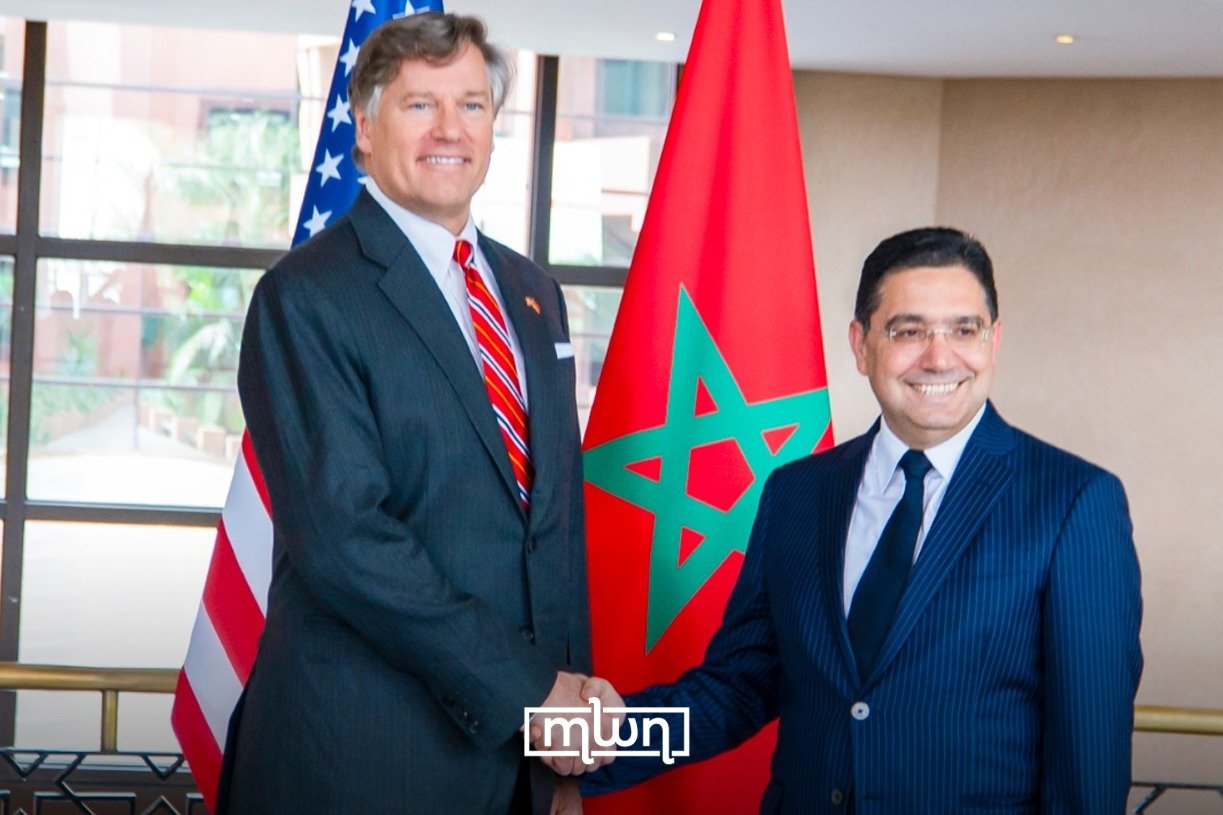
Marrakech – There was no ambiguity in Rabat on Wednesday, no diplomatic hedging, no parsed legalese designed to leave room for retreat. US Deputy Secretary of State Christopher Landau, standing shoulder to shoulder with Moroccan Foreign Minister Nasser Bourita after what both described as an excellent and frank meeting, delivered a message so categorical it left zero oxygen for the phantoms still clinging to the wreckage of the separatist project in the Sahara.
“The United States recognizes Morocco’s sovereignty over the Sahara,” Landau declared, before throwing his full weight behind Morocco’s Autonomy Plan as “the only basis for a just and lasting solution to the territorial dispute over the Sahara.” Not one of several bases. Not a promising framework among others. The only one.
The deputy secretary went further, announcing Washington’s active backing for American companies seeking to invest and conduct business in the Sahara – a pronouncement that effectively transforms diplomatic recognition into economic entrenchment.
He then invoked UN Security Council Resolution 2797, noting that “the United States is actively working with the UN and all parties” toward a mutually acceptable resolution, before delivering a warning that carried unmistakable finality: the solution “cannot wait indefinitely.”
View this post on Instagram
Landau’s rebuke of five decades of stasis was personal and visceral. “This can’t be that these kinds of conflicts last beyond the lifespan of human beings,” he told reporters, recalling that the dispute has festered since 1975, when he was eleven years old. “This situation cannot wait another 50 years or 150 years or 200 years to be resolved. That is ridiculous.”
The venue itself carried symbolic freight. Landau presided over Morocco’s signing of the Artemis Accords – making the kingdom the 64th nation and the fifth African country to join the international framework for peaceful space exploration. He pinned the Moroccan flag to his lapel alongside the American flag and declared: “I am now wearing your flag over my heart along with my flag.”
‘We can’t ask for a better partner than Morocco’
Additionally, Landau thanked King Mohammed VI for Rabat’s willingness to participate in what he termed “this common human endeavor, stressing: “I think we can’t ask for a better partner than Morocco.”
The deputy secretary’s maiden voyage to Morocco brimmed with gestures designed to telegraph permanence, not passing courtship. He announced that the United States will inaugurate its newest diplomatic facility in the world in Casablanca on Thursday – a consular outpost that will stand alongside America’s oldest diplomatic property, in Tangier, gifted by Sultan Mohammed III in 1821.
“The Kingdom of Morocco will be home to the United States’ newest diplomatic facility and its oldest diplomatic facility,” Landau observed, calling the symmetry a testament to both “the history of our relationship” and “the current and ongoing vibrancy of our relationship.”
He heaped praise on US Ambassador Duke Buchan as “one of our very best ambassadors around the world,” noting that President Trump appointed a personal confidant to Rabat as proof of the relationship’s strategic gravity.
Landau invoked the 250th anniversary of American independence and the nearly 250 years of Moroccan-American diplomatic ties – a bond born when Sultan Mohammed III became the first sovereign on Earth to recognize American independence in 1777.
He then pivoted to the commercial dimension of the partnership, painting Morocco as a land of untapped windfalls for American capital. The deputy secretary spoke of “many, many opportunities for win-win solutions,” calling Morocco “one of the most dynamic economies in this part of the world, a critical player in many areas.”
The United States, he ventured, possesses “capital and expertise that can be helpful to Morocco in realizing your country’s full potential and the full potential of your very talented citizenry, your human capital.” He lavished particular praise on the investment climate Rabat has cultivated, telling Bourita directly: “We really value the stability that you have created here, the certainty that you give American investors.”
Landau reserved some of his most personal remarks for Bourita himself, saluting the minister’s longevity and acumen on the world stage with a candor seldom heard at diplomatic lecterns.
“You have been around for a long time in diplomatic circles, and I really do respect and appreciate the wisdom that you bring to these issues,” Landau told him, adding that their exchanges were “very, very frank” – the kind of unvarnished dialogue that unfolds only “between friends.” He thanked King Mohammed VI, Bourita, and the people of Morocco for the “warm hospitality,” before confessing that the kingdom had already captivated him on first contact.
“This is my first time in your country. I know you have many beautiful areas,” Landau offered, mapping out an itinerary that would carry him from Rabat to Casablanca and then to Marrakech.
“I will be seeing a little bit of your country, but not enough,” he conceded with visible warmth, before closing with a declaration that doubled as both a personal pledge and a geopolitical marker: “I hope this is the first of many visits here, because Morocco has a friend in me and in the United States of America.”
A triptych of commitments
For his part, Bourita placed the encounter within the broader architecture of a partnership that has never been more multifaceted or more consequential. Speaking in Arabic, the top Moroccan diplomat declared that the bilateral relationship is experiencing “a very distinguished period in terms of its richness and its strength, thanks to the shared vision of His Majesty King Mohammed VI and President Donald Trump.”
Bourita catalogued the dimensions of the alliance with methodical precision: a free trade agreement – the only one Washington maintains with an African nation – that has multiplied bilateral commerce several times over; the launch of the 22nd edition of the African Lion military exercises, the largest of their kind on the continent; and Morocco’s adhesion to Washington’s “Trade Over Aid” initiative, unveiled by US Ambassador to the UN Mike Waltz in New York the previous day.
On the Sahara, Bourita unequivocally described the US position since the historic phone call between King Mohammed VI and President Trump on December 10, 2020, as “a watershed moment” in bilateral relations. He affirmed that Washington is now championing a path toward “a final solution within one single framework – the Autonomy Initiative under Moroccan sovereignty.”
Ambassador Buchan reinforced the triptych of commitments on social media, writing that “US businesses are ready to support King Mohammed VI’s vision for Morocco’s future, including in the Sahara.” He reiterated American recognition of Moroccan sovereignty and support for the Autonomy Plan as “the only basis for a just and lasting solution,” concluding with a sentence that read less like diplomacy and more like a verdict: “The time for peace and prosperity is now.”
Excellent conversation between Foreign Minister Bourita and Deputy Secretary Landau. We discussed opportunities to deepen our enduring 250 year relationship across all sectors. U.S. businesses are ready to support King Mohammed VI’s vision for Morocco’s future, including in the… pic.twitter.com/xK5EwmaeqL
— Ambassador Duke Buchan (@USAmbMorocco) April 29, 2026
The Rabat press conference did not occur in a vacuum. Landau arrived in Morocco after a stopover in Algiers, where he met President Abdelmadjid Tebboune and a constellation of cabinet ministers alongside AFRICOM Commander General Dagvin Anderson.
The Algerian leg, ostensibly devoted to trade and counterterrorism, carried an unspoken subtext that Algiers can no longer evade: Washington’s patience with the custodians of the Tindouf camps and the bankrollers of the moribund Polisario project has evaporated.
That message was delivered bluntly during an April 17 encounter in Antalya, where Trump’s special envoy for Arab and African affairs, Massad Boulos, reportedly pressed Algerian Foreign Minister Ahmed Attaf to dismantle the Tindouf camps and accept the Autonomy Plan as the foundation for a final settlement. Algeria dangled access to hydrocarbons and rare minerals as a counter-offer. Boulos walked away.
Political analyst and author Samir Bennis, writing on his X account, placed the day’s events within a trajectory he has charted for years. Bennis recalled that Trump’s December 2020 proclamation – which many described as “a tectonic shift” and “the beginning of the end for Polisario’s increasingly untenable and unworkable separatist agenda” – was in truth “the brutal confirmation” of a direction that Moroccan diplomacy had set in motion over two decades.
“On December 10 of the same year, meaning less than a month after Morocco’s FAR restored order in the border town, the Moroccan stance in the Sahara conflict gained an even more unprecedented, historic boost when then US President Donald Trump took to Twitter to announce… https://t.co/uxcVB9rogb
— Samir Bennis (@SamirBennis) April 29, 2026
The demolition of the Polisario’s statehood fantasies, Bennis argued, “did not start with America’s resolute embrace of the Moroccan proposal.” Rather, Moroccan diplomacy had already succeeded in “enshrining a politically negotiated solution as the only path likely to achieve a mutually acceptable and lasting political solution.”
The Western Sahara story, he wrote, “has been radically heading in Morocco’s direction for much of the past two decades, with Polisario’s erstwhile seductive, galvanizing rhetoric having increasingly failed to garner the same sympathy and active support it once did.”
The timing of Landau’s visit compounds the pressure on the Polisario’s battered remnants and their Algerian patrons. UN Secretary-General Antonio Guterres is expected to present a strategic review of MINURSO’s mandate to the Security Council on April 30 – a review mandated under Resolution 2797.
Ambassador Waltz has already signaled that any renewal must be tethered to a genuine political process anchored in the Autonomy Plan. Secretary of State Marco Rubio’s 2026-2030 strategic plan has committed the State Department to winding down costly and ineffective peacekeeping missions worldwide – a category in which MINURSO, deployed for over half a century with nothing to show for it, fits with grim precision.
Meanwhile, the Polisario’s own leaders have begun capitulating in plain sight. The front’s pseudo-foreign minister, Mohamed Yeslem Beisat, confessed to Spain’s El Español that his movement “cannot make independence the only option.”
He later told El País that autonomy under Moroccan sovereignty “can be discussed and accepted.” Six countries have withdrawn recognition of the fictitious Sahrawi republic in the past two years alone. No nation has extended new recognition since 2011.
Landau’s visit to Rabat was not a courtesy call. It was the sound of a gavel – deliberate, resonant, and final.
