


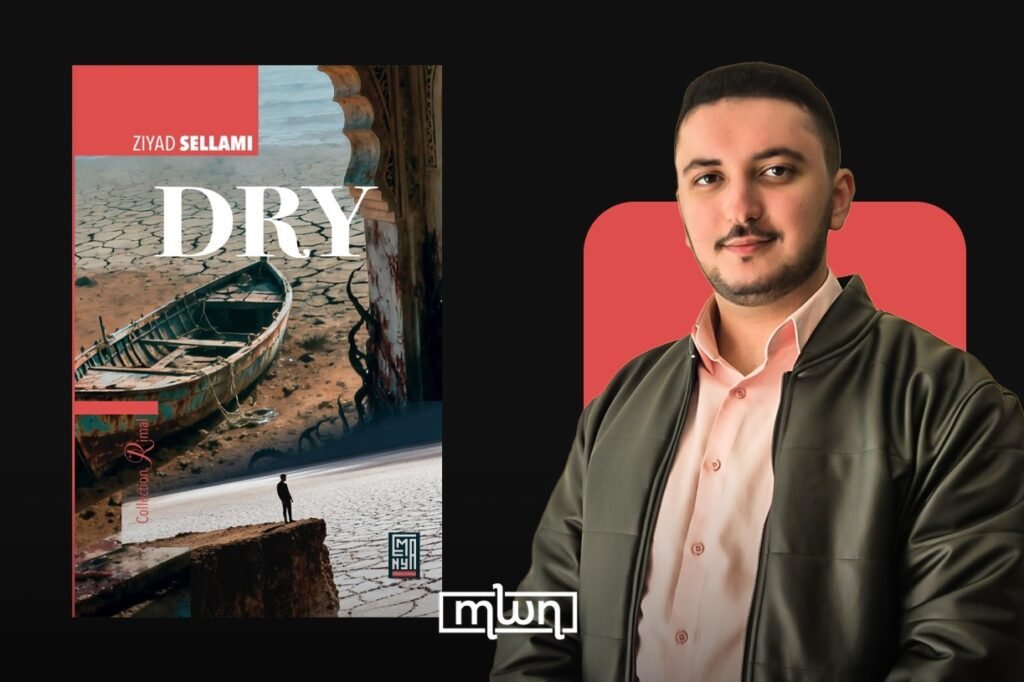
Casablanca – A young Moroccan writer is exploring what happens when something as constant as the sea simply disappears, in a debut novel shaped by memory, absence, and unease.
In an exclusive interview, Ziyad Sellami, 22, told Morocco World News his first novel “Dry” started with a simple moment at home, not a grand idea. He was sitting with his father, looking out at the sea, when a passing comment changed everything. “What if it just disappeared?” his father said. The thought stuck.
Sellami said it wasn’t just the image that stayed with him, but the feeling behind it. “Something so constant, so unquestioned, could vanish without explanation,” he said. From there, the story grew into something more introspective, less about the event itself and more about what comes after.
In “Dry,” the sea is already gone when the story begins. No storm, no warning, just absence. The tension doesn’t come from waiting for something to happen, but from trying to understand what already did. “It had to come from understanding what had already happened, and what it meant,” Sellami said.
He set the story in Mohammedia, a place closely tied to his own life. Sellami moved there as a child, and much of his memory is shaped by that coastline. “The sea isn’t just a backdrop, it’s part of how I experienced growing up,” he said.
There is great intentionality behind that choice. The more familiar the place, the more disturbing the idea becomes. A fictional setting, he suggested, would create distance, while a real one does the opposite bringing the loss closer.
What makes the novel more unsettling is how people respond. Most characters don’t react with shock as they don’t even remember the sea. Life adjusts around the absence, almost quietly. Only one character, Younes, holds on to that memory, and it isolates him. “It’s not comforting, it’s destabilizing,” Sellami said.
Read also: Rabat Launches ‘World Book Capital 2026’ Program Ahead of Book Fair
The contrast drives the story. Memory becomes fragile, but also resistant. Denial, on the other hand, isn’t always a choice, but feels built into the world itself.
Sellami, who is both a teacher and a student, said that constant observation shapes the way he writes. Watching how people interpret reality, or sometimes don’t question it at all, feeds into the story in subtle ways.
He chose to write “Dry” in English, describing it as both instinctive and deliberate. The language gives him distance, he said, helping him approach the story’s abstract tone with more clarity. Still, the core remains rooted in Morocco. “The words are in English, but the world, the rhythm, and the perspective are shaped by where I’m from,” he said.
“Dry,” at its core, is an attempt to capture that liminal state when something essential is missing, even if no one else seems to notice anymore.
Sellami isn’t trying to give readers clear answers. If anything, he’s aiming for the opposite. “I hope the book stays with them as a kind of lingering uncertainty,” he said.
Morocco World News is also on X — check out our latest posts now! Get MWN on iOS and Android for instant access to breaking news.