


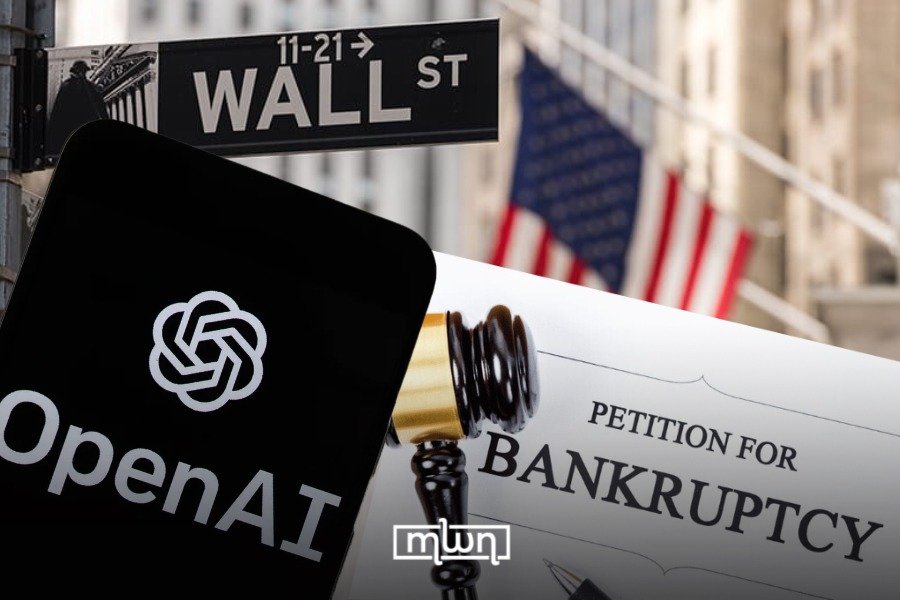
Rabat – Wall Street’s unease over AI is increasingly shifting away from technology itself and toward the economics of building it, according to a recent reporting that highlights the scale of financial pressure facing leading developers such as OpenAI.
Since the public release of ChatGPT more than three years ago, generative AI models have advanced rapidly, gaining the ability to generate realistic images and videos, solve complex reasoning and mathematics problems, and process extremely large volumes of text.
Monthly usage of generative AI tools now exceeds one billion users worldwide, showing how quickly the technology has entered everyday digital life.
Despite this uptake, monetization remains limited. Most users rely on free versions of AI services, and competition among model providers has made it easy for customers to switch platforms if fees, ads, or usage restrictions are introduced.
As a result, revenue growth has lagged far behind rising development and infrastructure costs.
However, it’s not a straightforward prediction, research on business adoption has produced mixed conclusions. A study published by the Massachusetts Institute of Technology (MIT) in mid-2025 found that only about 5% of corporate AI projects had delivered clear success, despite an estimated $30 billion to $40 billion invested by companies in generative AI initiatives.
In contrast, a Wharton School survey released in October, based on interviews with 801 executives at US companies, reported that roughly 75% of firms were already seeing positive returns from AI-related spending.
Financial disclosures and media reports indicate that the cost burden on developers is intensifying.
According to reporting by The Information, OpenAI projected cash burn exceeding $8 billion in 2025, with losses potentially rising above $40 billion by 2028.
The Wall Street Journal separately reported that the company expects to reach profitability by 2030.
In March 2025, OpenAI raised $40 billion in a single private funding round, the largest ever recorded, surpassing previous records set by Ant Group in 2018 and the Saudi Aramco initial public offering in 2019.
OpenAI has also committed to large-scale infrastructure expansion. Public statements and partner disclosures indicate planned spending of up to $1.4 trillion on data centers and related facilities over time.
However, industry analysts note that even with revisions or alternative financing, capital requirements across the AI sector remain unprecedented.
Bain & Company estimated in 2025 that the industry could face an $800 billion funding gap, even under favorable market conditions.
Analysts emphasize that these financial pressures do not reflect a lack of technological progress. Instead, they point to the capital-intensive nature of training and operating advanced AI models.
Established technology firms such as Microsoft, Google, and Meta are funding AI development through profits from existing businesses, while independent developers rely heavily on external capital.
The outcome of this imbalance is now becoming a central focus for investors assessing the future shape of the global AI industry. Time will only tell whether OpenAI will prove its a worthy investment.
Read also: WAM Morocco Brings Global Industry Leaders to Casablanca for Manufacturing Summit