


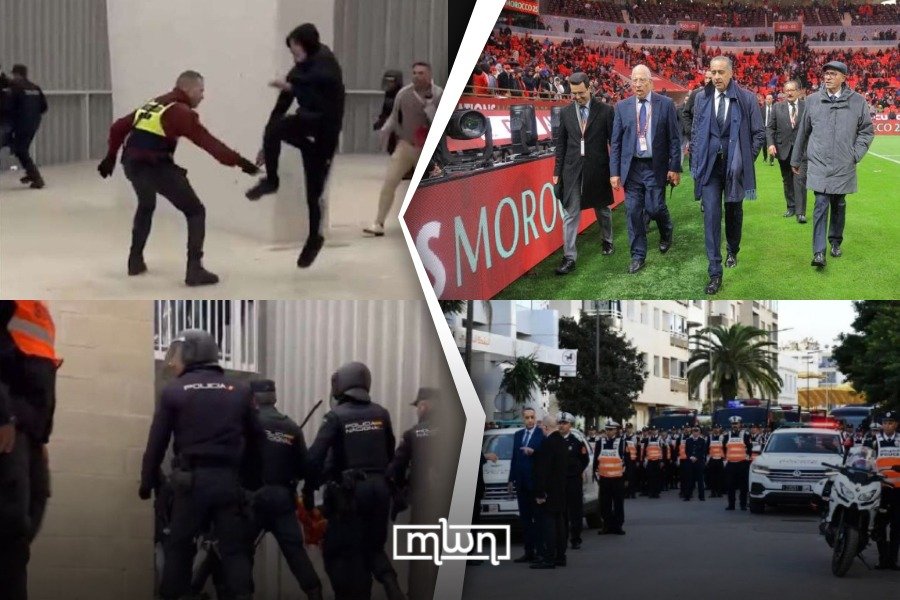
Rabat – When a high-stakes football match turns volatile, security can either protect the game or become the headline.
That’s the real lesson from two recent nights that should matter deeply to FIFA and to every fan looking ahead to the 2030 World Cup, which will be hosted by Morocco, Portugal, and Spain.
Rabat: a flashpoint handled with discipline
On January 18, Rabat’s Moulay El Hassan Stadium hosted the Africa Cup of Nations final in what ended in a tense atmosphere. The stadium was full, the host nation was under pressure, and a late VAR decision added fuel to emotions.
When Morocco was awarded a penalty against Senegal, the Senegalese players walked off in protest. The match stopped, and the situation threatened to spiral out of control.
What followed could have turned into a disaster. Senegalese fans tried to enter the pitch, and the atmosphere grew dangerous.
But Morocco’s security forces chose a different path. Instead of using force, they focused on containment and calm. Officers did not hit or push fans back; they worked to ease the tension and control the crowd without escalating violence.
This approach raised the bar for how major events can be handled. In moments where panic or aggression could have spread, Morocco showed restraint. The priority was to keep order and prevent the match from collapsing into chaos.
By choosing de-escalation over punishment, Morocco avoided the kind of images that can haunt host nations for decades.
The final became not only a test of football but also a test of security standards. Morocco passed that test by showing that discipline and calm can prevent disorder even in the most volatile moments.
Morocco’s security response during the AFCON final was not luck. It was the result of deliberate planning. Abdellatif Hammouchi personally reviewed match protocols, stressing layered deployment, surveillance, and coordinated command.
The approach reflected modern, risk-based planning similar to what FIFA promotes for major stadium operations.
The preparation also drew international attention. In early January, U.S. FBI officials visited Rabat to observe match-day security. They examined the use of drones, high-definition cameras, mobile and fixed command centers, and coordination with the African Security Cooperation Center.
Whether those visits were meant to benchmark or build partnerships, the message was clear: Morocco’s security model was treated as a case study. It was not seen as a regional footnote but as an example of how to manage risk at major sporting events.
Pamplona: a celebration turned into panic
On February 21, 2026, Pamplona’s El Sadar stadium should have been celebrating Osasuna’s 2-1 win over Real Madrid. Instead, the night ended in chaos after clashes between fans, private security, and Spain’s National Police.
The trouble began when a supporter threw a small bottle onto the pitch. Referee Alejandro Quintero handed it to Osasuna’s delegate, Pedro Arozarena. After the match, private security waited in the South Stand corridors to detain the fan.
Tensions rose, and several supporters confronted them. The Police Intervention Unit (UIP) was called in, leading to baton charges and running through the stadium corridors. The fan who threw the object was eventually arrested.
Outside the stadium, police carried out more charges, using riot shields and firing rubber bullets. Some fans were hit with batons, and another person was arrested for attacking authority. Official sources told Diario de Navarra outlet that at least two police officers were injured.
According to Diario AS, the club itself admitted that “scenes of panic” broke out among supporters leaving the stadium.
That phrase is serious. Panic in corridors and stairwells can quickly lead to crowd compression and injuries. Modern crowd management is designed to prevent exactly this kind of situation.
Even sticking only to what mainstream coverage confirms, the picture is troubling: force-first policing in confined spaces produced the chaos that careful planning is supposed to avoid.
For Spain, which will co-host the 2030 World Cup and is pushing to stage the final, the incident raises serious questions about readiness and standards.
The double standard Moroccans keep noticing
Here’s the uncomfortable truth: if footage of baton charges and post‑match panic in narrow corridors came from Casablanca, Rabat, or Tangier, the global reaction would be immediate. Morocco would be framed as a case study in “repression,” and headlines would spread faster than the facts.
Yet, when the same kind of fear‑driven scene happens in a European co‑host country, it tends to remain a largely domestic story. For the Pamplona incident, coverage stayed mostly in national outlets like AS and Marca, with any follow ups coming from the club or local authorities.
That media imbalance is real, and it undermines trust. It suggests that “rights‑based policing” is applied selectively, depending on geography.
The irony is that FIFA’s own guidance stresses proportionate, risk‑based deployment – namely polite, welcoming communication among security officers as a way to reduce tension and encourage compliance.
Human‑rights standards go further: for unlawful but non‑violent assemblies, authorities should avoid force whenever possible, and if force is used, it must be limited to the minimum necessary.
2030 is coming, and Morocco is acting like it
Morocco’s AFCON final in Rabat proved something important for 2030. Even in a shocking moment, players walking off, anger in the stands, and fans trying to storm the pitch, the stadium stayed under control. Security focused on calm and containment, and the match did not turn into a national crisis.
Pamplona’s El Sadar showed the opposite risk. After Osasuna’s win over Real Madrid, police charges and rubber bullets in tight corridors turned celebration into fear.
Both countries will share the World Cup spotlight. Right now, Morocco looks like it is building a modern playbook, planned, layered, tech‑enabled, and restrained. Spain’s Pamplona images look like a warning from the past.
In order to ensure a safe, smooth tournament affixed to global standards, co-hosting countries should mirror continued mutual progress, not the opposite. With time still to go before the all three countries open their doors, the aim is for Morocco to continue to me a model about how to act when chaos strikes in stadiums.
