


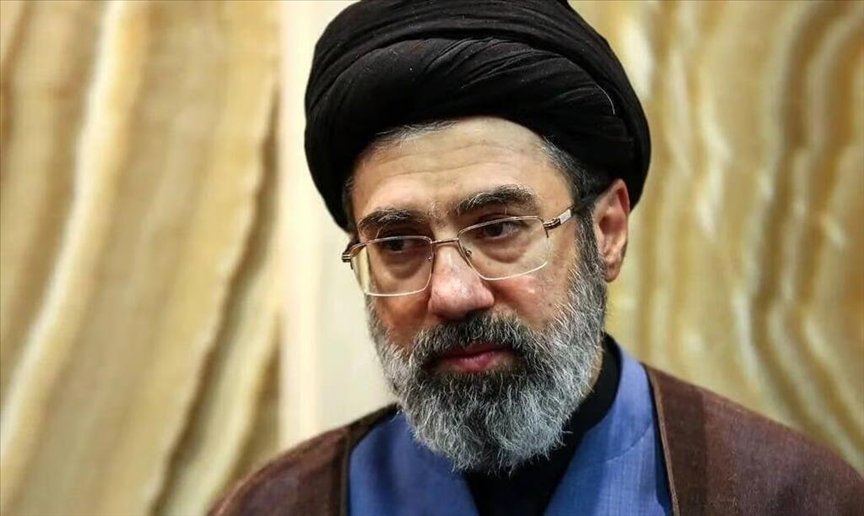
Marrakech – Iran’s Assembly of Experts has formally named Mojtaba Khamenei as the country’s third supreme leader. The 88-member clerical body selected the 56-year-old cleric to succeed his father, Ayatollah Ali Khamenei, who was killed in a US-Israeli airstrike on his compound in Tehran on February 28.
Mojtaba’s wife, Zahra Haddad-Adel, his mother, his sister, his brother-in-law, and his nephews were also killed in the strike. Mojtaba was not present at the compound and has not been seen publicly since.
The Assembly said the decision was reached through a “decisive vote” and urged all Iranians to pledge allegiance. Iran International reported that the Revolutionary Guards pressured the body into the selection, with members subjected to intimidation during online sessions held under active US-Israeli bombardment. A March 3 Israeli strike had already hit the Assembly’s own office in Qom.
Critics argue the IRGC installed Mojtaba not because he is qualified but because he is controllable. A supreme leader who lacks religious authority, strategic vision, and popular legitimacy is one who owes everything to the men with guns. For the Guards, a controllable leader is worth more than a legitimate one.
His appointment signals that hardline factions retain firm control of the Islamic Republic. It also defies Washington directly. Trump dismissed Mojtaba as “a lightweight” and said any new leader not coordinated with the US would “not last long.” Israel’s defense minister vowed to assassinate whoever was chosen.
The selection creates a dynastic paradox at the heart of a republic founded on the rejection of monarchy. The 1979 revolution was built explicitly on the premise that the transmission of sovereign authority through bloodline was ontologically illegitimate. A son now succeeds his father in the highest office in the land.
Ayatollah Ruhollah Khomeini, in his 1970 treatise “Islamic Government,” did not argue that the Pahlavi monarchy was merely corrupt, or inefficient, or Western-aligned. He argued that hereditary kingship was an affront to the very architecture of Islamic governance and fundamentally incompatible with Islam.
The entire edifice and theoretical scaffolding of “Velayat-e Faqih” (the Guardianship of the Islamic Jurist) was constructed as the antithesis of lineal succession, and was erected on this single, load-bearing claim: that the Islamic jurist derives his authority from jurisprudential merit, religious erudition, knowledge, piety, and divine sanction mediated through clerical consensus – not from the accident of patrilineal descent.
A secretive figure now commands a nation at war
Mojtaba Khamenei was born on September 8, 1969, in Mashhad, one of Iran’s major religious centers. He is the second of Ali Khamenei’s sons. He grew up as his father rose from revolutionary activist to president and then to supreme leader.
He completed secondary school at Tehran’s Alavi High School, a prestigious institution that produced many of the Islamic Republic’s elite, including former foreign minister Javad Zarif.
He then entered the seminary in Qom, studying Islamic jurisprudence under prominent conservative scholars including Mohammad-Taqi Mesbah-Yazdi, Mahmoud Hashemi Shahroudi, and Lotfollah Safi Golpaygani.
Mesbah-Yazdi was an influential ideologue who mentored many hardline political figures and fiercely opposed republicanism. He argued the supreme leader should be appointed without regard for public consent. Mojtaba embraced this worldview.
For more than 15 years, Mojtaba taught dars-e kharej, the highest level of seminary instruction in Shia jurisprudence. Reports from the Qom seminary’s news agency indicate he reached the rank of Ayatollah in 2022.
In October 2024, he unexpectedly suspended his classes in a video message, describing the decision as “a matter between myself and God.” Analysts interpreted the move as a political maneuver tied to succession planning.
He married Zahra Haddad-Adel, daughter of Gholam-Ali Haddad-Adel, a prominent conservative politician and former parliament speaker. The marriage was widely viewed as a strategic alliance between the supreme leader’s office and a conservative technocratic faction. The couple had three children.
His public record is thin; his behind-the-scenes influence is not
Mojtaba has never held elected office, never delivered a public address, and never given a political interview. Most Iranians have never heard his voice. Yet US diplomats have for decades called him “the power behind the robes.”
His ties to the Islamic Revolutionary Guard Corps date to his teenage years. In the mid-1980s, during the final phase of the Iran-Iraq War, he served in the IRGC’s Habib ibn Mazaher Battalion. Several of his comrades from that unit went on to become senior commanders and intelligence figures, including Qasem Soleimani, Hossein Hamedani, and Hossein Taeb, the former head of IRGC intelligence.
Mojtaba’s name first surfaced in national politics during the 2005 presidential election. Mehdi Karroubi, a losing candidate, wrote an open letter accusing him of engineering votes in favor of Mahmoud Ahmadinejad. Four years later, during the mass protests that followed Ahmadinejad’s disputed reelection, demonstrators chanted slogans directly against Mojtaba, rejecting the prospect of his succession.
He was widely identified as one of the key figures overseeing the crackdown on the 2009 Green Movement. He faced the same accusations during the nationwide protests earlier this year, when UN bodies and human rights organizations said state forces killed thousands of people, mostly on the nights of January 8 and 9.
US diplomatic cables published by WikiLeaks described him as his father’s “principal gatekeeper” and noted he had been forming his own power base. A 2008 cable stated he was “widely viewed within the regime as a capable and forceful leader” and a “plausible candidate for shared leadership.”
His financial empire has drawn increasing international scrutiny.
A Bloomberg investigation found that Mojtaba built a vast network of investments through shell companies, with high-value real estate in London, Frankfurt, and Dubai, and interests linked to shipping, banking, and hospitality. The assets were not held in his name but structured through intermediaries and layered entities across multiple jurisdictions.
Bloomberg also tied him to Ali Ansari, whose Bank Ayandeh was forcibly dissolved after going bankrupt from loans to unnamed insiders. The bank’s collapse pushed Iran’s inflation higher and required partial compensation through public funds. Neither Mojtaba nor Ansari publicly addressed the allegations.
The US Treasury sanctioned him in 2019, stating he played a role in advancing his father’s policies through political and security networks. And he remains under Western sanctions.
A country under bombardment and a system under strain
Mojtaba takes power as the US-Israeli war on Iran enters its second week. Oil has surged past $100 a barrel. The Strait of Hormuz, through which a fifth of the world’s oil passes, has seen tanker traffic come to a near standstill. G7 finance ministers are discussing emergency oil reserve releases. Gulf states hosting US bases have come under Iranian fire, with strikes reported in Saudi Arabia, Bahrain, and the UAE.
Iran’s armed forces leadership has pledged allegiance to the new supreme leader. He now commands the country’s military, the IRGC, and a stockpile of highly enriched uranium that could be weaponized if he chooses.
His clerical rank remains a point of contention. He is a hojatoleslam, a mid-level cleric, not an ayatollah by the constitutional standard required of a supreme leader. His father faced the same issue in 1989, and the law was amended. A similar accommodation is expected.
For foreign capitals, his near-total absence from diplomatic settings represents uncertainty. He has no executive record, no known meetings with foreign officials, and no public positions on Iran’s nuclear program or relations with global powers. His political orientation is rooted in deep distrust of the West and commitment to expanding Iran’s regional influence through the so-called Axis of Resistance.
Former Prime Minister Mir Hossein Mousavi, under house arrest since 2011, once asked whether the dynasties of 2,500 years had returned so that a son could succeed his father. On Sunday, the Assembly of Experts answered that question.