


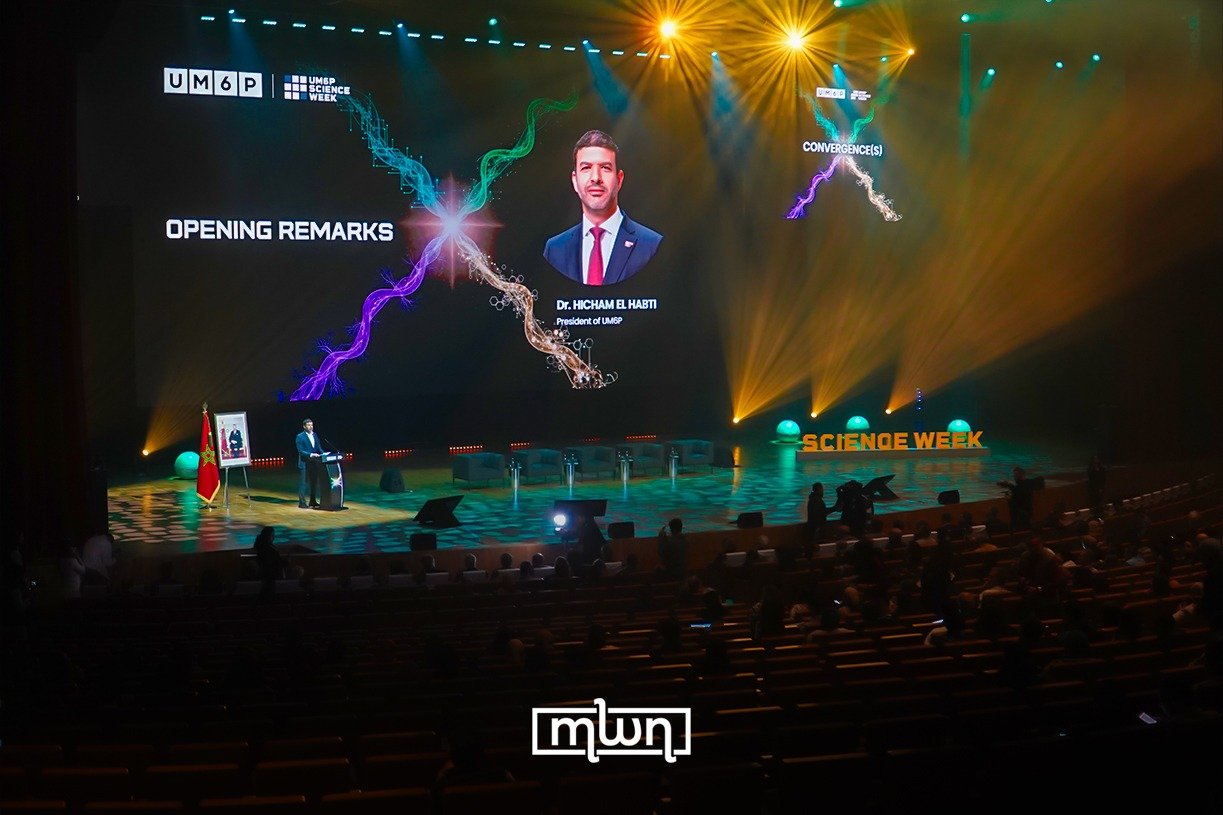
Benguerir – The University Mohammed VI Polytechnique (UM6P) launched the sixth edition of its Science Week on Monday in Benguerir. The event, running through April 5, brings together more than 100 international scientists and experts under the theme “CONVERGENCE(S).”
The week-long program explores how scientific disciplines are increasingly merging at their boundaries. Sessions pair multiple academic departments and address intersections ranging from nanomaterials and medicine to artificial intelligence and education, to agriculture and environmental science.
The choice of theme follows a deliberate trajectory. Over the past five editions, UM6P Science Week has moved through the frontiers of knowledge, complexity, transitions, and future-shaping. Convergence, according to organizers, is the logical next step – a recognition that the most significant scientific breakthroughs now emerge at the interfaces between disciplines rather than within them.
View this post on Instagram
Among the headline speakers, Victor J. Dzau, President of the US National Academy of Medicine, delivered the opening keynote. Nobel laureate Omar M. Yaghi, pioneer of metal-organic frameworks (MOFs), is scheduled to address the role of advanced materials in energy and environmental transitions.
Steve Levine, founder of the Living Heart Project, will present advances in digital modeling and virtual twins. Paula A. Harrison, Co-Chair of the IPBES Nexus Assessment, brings a perspective on biodiversity, climate, and public policy interactions.
Science without ethics is incomplete
UM6P President Hicham El Habti set the tone in his opening remarks, framing the university’s identity around the relationship between research and teaching.
“Research without transmission remains silent. Teaching without inquiry becomes repetition. It is in their articulation that a university truly exists,” El Habti said.
He described Science Week as the “visible form” of that mission, and called on departments to present “not only results, but questions, methods, hesitations, perspectives.”
Scientific disciplines have operated too long in isolation, El Habti argued, stressing: “We have become masters of our own corridors, experts in our own rooms. This has given us depth, but it has also built walls. The great challenge of our century – from the urgency of climate change to the enigma of consciousness – refuses to stay within a single room.”
He also put into focus the university’s responsibility to ensure knowledge reaches beyond the laboratory. “We hold the responsibility to accompany its transformation into technologies, into industries, into tangible contributions to Morocco, Africa, and the world,” he pledged.
But El Habti was careful to recast convergence as a matter of ethical weight, not only scientific opportunity. “Convergence amplifies both our power and our responsibility,” he asserted. “The question is not only what we can do, but what we choose to do and under which frameworks of responsibility.”
He closed his remarks with an image borrowed from French philosopher Michel Serres. The French thinker wrote about the Harlequin figure in commedia dell’arte, whose coat is stitched from different fabrics, colors, and histories.
“I hope that we leave here not with our disciplines intact, folded and untroubled,” El Habti posited. “But to leave here more like Harlequin’s coat: marked by the encounters we have had, the patches we have received from others, the colors we did not know we could wear.”
The program follows a fixed daily structure. Mornings feature parallel sessions organized by departments. Afternoons extend discussions through roundtables and workshops. Evenings include documentary screenings and informal exchanges. The closing event on April 5 will feature a conference on the convergence of arts and reveal the theme of the 2027 edition.
‘The Cambridge of the Rhamna’
In an interview with Morocco World News (MWN), Science Week Scientific Director and Moroccan writer Fouad Laroui explained the rationale behind the event.
“We ask every department to present their work and also to show us that they are really at the frontiers of science,” Laroui stated. “We shouldn’t be behind the ambition of Morocco and the ambition of our university. It’s not to be behind Europe, America, Japan, but being exactly at the same level, or even first.”
He described convergence as a shift toward a larger purpose. “All sciences are starting to converge towards a bigger goal, which is human health and the earth, the soil, the air that we breathe,” he contended.
Laroui spoke candidly about the university’s ambitions for Benguerir. “Who would have thought that a couple of years ago?” he said. “I suggest that we call it the Cambridge of the Rhamna, because that’s the ambition, to become the place in Morocco where scientific research is done in collaboration with everyone.”
He framed the broader case for science in direct terms. “A Moroccan born 100 years ago had almost a 100% chance to be dead by the age of 40. Now, we can live to be 80, 90, maybe sometimes even more, and in good health,” he said.
He added, however, that caution remains essential. “People who thought of using science to make an atom bomb are not very, very nice people. But generally speaking, science has been good for humanity.”
“We intend here at Benguerir to pursue science exactly with that objective in mind, to do something useful for humankind and certainly for Morocco to start with. Let’s be even more specific – for Rhamna first and then for Morocco and then for the world,” Laroui maintained.
Specialization built walls
In a separate interview with MWN, Raphael Liogier, a sociologist and founder of the Chair of Transitions at UM6P’s Institute of Advanced Studies, traced the origins of the convergence theme.
“What made science successful until now is actually divergence – specialization, the fact that you have different disciplines,” Liogier told MWN. “But there was this new phenomenon at the end of the 20th century. Step by step, it was becoming more and more successful to converge, to use one science with another.”
He cited artificial intelligence as a central example. “Artificial intelligence was created out of neural networks. Neurons – so it’s biological. But by imitating neural networks, we thought we could create some kind of artificial brain,” he shared.
He pointed to neural prosthetics as another case where the line between biology and engineering has dissolved entirely. “The nervous system is the perimeter of our body. But now that you can plug an engineer-made artifact into our body, is it biological or is it engineering? We don’t know,” he asked.
“But the only thing is that we don’t really know where it’s converging,” Liogier said. “And that’s one of the reasons for this Science Week. It’s also to think about where this convergence is heading.”
The event is open to both the UM6P community and the general public. It forms part of the university’s broader ambition to anchor Morocco in the international scientific landscape.
