


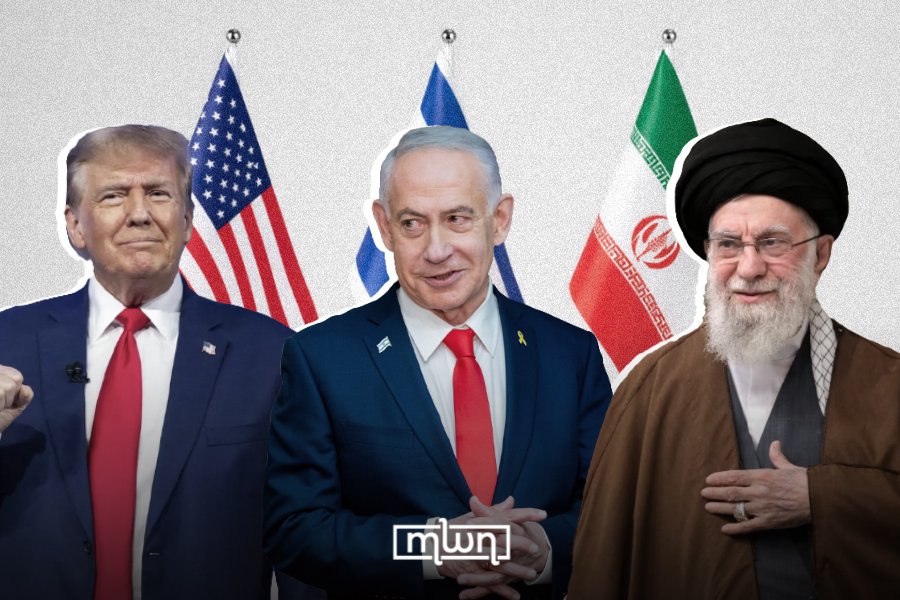
Marrakech – The United States and Israel launched a large-scale military offensive against Iran on Saturday, February 28. The joint operation struck multiple cities across the country. Tehran retaliated within hours, firing missiles at Israel and US military bases across the Middle East. The escalation came despite ongoing nuclear negotiations between Washington and Tehran.
US President Donald Trump confirmed the strikes in a video posted on Truth Social. “A short time ago, the United States military began major combat operations in Iran,” he said, describing the operation as “massive and ongoing.” The US Department of Defense named the mission “Operation Epic Fury.”
Israel’s Defense Minister Israel Katz declared it a “pre-emptive attack.” Israeli Prime Minister Benjamin Netanyahu said the operation, dubbed “Lion’s Roar,” aimed to “remove the existential threat posed by the terrorist regime in Iran.” He called on Iranians to “take their destiny into their own hands.”
Explosions were first reported in Tehran around 9:27 a.m. local time. Missiles struck University Street, the Jomhouri area, and near the Islamic Revolutionary Guard Corps (IRGC) headquarters. The Associated Press (AP) reported a strike near the offices of Supreme Leader Ayatollah Ali Khamenei. Satellite imagery showed extensive damage at his compound.
Explosions were also reported in Isfahan, Qom, Karaj, Kermanshah, Tabriz, Ilam, and Lorestan province. Iran’s airspace was shut down. Internet connectivity dropped to 4%, and cellphone service was cut in parts of Tehran. An Israeli military official said the US and Israel had worked “for thousands of hours” to build a target bank.
Iran’s Revolutionary Guard reportedly began closing the Strait of Hormuz, a critical global chokepoint through which approximately one-fifth of the world’s oil and gas passes. Ships received warnings from the IRGC that no vessel is permitted to pass through the waterway.
Trump and Netanyahu urge Iranians to aid regime change efforts
Trump framed the strikes as a response to decades of Iranian hostility. He cited the 1979 hostage crisis, the 1983 Beirut barracks bombing, attacks on US forces in Iraq, and Iran’s backing of Hamas. “For 47 years, the Iranian regime has chanted death to America,” he said.
He stated the military objectives clearly. The US aimed to destroy Iran’s missile capabilities, annihilate its navy, disrupt Iran-backed armed groups, and prevent Iran from obtaining a nuclear weapon. “They can never have a nuclear weapon,” Trump repeated.
Trump also called for regime change. “When we are finished, take over your government. It will be yours to take. This will probably be your only chance for generations,” he told Iranians. He offered immunity to members of the Revolutionary Guard who lay down their weapons. Those who do not, he warned, would face “certain death.”
Netanyahu echoed the message. He urged ethnic groups, including “the Kurds, the Azeris, the Balochis and the Ahwazis,” to “throw off the yoke of tyranny.” A Reuters report quoted a US official as saying the Trump administration was planning a “multiday operation.”
Israel said it targeted Iran’s supreme leader, president, and head of the armed forces. An Israeli military official confirmed that “several senior figures essential to the management of the campaign and the regime’s governance were eliminated.” No names were provided.
Iran’s Foreign Minister Abbas Araghchi told NBC News that Khamenei was alive “as far as I know” and that President Masoud Pezeshkian was unharmed. Earlier on Saturday, an Iranian official told Reuters that Khamenei was no longer in Tehran and had been relocated to a “secure location.”
Iran hits back across the Middle East
Iran retaliated swiftly. The Revolutionary Guard announced a “crushing response.” They declared that all US and Israeli assets in the region were “legitimate targets,” vowing to continue strikes “relentlessly until the enemy is decisively defeated.”
Tehran launched ballistic missiles at Israel, sparking air-raid sirens and explosions in northern areas, including Haifa.
Iran also struck US military facilities across the region. Targets included Al Udeid Air Base in Qatar, Al-Salem Air Base in Kuwait, Al-Dhafra Air Base in the UAE, and the US Navy Fifth Fleet headquarters in Bahrain. Explosions were also reported in Riyadh, Saudi Arabia, and in Jordan.
The UAE confirmed one person was killed by falling debris in Abu Dhabi. Qatar said it “successfully countered” attacks on its territory. Kuwait intercepted multiple ballistic missiles. Jordan destroyed two missiles targeting its territory. Kuwait International Airport was hit by a drone, causing minor injuries and damage.
New verified footage showed an explosion striking the Fairmont hotel on Dubai’s Palm Jumeirah. Dubai authorities confirmed four people were injured and emergency teams brought the resulting fire under control. The man-made archipelago is known worldwide for its luxury hotels and tourism appeal.
As of Saturday afternoon, no American casualties had been reported. US officials stressed the assessment was preliminary and the situation remained fluid. A text message sent to cellphones in Iran warned that Iran’s response would be “faster, more forceful, and more extensive” than the 12-day war with Israel last June.
Several major carriers, including Emirates, Qatar Airways, Air France, Lufthansa, Turkish Airlines, British Airways, and Royal Air Maroc, suspended flights across the region, as multiple countries closed their airspace until further notice.
Civilian toll and claims of a school strike
Iranian state media reported that at least 53 people were killed in an Israeli strike on a girls’ primary school in the southern county of Minab. Iranian Foreign Minister Araghchi said the school was “bombed in broad daylight, when packed with young pupils.” The Israeli military said it was looking into the reports.
In Tehran, heavy traffic clogged roads as residents rushed to pick schools and stock up on essentials. Long lines formed at bakeries and gas stations. The government ordered people to stay home. Schools and universities were closed. Banks remained open. Government offices operated at half capacity.
The Basij militia, overseen by the Revolutionary Guard, began patrols across Tehran’s 22 districts. The deployment raised concerns about internal unrest. Iran’s Interior Ministry warned it would “preserve order and peace,” a signal directed at potential protesters.
Authorities advised nearly 10 million Tehran residents to evacuate.
The world reacts with alarm
UN Secretary-General António Guterres condemned the military escalation, saying the strikes and Iran’s retaliation “undermine international peace and security.” A UN Security Council emergency meeting was called for later Saturday.
The UK, France, and Germany issued a joint statement. They condemned Iran’s retaliatory strikes but stopped short of fully endorsing the US-Israeli operation. “We did not participate in these strikes,” the three leaders said. They urged Iran to “seek a negotiated solution.”
UK Prime Minister Keir Starmer said British planes were “in the sky” in the Middle East for defensive operations. Russia condemned the strikes as “a pre-planned and unprovoked act of armed aggression.” China called for an end to military action.
Saudi Arabia condemned what it called “brutal Iranian aggression” against Gulf states. Oman’s Foreign Minister said he was “dismayed” that “active and serious negotiations have yet again been undermined.” He urged the US “not to get sucked in further,” saying “this is not your war.”
Morocco issued a firm condemnation of what it called an “abject” Iranian missile attack targeting five Arab Gulf states, describing the strikes as a “flagrant violation of national sovereignty” of the UAE, Bahrain, Qatar, Kuwait, and Jordan.
The UN rights chief called for immediate de-escalation, warning that civilians “always pay the ultimate price.”
A ‘huge gamble’
The operation drew immediate comparisons to the 2003 Iraq invasion. Chatham House experts warned that “collapsing or attempting to collapse a regime is far easier than shaping what follows.” Iran has about twice Iraq’s population and three times its geographic area.
Trump campaigned against regime-change wars. His own national security strategy, published two months ago, said the days when the Middle East dominated US foreign policy “are thankfully over.” Yet the scale of Saturday’s strikes suggests objectives far beyond coercive diplomacy.
There is no organized political opposition inside Iran capable of replacing the regime. Reza Pahlavi, the exiled son of the deposed Shah, called on Iranians to prepare for “the final battle.” But it remains unclear how much support he commands inside the country.
“You don’t do regime change from the air,” warned Chatham House Director Bronwen Maddox. She noted the US already has multiple stated objectives – ending Iran’s nuclear program, destroying its missiles, and supporting Iranian protesters. “That is a recipe for confusion,” she said.
Even if Khamenei were removed, Iran’s Revolutionary Guard operates as a powerful military-industrial complex running much of the economy, and one of its commanders could simply take charge. Maddox concluded bluntly: “This has the makings of the kind of enduring conflict that Trump said he didn’t want.”
Laurel Rapp, Director of Chatham House’s US and North America Programme, called the operation “a high-risk break with decades of US policy.” She said the American strategy is “wholly predicated on the untested proposition that the Iranian people will quickly rise up – a huge gamble.”
Should a mass revolt fail to materialize, the Trump administration would face a stark choice: fold or double down. Rapp noted that Trump ran on ending forever wars and bringing troops home. “Trump’s desire to project strength and ‘win’ may quickly supplant the popular mandate that brought him back to power – as well as his own strategy,” she warned.
A senior Middle East diplomat told NBC News that Israel “intervened to preempt diplomacy” as nuclear talks appeared “close to success.” Araghchi told NBC News that Iran was willing to de-escalate if the strikes stopped. “This is a war of choice by the United States,” he said.
Georgetown University professor Marc Weller concluded that the US “cannot claim to have acted in its own defence,” noting that talks were progressing and no imminent threat existed. Oil prices were expected to rise when markets reopen, with analysts predicting a $3 to $5 per barrel increase.
The legal basis for the strikes also faces scrutiny. Constitutional law experts noted the absence of congressional authorization. Senator Andy Kim called on Congress to return and vote on a war powers resolution. The situation remained fluid as of Saturday evening, with US officials confirming strikes would continue.
Some analysts argue that the real issue with Iran is not its nuclear program or authoritarian governance, but its persistent refusal to align with the US-Israeli vision for the Middle East, making it the last major regional power resisting Western strategic dominance.
Others have also questioned the timing of the operation, contending that Trump may be using the military escalation to divert public attention from mounting domestic controversies, including renewed scrutiny over his alleged ties to the late Jeffrey Epstein and the release of related files.
While the White House has not addressed these claims, the pattern of launching major foreign policy actions during periods of domestic pressure is not new in American politics.
Read also: Should Moroccans Celebrate the Fall of Iran’s Theocratic Regime, Venezuela’s Maduro?
