


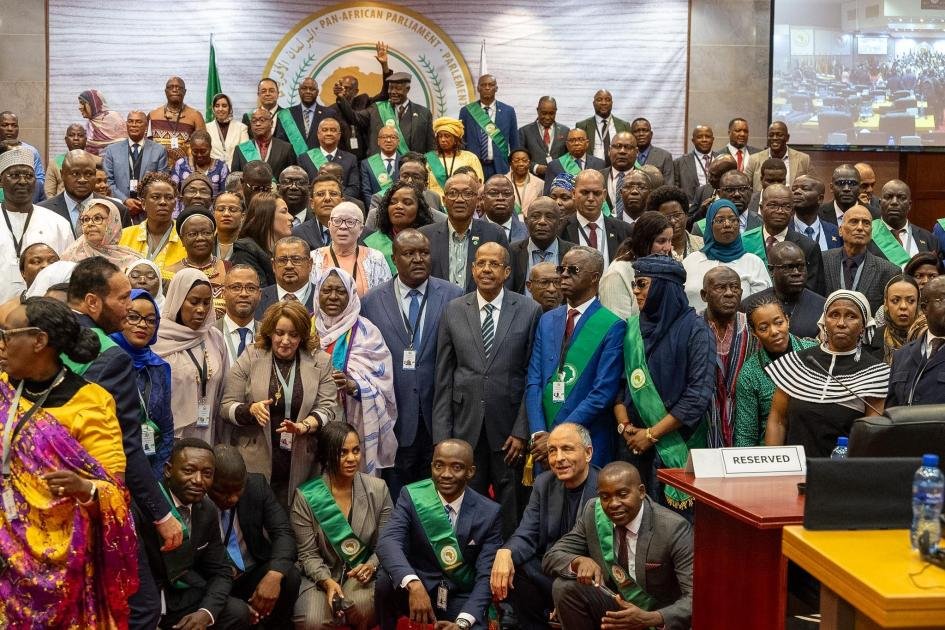
At a time when Africa more than ever needs unity, coherence, and credible institutions, the recent election process within the Pan-African Parliament (PAP) raises legitimate questions—not only about the outcome, but about the conditions under which it was produced.
This is not a matter of personalities. It is a matter of principles.
The presidency of the Pan-African Parliament is not a symbolic function. It carries political weight and institutional responsibility in a context where Africa is navigating major geopolitical, economic, and governance transformations. Such a position must derive its legitimacy from a process that is clear, transparent, and beyond reproach.
Yet, the proceedings within the North Africa Caucus were marked by a series of irregularities that cannot be overlooked.
From the outset, the process revealed significant procedural weaknesses. A first meeting that failed to produce a consensus was followed by a second sequence whose legitimacy raises questions, particularly in light of the conditions under which it was conducted. The framework that was meant to guarantee neutrality appeared to be compromised, notably through the intervention of actors whose role did not include presiding over such deliberations.
More concerning still was the apparent imposition of a voting process in the absence of consensus—contrary to the spirit that has traditionally guided the functioning of regional caucuses. In such settings, consensus is not incidental; it is a foundational mechanism that ensures cohesion and collective ownership.
When that mechanism is bypassed, the result is not merely disagreement—it is a structural weakening of the process.
The immediate consequence is clear: the candidate emerging from such a process cannot fully claim to embody a unified regional position. This is not a question of individual merit, but of collective legitimacy. A mandate derived from a contested process inevitably affects the authority of the office it seeks to establish.
This is precisely what the Pan-African Parliament must avoid.
At a time when Africa is striving to strengthen its continental integration—through initiatives such as the African Continental Free Trade Area (AfCFTA) and the broader ambitions of Agenda 2063—its institutions must reflect the values they promote: transparency, accountability, and respect for established rules.
When internal procedures fall short, institutional credibility is weakened externally.
The implications extend beyond this specific election.
Allowing such precedents to stand risks normalizing practices that undermine the rule-based functioning of continental institutions. The issue is not only procedural; it is structural. Institutions draw their strength not solely from their mandates, but from the confidence they inspire.
And that confidence is fragile.
It is built through consistency, fairness, and the uniform application of rules. It can be quickly eroded when these principles appear to be selectively interpreted or disregarded.
What is required now is not escalation, but clarity.
The questions raised by this process deserve to be addressed with seriousness and institutional responsibility. This includes a careful examination of the procedures followed, the roles played by the various actors, and the extent to which the outcome genuinely reflects the will of the regional grouping concerned.
Such an approach is not an act of contestation. It is an act of institutional preservation.
Preserving the credibility of the Pan-African Parliament is a shared responsibility. It requires a collective commitment to uphold not only the letter of the rules, but also their spirit.
There are pathways forward that respect both institutional continuity and the need for legitimacy.
A return to a framework grounded in consensus remains essential. A reaffirmation of procedural clarity and neutrality is equally necessary. Ultimately, what matters is not the speed at which decisions are made, but the legitimacy of the process that produces them.
In institutional life, how decisions are made is often as important as the decisions themselves.
The Pan-African Parliament stands at a critical juncture. It can choose to reinforce its credibility by addressing these concerns with transparency and rigor. Or it can allow ambiguity to persist, at the risk of weakening the very foundations of its authority.
Africa deserves institutions that are not only representative, but respected.
This moment should be seen not as a point of division, but as an opportunity to reaffirm a shared commitment to the principles that give strength and meaning to the continental project.
Because legitimacy is not proclaimed. It is earned.