


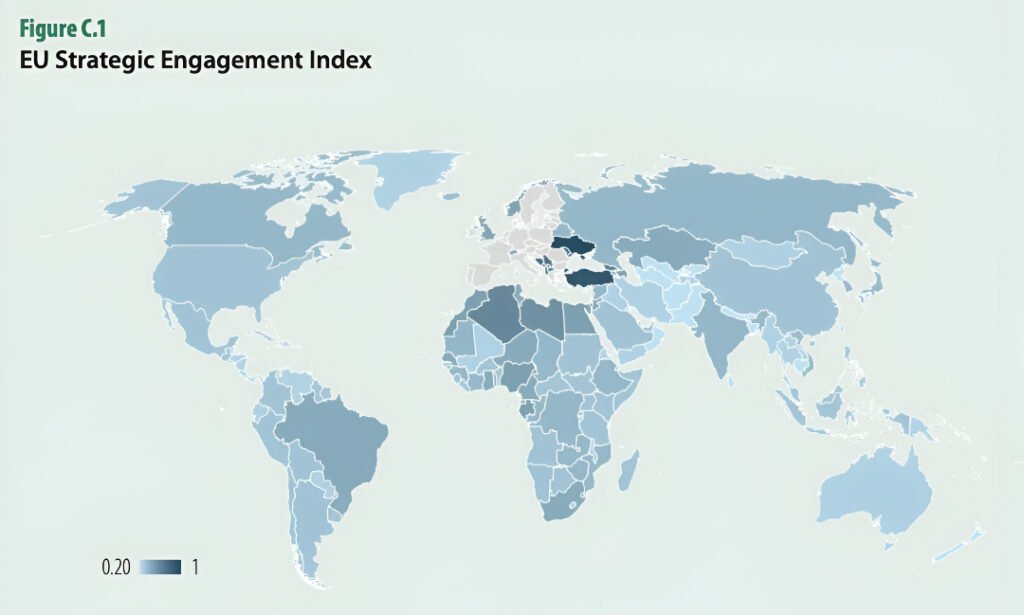
Marrakech – The European Investment Bank (EIB) published on Tuesday its annual Investment Report 2025/26, titled “Capitalising on Europe’s Strengths.” Page 41 of the report features a world map illustrating the EU Strategic Engagement Index, displaying Morocco’s complete, uncut territory, including Western Sahara, with no separating border line.
This is the first time an EU institution adopts such a representation in an official publication, signaling the EU’s increasingly overt support for Morocco’s territorial integrity.
The move comes just weeks after the 27 EU member states adopted a unified position backing Morocco’s autonomy plan for Western Sahara on January 29 during the 15th EU-Morocco Association Council session in Brussels.
The joint statement also celebrated the adoption of UN Security Council Resolution 2797 on October 31, 2025, which for the first time narrowed the framework for negotiations exclusively to the autonomy plan proposed by Morocco, consolidating international backing for Rabat’s approach and further shrinking the political space for separatist narratives at the multilateral level.
The EIB report is a 334-page assessment of Europe’s investment landscape amid a shifting global order. Sourced from the EIB Economics Department, the EU Strategic Engagement Index is a composite indicator measuring each country’s strategic relevance to the bloc.
It factors in trade volumes, depth of trade agreements, foreign direct investment from EU countries, energy security, critical raw materials supply, alignment in UN General Assembly votes, and inclusion in EU-Africa strategic corridors and Global Gateway priority sectors.
Page 41 also notes that EU trade relevance “is the highest in the Western Balkans, the Eastern Candidate Countries (Ukraine, Moldova and Georgia), and North Africa (above 40%).”
It further flags that in the first seven months of 2025, following a tariff shock, EU companies lost some trade share in Morocco, Lebanon, and Algeria within the Middle East and North Africa region. On the other side, EU trade became more relevant in Tunisia, Libya, Armenia, and various sub-Saharan African countries.
All 27 EU states back autonomy as realistic solution
The decision to represent Morocco with its full territorial boundaries in an official EU document carries political weight. It carries the full weight of the January 29 joint communiqué, signed by Foreign Affairs Minister Nasser Bourita and EU High Representative Kaja Kallas, now filtering from the political sphere into the EU’s institutional and technical output.
In that document, all 27 member states agreed that “genuine autonomy could represent one of the most realistic solutions” for the Western Sahara dispute.
The Association Council also endorsed the UN Security Council’s call for “all parties to participate in discussions without preconditions and based on the autonomy plan proposed by Morocco.” It welcomed Morocco’s commitment to engage with all concerned parties on the modalities of the autonomy framework within Moroccan sovereignty.
The EU’s collective repositioning did not emerge in a vacuum. Spain broke ranks in March 2022, becoming the first major European power to formally back Morocco’s autonomy plan. France followed in July 2024, establishing a second decisive precedent that made the old European ambiguity increasingly untenable.
Together, these bilateral shifts dismantled the bloc’s decades-long calculated neutrality on the territory, paving the way for the unanimous position adopted in January.
The message to the Polisario Front could not be clearer: a movement that has failed for five decades to offer any credible political alternative, that clings to an obsolete referendum fantasy rejected by the international community, and that survives only as a tool of Algerian regional agendas, has now been shut out of Europe’s diplomatic calculus entirely.
Its separatist project is not just weakened. It is diplomatically dead on the continent that once gave it oxygen.
The January session, which marked nearly 30 years of the EU-Morocco partnership, also reaffirmed the partnership’s depth.
The joint declaration noted Morocco remains the main beneficiary of EU financing in North Africa, receiving approximately €270 million annually between 2021 and 2024 through bilateral allocations and European Fund for Sustainable Development investments.
The EIB report’s cartographic choice is far from a technocratic footnote. By rendering Morocco’s full sovereign map – with no partition line, no asterisk, no ambiguity – an EU institution has now embedded Rabat’s territorial integrity into the bloc’s official institutional architecture.
Read also: Belgium Expands Consular Reach, Plans Investments in Western Sahara