


Marrakech – The United States plans to establish a regional drone training center in Morocco as part of a broader push to build sustainable security capabilities across Africa. The announcement came during the 13th African Land Forces Summit held in Rome on March 23 and 24.
According to Africa Defense Forum (ADF), a magazine published quarterly by US Africa Command to provide an international forum for African security professionals, the summit was sponsored by US Army Southern European Task Force, Africa (SETAF-AF).
It drew more than 300 participants from 47 countries. It was the first time the event took place outside Africa since 2022 and the first to include representatives from the defense industry.
Gen. Christopher Donahue, commander of US Army Europe and Africa, unveiled the drone center plan during his opening remarks.
He said the center would serve as a hub where stakeholders can identify pressing security problems and bring together a wide range of assets to solve them. “It is about a sustainable, enduring capability that, once we prove its effectiveness, we can take to other parts of Africa,” Donahue said.
The initiative will begin with a drone training module during the upcoming African Lion 2026 exercise. About 16 participants will take part in the module.
Donahue described the Morocco-based center as offering “a different approach to train each other, to learn from each other and to share information to solve a problem.” He added: “That is what we’re going to start in Morocco.”
Morocco holds a unique place in U.S. history: In 1777, it became the first nation to officially recognize the United States as an independent country. A historic act of diplomatic respect for U.S. sovereignty.
#Freedom250 #Morocco #USHistory #Diplomacy pic.twitter.com/MBP2ymY67p— U.S. Africa Command (AFRICOM) (@USAfricaCommand) March 31, 2026
The drone center announcement builds on existing momentum. AFRICOM Commander Gen. Dagvin R.M. Anderson has visited Morocco twice since assuming command in August 2025.
During AFRICOM’s first 2026 media briefing on February 3, Anderson detailed ongoing work to develop counterterrorism centers of excellence in Morocco and Tunisia, describing them as “force multipliers” across the continent.
“Security leads to stability; that stability creates opportunities for investment; and that investment creates prosperity for both African partners as well as the United States,” he stated.
The largest military event in Africa
Last month, Massad Boulos, President Donald Trump’s special adviser for African and Arab affairs, met with Anderson to discuss African Lion 2026 and other US-Africa security partnerships. Boulos confirmed the meeting on X, stating that they spoke about “joint efforts to strengthen peace and security across North Africa.”
Anderson also placed the US-Morocco relationship in historical context during his February briefing. “We are excited this year as the United States approaches its 250th birthday, that Morocco has been with us every step of the way as the first country to have recognized us as a nation,” he asserted.
That recognition dates to December 1777, when Sultan Sidi Mohammed Ben Abdallah opened Moroccan ports to American vessels. The move led to the 1786 Treaty of Peace and Friendship, widely considered America’s oldest continuously operative treaty relationship.
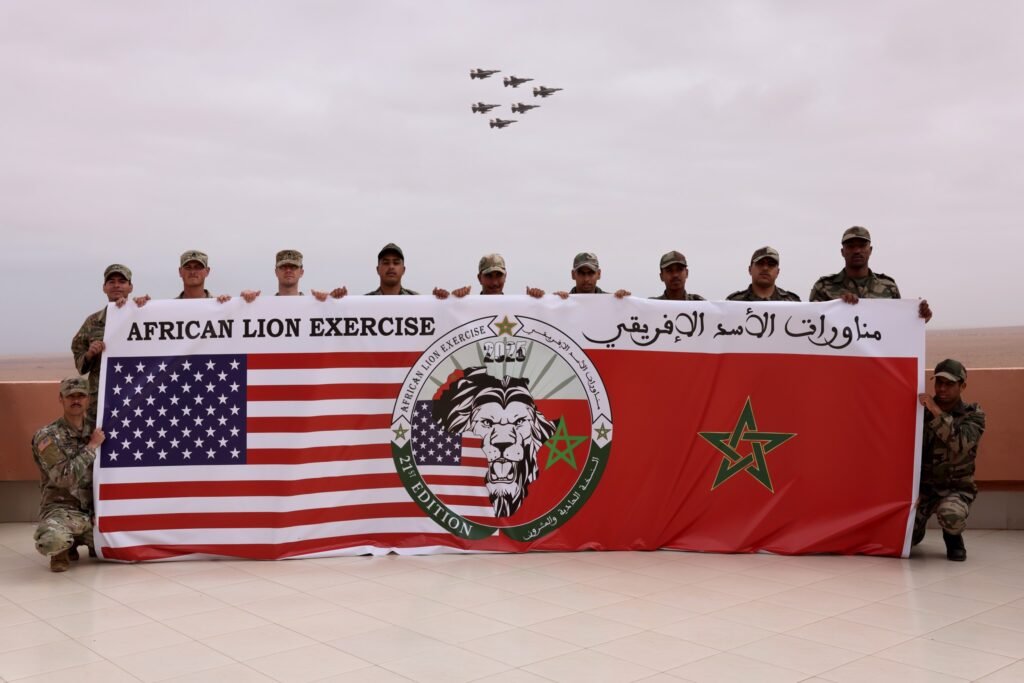
African Lion 2026, the 22nd edition of the exercise first launched in 2004, is scheduled from April 20 to May 8 across Agadir, Tan Tan, Taroudant, Kenitra, and Benguerir. The exercise will bring together 19 African countries alongside European and other international partners.
What distinguishes this edition is the scale of technological experimentation. More than 40 technology vendors will embed with US forces to test battlefield systems, including 10 mission command platforms, four deep attack capabilities, 12 defense-in-depth enablers, and 15 counter-attack integrators.
Units such as the 19th Special Forces Group, the 173rd Airborne Brigade, and the 207th Military Intelligence Brigade will field these tools.
Preparations involved two rounds of planning meetings at the Southern Zone headquarters in Agadir. The first was held from December 8-12.
A final planning conference took place from February 2-6, bringing together representatives from the Royal Armed Forces, US forces, and several partner nations to finalize organizational and operational aspects across land, air, maritime, and special operations domains.
During those final preparations in February, Lt. Col. Ramon Leonguerrero, innovation division project manager for SETAF-AF’s Advanced Capabilities Directorate, indicated: “Our goal is to close the gap between emerging technology and the warfighter, using African Lion 26 to rapidly field and validate the tools and technology needed for a decisive edge.”
More than 40,000 troops participated across the last five editions of the exercise, which has been described as the largest military event in Africa.
‘African security issues are not just African concerns’
At the Rome summit, Nigerian Maj. Gen. Saidu Audu, force commander of the Multinational Joint Task Force, pointed to the growing role of drone technology in African security operations.
Audu noted that unmanned aerial vehicles have proved vital to intelligence gathering in the Lake Chad Basin. The four-nation task force received eight drones from the European Union, which also trained operators and held maintenance courses. Audu called for greater international support. “African security issues are not just African concerns,” he told attendees.
Col. William Daniel, SETAF-AF’s director of security cooperation, described the goal of the summit as matching ideas with “proven, scalable solutions” to Africa’s security challenges. Speaking about the industry leaders displaying cutting-edge technology, Daniel added: “Their purpose is to help us move from identifying challenges to deploying solutions.”
In closing remarks, Lt. Gen. John W. Brennan Jr., deputy commander of US Africa Command, warned that the pace of change demands innovation and deeper alliances.
“The ongoing technical revolution is relentless, and changes are now occurring in a matter of months,” Brennan told the gathering. “We must build interdependent forces to ensure a more stable world for future generations.”