


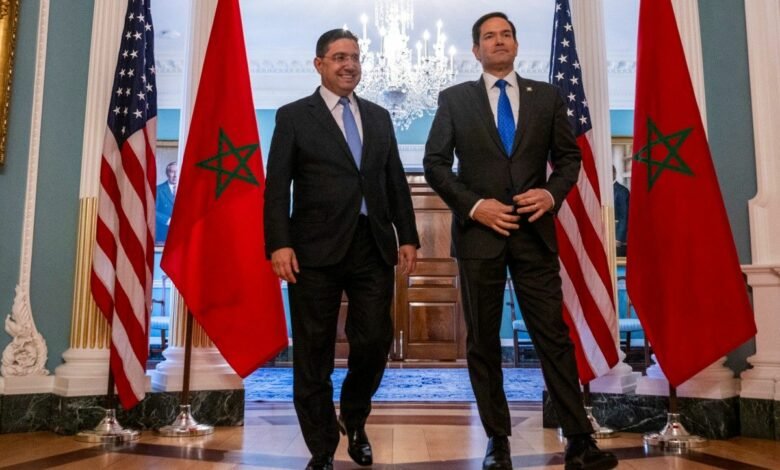
Rabat – Washington has been hosting, from February 23-24, a new round of talks, with the US pushing to advance the UN-led political process toward a mutually acceptable solution based on Morocco’s Autonomy Plan for Western Sahara.
The meeting includes representatives from Morocco, Algeria, Mauritania, and Polisario as well as US and UN officials to advance talks on the Sahara dispute, following up on the Madrid meetings held earlier this month.
Reports in the Spanish media indicate this new round of talks marks’ Washington’s continued efforts toward accelerating the process to reach an agreement based on Morocco’s Autonomy Plan as the “strongest premise for consensus.”
The “increased pace of US action is not part of a traditional mediation context but rather reflects a political decision to redesign the negotiation process and set a clear negotiating ceiling based on Rabat’s proposed approach as the only applicable framework,” the Spanish website Atalayar reported today.
This was made clear during the recent talk on Western Sahara in Washington, the same source added.
Also reporting today, El Independiente cited diplomatic sources as noting that the ministerial format meeting in Washington is taking place in a “climate of maximum confidentiality with only limited details availability.”
US advisor Massad Boulos is leading the talks with US ambassador to the UN Michael Waltz, said El Independiente, adding that the talks are taking place in the presence of Morocco’s Minister of Foreign Affairs Nasser Bourita, Algeria’s chief diplomat Ahmed Attaf, and Mauritania’s Mohamed Salem Ould Merzoug, in addition to a Polisario representative.
Staffan De Mistura, the UN envoy for Western Sahara is representing the UN Secretary General during the talks.
Read also: Trump Pushes Third Round of Talks on Western Sahara for February 23-24
“The Donald Trump administration seeks to accelerate the process toward a framework agreement before the summer,” said the El Independiente report, citing Resolution 2797 as the roadmap of the current talks.
The UN Security Council adopted the resolution in October last year, endorsing Morocco’s Autonomy Plan as the genuine political framework able to find a political solution to end the long-standing dispute.
According to El Independiente, the Madrid meetings were marked by divergences, including about the “right to self-determination,” claims promoted and advocated by Algeria’s regime in support of Polisario’s separatist agenda.
“The Polisario, backed by Algeria, insists that any self-determination process must include all alternatives recognized under international law, including independence. It considers unacceptable a pre-determined formula that limits the range of options,” the same source added.
Morocco has been emphasizing that any solution to the dispute should be based on its Autonomy Plan, with Rabat committed to further table a well-explained and thorough dossier about its proposal.
As for self-determination claims, Morocco has stressed that this concept has never been synonymous with a referendum, as Algeria alleges and promotes.
Last year in December, Bourita said that the concept rather refers to an expression of will that can take different forms within the framework of Morocco’s Autonomy Plan.
Spanish media also acknowledged that without Washington’s efforts to advance talks, the “margin for an agreement is limited.”
“The US sees the Moroccan proposal as a basis for work, but hopes the text can be broadened to make it acceptable to all parties,” El Independiente adds, emphasizing how the White House pushes the talk forward at “high speed.”
Following the Madrid talks, Boulos told Deutsche Welle that the situation concerning the Western Sahara is an old dispute, acknowledging its complexity.
He described UN Security Council Resolution 2797, adopted in October, as “an important and historic decision.”
The resolution, Boulos noted, “clearly identifies the parties concerned: Morocco, the Polisario Front, Algeria, and Mauritania – each involved to different degrees.”
