


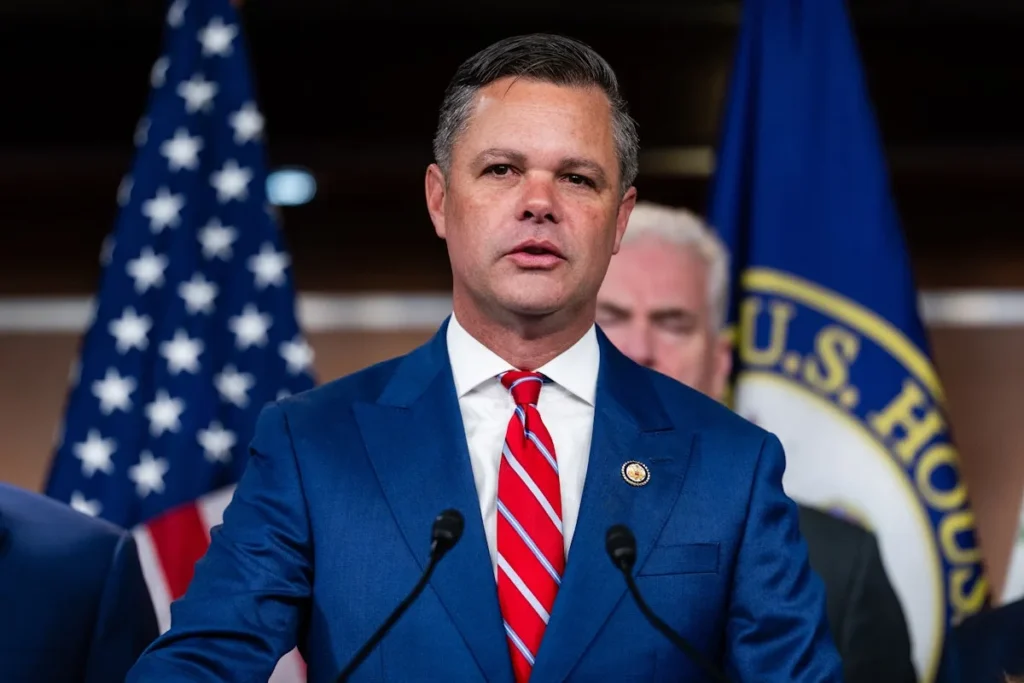
Beni Mellal – Iowa Republican Congressman Zachary Nunn became the latest lawmaker to co-sponsor the “Polisario Front Terrorist Designation Act” on February 24, bringing the total number of co-sponsors to seven, according to the bill’s latest update on the official US Congress website.
Formally introduced on June 24, 2025, by Republican Congressman Joe Wilson of South Carolina and Democratic Congressman Jimmy Panetta of California, the legislation seeks to classify the Polisario Front as a foreign terrorist organization and impose sweeping sanctions against the separatist movement.
The bill’s co-sponsor list has grown steadily since its introduction. Mario Diaz-Balart joined on September 18, followed by Jefferson Shreve on October 8, Randy Fine on October 24, Lance Gooden on December 1, and Pat Harrigan on February 13. Nunn’s addition on February 24 brings the total to seven co-sponsors alongside Wilson.
Currently referred to both the House Committee on Foreign Affairs and the House Judiciary Committee, the bill states that the Polisario “has a documented history of ideological and operational ties with Iran, a state sponsor of terrorism, dating back at least to 1980, when Polisario fighters publicly posed with portraits of Ayatollah Ruhollah Khomeini in a bid to attract revolutionary credibility and Iranian patronage.”
The legislation further documents that “three Hezbollah officers served as trainers in the Tindouf camps in 2018,” one of whom had been sanctioned by the United States for “orchestrating the 2007 Karbala raid in Iraq that killed five American soldiers.”
Polisario is not a liberation movement
The bill also cites the Syrian wing of the PKK, itself a designated terrorist organization, participating in the Polisario’s so-called “Sahrawi Solidarity Summit” in January 2025, and references Washington Post reporting from April 2025 confirming that Iran trained Polisario fighters and supplied them with unmanned aerial vehicles (UAVs).
Rather than a liberation movement, the Polisario operates as a fully weaponized Iranian proxy and a mercenary militia, smuggling arms to Sahel jihadists, harboring terrorist trainers, and holding thousands of civilians hostage in Tindouf. “Iran’s support has reportedly advanced from training to the provision of lethal hardware,” it affirmed.
Under the legislation, the Secretary of State would be required within 90 days to determine whether the Polisario meets criteria for designation as a foreign terrorist organization under the Immigration and Nationality Act.
The Secretary of the Treasury would face the same deadline to assess whether the group qualifies for sanctions under Executive Order 13224.
The bill includes a waiver provision, allowing the President to suspend designations should the Polisario engage in “good faith negotiations to implement the autonomy plan for the Western Sahara put forward by the Kingdom of Morocco.”
A newfound US push for a lasting political solution to the Sahara saga
The congressional push coincides with active diplomatic movements in recent weeks. Preliminary talks were held February 8 and 9 at the US Embassy in Madrid, bringing together representatives from Morocco, the Polisario, Algeria, Spain, and Mauritania, under joint US and UN sponsorship.
A second round of negotiations then moved to Washington, where UN spokesman Stéphane Dujarric confirmed on Tuesday that UN envoy Staffan de Mistura is co-chairing ongoing talks on the implementation of UN Security Council Resolution 2797.
Adopted last year on October 31, the resolution explicitly narrows the parameters of a political settlement to Morocco’s 2007 autonomy plan, presenting it as the basis for a negotiated solution to the Sahara dispute.
On the Senate side, Republican Senator Ted Cruz delivered a scathing indictment of the Polisario before the Senate Subcommittee on the Near East and Counterterrorism on February 3.
Cruz warned that Iran is attempting to “transform the Polisario into a kind of Houthis of West Africa – a proxy force capable of waging war to threaten regional stability and pressure US partners.”
He stated flatly that “the Polisario collaborates with Iranian terrorist groups,” receives drones from the Islamic Revolutionary Guard Corps, and funnels weapons and resources to jihadist networks across the Sahel. “I have prepared a bill to that effect if it does not change its behavior,” Cruz told the subcommittee.
State Department official Joel Borkert, responding to senators’ questions, indicated that the administration continues working with regional partners to “counter the threat posed by Iran and its proxies” across North Africa.