


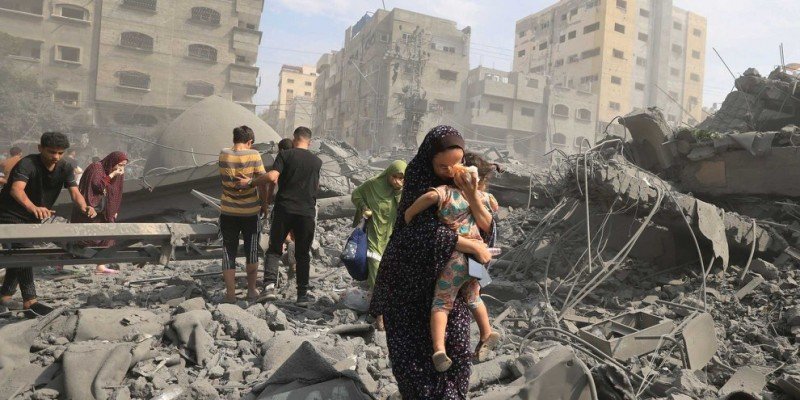
Rabat – A report released by the UN Women today shows that more than 22,000 women and 16,000 girls were killed in Gaza between October 2023 and December 2025 – representing an average of at least 47 women and girls killed per day.
Women account for more than half of all 71,200 people killed. The analysis noted that the numbers are likely underestimated given the collapse of health information and reporting systems.
Broader tensions in the Middle East have diverted attention from the genocide in Gaza since the US and Israel launched attacks on Iran at the end of February.
Israel has carried out a bloody genocidal camapaign in Gaza involving mass killings, starvation, destruction of infrastructure, and forced expulsions since October 2, 2023.
Israel’s Prime Minister, Benjamin Netanyahu, previously used the Iranian regime’s abuses of women’s rights as justification for his attacks on the country.
“They’ve impoverished you, they’ve given you misery, they’ve given you death, they’ve given you terror, they shoot down your women, leaving this brave, unbelievable woman, Mahsa Amini, to bleed on the sidewalk for not covering her hair,” he told Iranians in an interview with Iran International after launching attacks in June 2025.
His comments juxtapose a reality in which Israel killed more women and children in Palestine in a single year than any other conflict in two decades in the same span of time. Following the full-blown escalation by US and Israel Occupation Forces (IOF), there have been at least 1,700 civilian casualties in Iran since February.
As of April 2, the Iranian Red Crescent Society recorded at least 763 schools and 316 health care facilities were damaged or destroyed.
A New York Times analysis verified damage to 22 schools and 17 health care facilities, while remarking the destruction is likely more extensive.
Ceasefire violations intensify civilian struggle
As global attention remains turned to the war with Iran, Israel has intensified its chokehold on Gaza.
Between February 28 and April 8, IOF bombed Gaza on 36 out of those 40 days.
The consistent ceasefire violations also apply to humanitarian aid. Only 37% of aid trucks stipulated in the ceasefire agreement have entered Gaza, along with only 14% of the promised 9,200 fuel trucks.
The UN Women report shows that 93% of Gaza’s population faced acute food insecurity in 2025. At least 49,000 children were receiving treatment for malnutrition when the ceasefire agreement was reached in October 2025. By July 2025, around 40% of pregnant and breastfeeding women were malnourished.
An estimated 500,000 women and girls remain at risk of starvation, as the UN emphasizes that in conflict, they usually “eat last and least.”
In the past six months since the October ceasefire, only 2,703 of the expected 36,800 people have been allowed to cross through Rafah. According to the World Health Organization (WHO), more than 18,500 people in Gaza are awaiting urgent medical care.
Since the US-Israel war with Iran, Israel has only permitted 8% of the ceasefire settled number of travellers to leave Gaza.
A UNFPA report released this week called for urgent attention on gender-focused research and response efforts as the humanitarian crisis deepens across the Middle East.