



Rabat – Morocco produces tens of millions of tons of agricultural and industrial plant waste every year, much of it burned or left underused. To the average eye, this problem may seem poor for the environment, but merely an issue to be tossed aside. Yet, as this waste contains a carbon-rich molecule called lignin, a team of researchers from University Mohammed VI Polytechnic (UM6P) sees the issue through another lens.
At the intersection of waste management, clean manufacturing, and the growing demand for advanced carbon materials, they are turning this waste into an opportunity.
Morocco World News spoke with Mehdi Mennani, a researcher in the College of Chemical Science & Engineering (CCSE), Materials Science and Nano-Engineering (MSN) Department, who is working on converting local biomass into high-value, graphene-like materials using lasers.
The team recently published a review paper examining how lignin, a natural component of plant biomass, can be transformed into graphene-like materials using laser technology.
Lignin is a natural polymer in plants and agricultural residues. “Lignin is especially attractive because it’s abundant, renewable, and rich in carbon,” Mennani told MWN, explaining why his team focused on it rather than on fossil-derived plastics.
How lasers transform biomass
The basic idea behind the work is simple. The team uses a laser to rapidly heat and rearrange the carbon in lignin, creating a porous, conductive form of carbon similar to graphene, which is a material engineers prize for its electrical and mechanical properties.
The process is called laser-induced graphitization. In practice, a focused laser beam scans the surface of lignin-based material and creates a tiny, extremely hot spot for a very short time. That local heating reorganizes carbon atoms and produces a porous, conductive carbon network. “When the laser scans the surface of lignin-based material or biomass in general, it generates a very high localized temperature. It’s a focused temperature for a short time,” Mennani said. “This heat reorganizes the carbon atoms in lignin into porous and conductive carbon material.”
One of the key advantages of this route is speed and simplicity. Traditional methods for making graphene or graphitic carbons often require long furnace cycles, high temperatures, and harsh chemicals. The laser approach can convert material in seconds without solvents or catalysts, which reduces chemical waste and simplifies processing.
“This heat reorganizes the carbon atoms,” Mennani added, saying that what makes this process particularly interesting is that it can occur in seconds. “We can call it ultrafast processing, unlike the classical method of putting the material in an oven or furnace at high temperature,” he said.
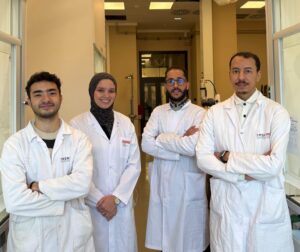
The MSN team has been testing local feedstocks that are common in Morocco. They have tried bagasse from the sugar industry, olive pomace from olive oil production, and alfa fibers, among others. Some work begins with raw biomass; sometimes the researchers extract biopolymers such as lignin or cellulose first and compare results.
Mennani noted that extraction can give higher yields because extracted lignin is richer in carbon and has fewer impurities.
Potential applications are immediate and practical, as lignin-derived laser graphitized material tends to be porous and conductive. These attributes are useful for electrodes in energy storage and for electrochemical sensors. “The material produced has a highly porous structure and excellent electric conductivity, which makes it very suitable for electrodes in supercapacitors or batteries,” Mennani said.
He also pointed to sensing and environmental uses. Because lasers can pattern graphene directly on a surface, the material can become flexible sensors for agriculture, packaging, or wearable devices, and it can be adapted for pollutant detection and water purification.
Challenges to industrial adoption
However, the path to industrial adoption faces real hurdles. One major challenge is feedstock variability. Lignin from different plants or processing routes is not identical. “Lignin from different biomass sources can have different molecular structure impurities or mineral content. Even these variations can affect or influence how the material decomposes during laser treatments,” Mennani explained. That heterogeneity affects how the carbon reorganizes under the laser, and therefore the final material’s performance.
Scaling the technique is another big issue. Lab lasers are good for small samples and experiments, but industry needs continuous production lines that deliver a steady quality at much higher throughput. “One of the main challenges is scaling up the process while maintaining consistent material quality,” the researcher said.
The team at UM6P is tackling these problems by combining hands-on experiments with theoretical work and data-driven methods. “We are working on theoretical modeling to implement theory and experiment… and we are also using machine learning and artificial intelligence,” Mennani said, describing a strategy to reduce the number of physical experiments and speed optimization.
“If you want to do 100 experiments, machine learning can help reduce that to 5 or 10 experiments using the laser,” he explained.
The MSN team is also connecting with Moroccan industries, Mennani said. They collect samples from local firms, for example, sugar operator Cosumar, to study real waste streams and to better understand the materials that will actually be available for processing.
The researchers’ roadmap includes standardizing feedstocks or developing mild pretreatments to reduce variability, optimizing laser parameters (power, scanning speed, wavelength) for each feedstock, scaling equipment toward continuous processing, and demonstrating finished devices that prove cost and performance advantages.
A vision for AI-driven biomass
Mennani emphasized that the field is young, but moving quickly. “Technology is very promising and progressing rapidly,” he told MWN, underlining both optimism and the work that still lies ahead.
The potential is significant for Morocco, as a domestic route to convert agricultural residues and industrial byproducts into advanced carbon materials could create local value, reduce waste, and supply crucial components for energy and electronics industries.
The MSN team sees a future where local biomass is mapped and used efficiently, where lasers pattern electrodes and sensors on demand, and where AI helps predict the right settings for each batch.
“We want to build a Moroccan AI platform linking biomass with experiments. And instead of doing a lot of experiments, we may reduce that time, energy, and cost … This is our vision,” Mennani said.
Turning lignin into useful graphene-like materials is not a silver bullet, but it is a promising piece of a larger, greener industrial puzzle, the conversation with Mennani indicates.
